Before You Buy Another Recovery Tool, Decide What You Need It to Do
Garage full of recovery gear, and the knee still hurts? “Accelerates recovery” is a slogan. A one-page test to run before the next gadget, supplement or service goes in your cart.
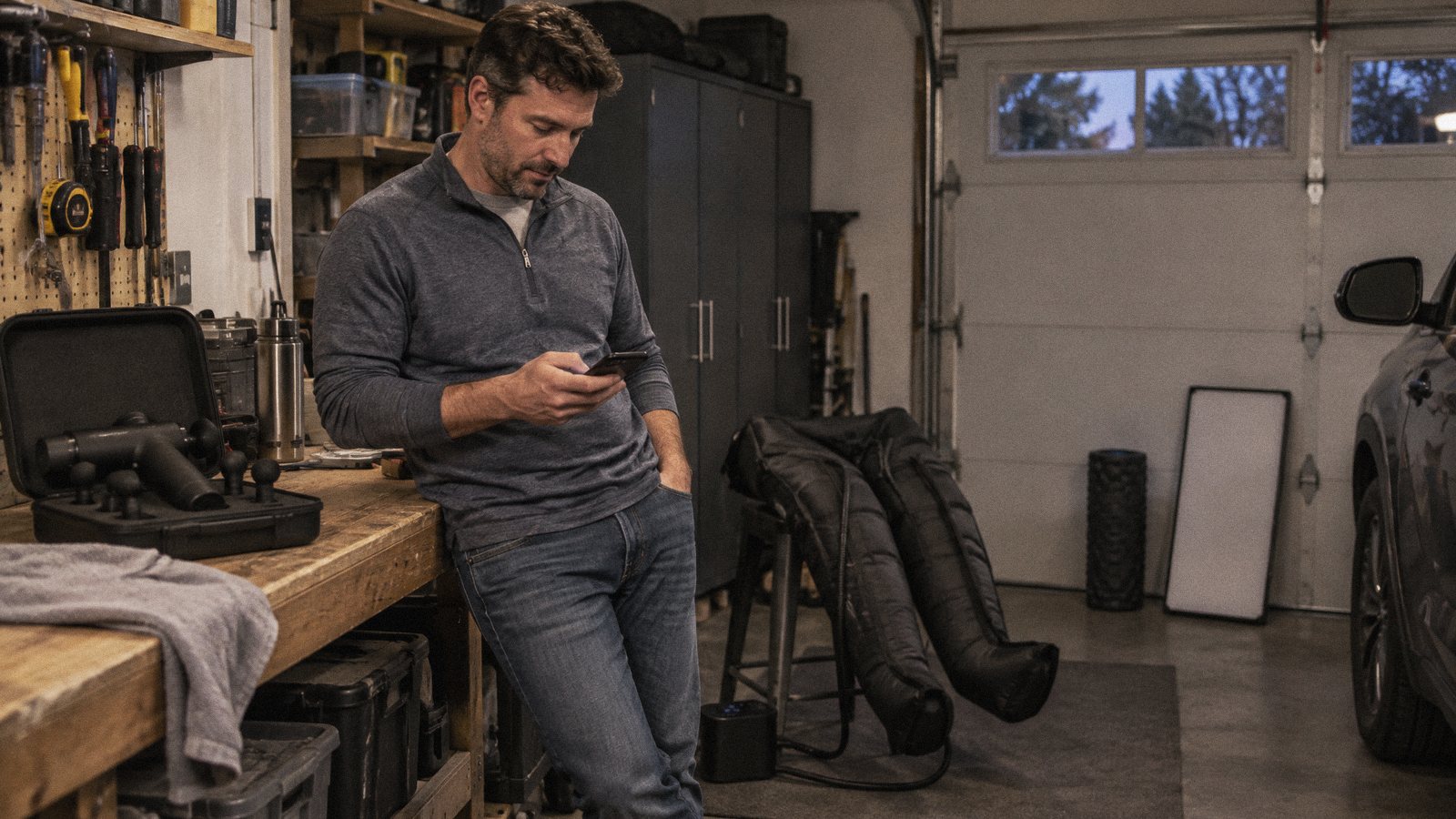
The story below is a composite of real experiences; details changed.
It’s 10 p.m., and Jason Reed’s thumb is hovering over “Buy now.” In the cart: a $600 cold plunge. The ad says it “accelerates recovery.”
Jason, 39, runs sales for a software company. His right knee has been cranky for a year. His garage already holds a $400 massage gun, a $900 pair of compression boots and a red-light panel he uses “sometimes.”
Every purchase felt like doing something. A year later, the garage looks like a recovery store, and the knee still hurts.
His wife walks by with one question: “Recovery from what, exactly?”
He doesn’t have an answer. Here’s how to find yours before the next thing goes in your cart.
Decide the job before you buy the tool
“Recovery” can mean four very different things. Most products only have a case for one of them.
| The job | What it means | Example question |
|---|---|---|
| Comfort | Feel better short term | Does it take the edge off tonight? |
| Consistency | Help you stick with the plan | Does it make me more likely to do my rehab? |
| Capacity | Do more, longer, stronger | Can I carry, lift or run more after a month? |
| Tissue healing | Change the injured structure | Is there evidence it changes the tendon or joint? |
Feeling better and healing faster aren’t the same claim. A tool can be worth buying for comfort alone. Just don’t pay a “healing” price for a “comfort” result.
“Accelerates recovery” is a slogan. Ask: recovery of what, measured how, in whom?
Read the claim like a skeptic
The National Center for Complementary and Integrative Health suggests going to the source, not the headline. It points to the same few questions every time: the study design, the sample size, the methods and whether the conclusions match the results. (NCCIH)
In plain terms, ask:
- Who was studied? Young athletes? Healthy volunteers? People with your injury?
- What was measured? Soreness the next day? Strength? A blood marker? Healing?
- Compared with what? Nothing? A fake version? Plain exercise?
- How long? One session, or months?
And remember: sometimes the simple option holds up as well as the fancy one.
A large UK trial included 708 people with rotator cuff problems. Up to six sessions of physiotherapy did no better, on average, than one session of good advice plus a home exercise program. (GRASP trial, The Lancet, 2021) More isn’t automatically better.
For a full walkthrough on judging stories and claims, read how to evaluate a recovery claim.
The evidence, without the theater
What the research shows
- Study design, sample size and methods decide how much a result means.
- More treatment doesn’t always beat a simple, well-done home program.
What it doesn’t show
- That recovery products are useless. Some help with comfort or consistency.
- That results in healthy athletes apply to your injury.
- That a home trial proves a gadget caused your improvement.
The one-page purchase test
Answer all six before you click buy
- The job: Which of the four jobs is this for?
- The measure: What will I track to know it worked? (Sleep, a daily task, rehab sessions completed.)
- The evidence: In whom, measuring what, compared with what?
- The cost per use: Price divided by how often I’ll realistically use it in six months.
- The burden: Time, space, risks, and whether it pulls time from my actual rehab.
- The review date: When do I decide to keep it, sell it or stop?
A quick example. A $600 cold plunge used three times a week for six months is about 78 uses, or roughly $7.70 each. That can be fair for a job you care about. It’s expensive for a job you never named.
One more rule: a gadget never replaces getting assessed. If something is getting worse, spend the money on a visit first.
When not to wait
Skip the shopping and get checked if:
- The joint swells, locks, gives way or loses strength.
- Pain is steadily getting worse, or wakes you every night.
- You’ve been “managing it” with tools for months with no real change.
The cart, emptied
Jason runs the test on the cold plunge. Job: comfort, maybe. Measure: none. Evidence: an ad. Review date: never.
He closes the tab. Instead, he books a physical therapy evaluation for the knee. It costs less than the plunge.
At the evaluation, he learns his knee problem is a strength and loading issue. The massage gun stays, because it helps him warm up. The boots go on Facebook Marketplace.
The best recovery purchase was an answer, not an object.
Your next step: before anything else goes in your cart, write down the job it’s for. If you can’t name one, close the tab.
Jason is a composite, drawn from the kinds of stories people describe during recovery. The details and prices are illustrative.
Free · Your Before-You-Leave Card
Don’t leave your next appointment with “rest it.”
Get the questions for your injury in 8 taps.
Get my card →Questions readers ask
- How do I know if a recovery product is worth buying?
- Decide which job it’s for (comfort, consistency, capacity or tissue healing), how you’ll measure whether it works, what evidence supports it in people like you, its realistic cost per use, its burdens, and a date to review whether it earned its keep.
- What should I look for in a study behind a recovery claim?
- Look at who was studied, what was measured, what it was compared with and for how long. NCCIH suggests checking study design, sample size, methods and whether conclusions match the results.
- Is more treatment always better?
- Not necessarily. In the GRASP trial of 708 people with rotator cuff disorders, up to six physiotherapy sessions did not outperform one session of best-practice advice with a home exercise program on average.
Sources & references (2)
The Series
45 articlesPart 1: Understanding Your Injury (1 to 19)
- After the MRI: How to Read a Rotator Cuff Report Without Getting Sold a Surgery
- Told to “Just Rest It”? Five Questions to Ask Before You Leave
- When Shoulder Pain Keeps Waking You Up
- Meniscus Surgery Recovery: When Can You Return to Your Kind of Work?
- Rotator Cuff Surgery or More Physical Therapy? Questions That Clarify the Decision
- Achilles Tendon Pain: Why This Tendon Is a Different Problem
- Four Months After Rotator Cuff Repair and It Still Hurts: Normal, or a Retear?
- Your Knee Feels Worse After the Meniscus Scope. What Could Be Going On?
- Hip Flexor Pain After Hip Arthroscopy: Why It Shows Up and When It Settles
- Tennis Elbow That Won’t Go Away: Why Rest and Shots Stall, and What Helps
- Knee Swelling After Meniscus Surgery: How Long Is Normal, and When to Call
- Quad Won’t Fire After Knee Surgery? What Quad Shutdown Is and How to Get It Back
- Walking After Meniscus Surgery: When You Can, How Far, and When to Drop the Crutches
- How to Sleep After Rotator Cuff Surgery, and When Nights Get Easier
- Felt a Pop After Knee Surgery? Re-Tear or Setback, and When to Call
- Home After a Microdiscectomy: How Much to Walk and How Long to Sit
- Running After ACL Surgery: When Your First Jog Comes, and What It Tells You About Work
- When Can You Drive After Rotator Cuff Surgery and Get Back in the Work Truck?
- Knee Won’t Straighten After Meniscus Surgery? Why It Happens and What Helps
Part 2: Work and Real Life (20 to 29)
- You Can Still Work. But What Is Your Injury Costing You?
- Self-Employed and Injured: How to Plan for Time Away From Work
- Your Job and Your Workouts Are Loading the Same Injury
- How to Take Time to Recover When Everyone Depends on You
- What Do You Still Want to Be Able to Do in Ten Years?
- Microdiscectomy Recovery: When Can You Go Back to Heavy Work?
- Kneeling After Knee Surgery: Why It Comes Back Last and How to Retrain It
- Rotator Cuff Surgery Recovery: When Can You Go Back to Work?
- When Can You Drive After Knee Surgery and Get Back in the Work Van?
- When Can You Go Back to Physical Work After ACL Surgery?
Part 3: Back to Training (30 to 34)
Part 4: Reading the Evidence (35 to 45)
- Your Watch Says You’re Recovered. Your Shoulder Disagrees.
- Recovery Is Taking Longer Than You Expected. What Counts as Progress?
- Before You Buy Another Recovery Tool, Decide What You Need It to Do
- “It Worked for Me”: How to Evaluate a Recovery Claim
- BPC-157 After an Orthopedic Procedure: What Does the Research Actually Show?
- TB-500 vs. BPC-157: What the Research Actually Compares
- How to Read a Peptide COA: What It Proves and What It Doesn’t
- The Research Stack People Ask About After a Scope, and the Gaps in the Human Data
- What the Tendon Research on BPC-157 Actually Measured
- What’s in the Other 1%? Peptide Impurities, Explained
- Approved, Compounded or “Research Use Only”: What a Peptide’s Label Means in 2026
Free · 60-second recovery check
What’s really holding your recovery back?
Eight quick taps. Find the one thing stalling your recovery, then get the three moves to work on first, picked from 30 guides and 100+ cited sources.
- Your bottleneck, named in 60 seconds
- 3 moves for this week, fitted to your job
- Your Before-You-Leave Card: the questions for your next appointment
What got hurt?
Free. No sign-up to start. Not medical advice.
Keep reading
Your Watch Says You’re Recovered. Your Shoulder Disagrees.
Green score, sore shoulder? A recovery score reads your whole system, not one injured joint. What it can and can’t tell you, and which signal wins when they disagree.

Recovery Is Taking Longer Than You Expected. What Counts as Progress?
A good day feels like a cure. A bad day feels like failure. Neither is true. How to track pain, function, activity and confidence separately, and see the trend that matters.
Knee Won’t Straighten After Meniscus Surgery? Why It Happens and What Helps
Three weeks out, the other knee lies flat and yours won’t. Why a knee stays bent after a meniscus trim or repair, when protocols expect it straight, what rehab teams use to get it back, and the signs that mean call to…