Knee Won’t Straighten After Meniscus Surgery? Why It Happens and What Helps
Three weeks out, the other knee lies flat and yours won’t. Why a knee stays bent after a meniscus trim or repair, when protocols expect it straight, what rehab teams use to get it back, and the signs that mean call today.
The story below is a composite of real experiences; details changed.
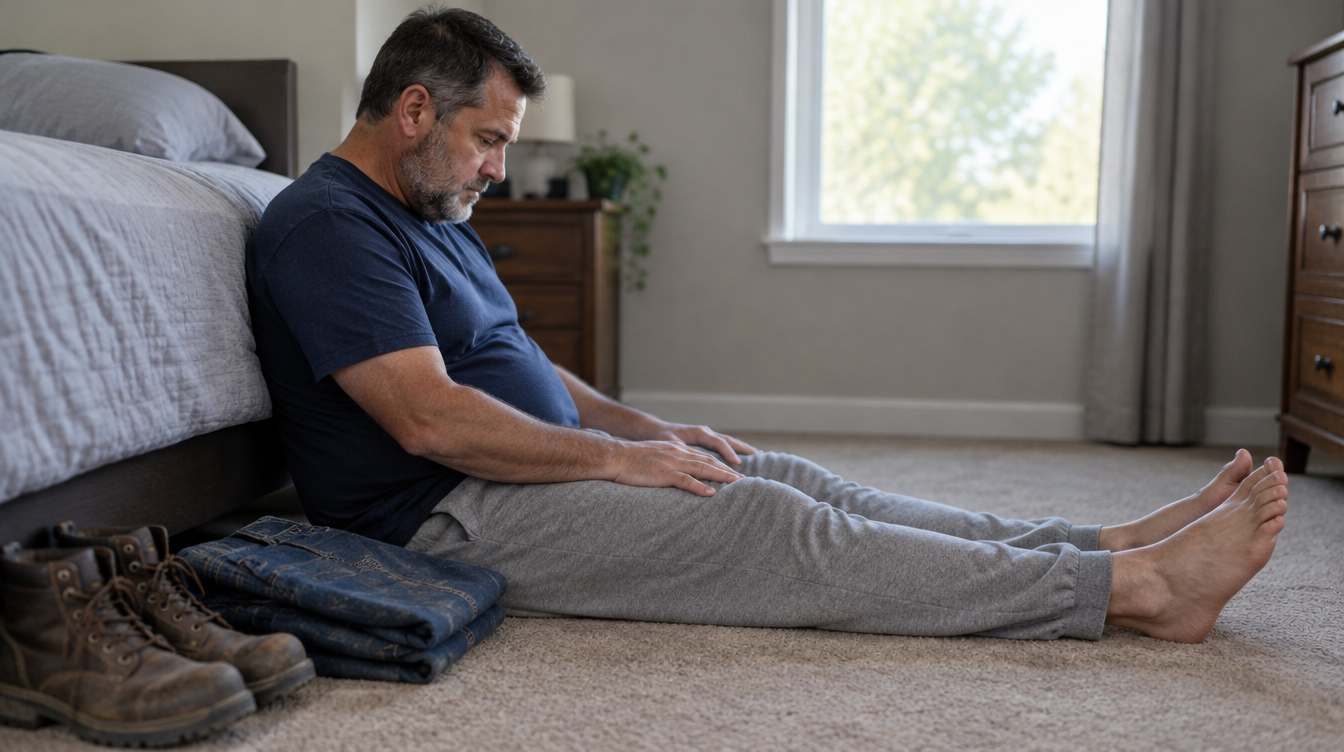
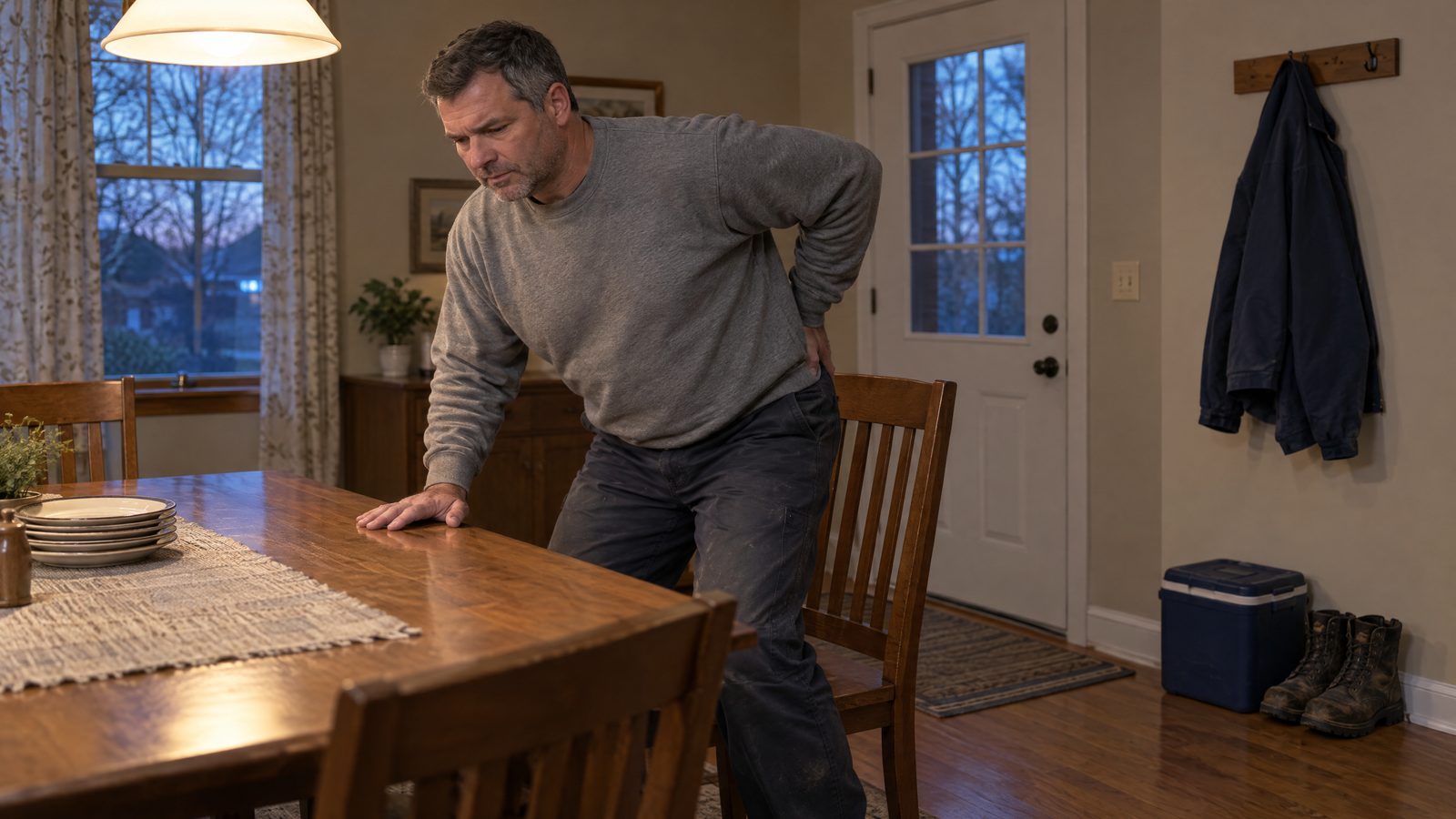
Dale sits on the bedroom floor at 6 a.m., back against the bed, work jeans beside him. He’s 48, a tile setter. Three weeks ago, a surgeon trimmed a torn meniscus in his right knee.
He stretches both legs out on the carpet and looks down. The left knee lies flat. The right one stays up, like there’s a pencil under it.
Last week the limp was almost gone. Now, after two days back on a light job, it’s back. His foreman texts: “Can you do the shower pan Thursday?”
Here’s why a knee won’t fully straighten after meniscus surgery, when protocols expect it back, what rehab teams use to get it, and the signs that mean call today.
Why the knee stays bent
Often, it’s not something blocking the joint. It’s the body protecting it.
Even before surgery, a review of meniscus tears said a knee that “locks” is usually stiff, not blocked. The cause is often a small amount of swelling, or pain holding the muscles back. Doctors call it pseudo-locking. (Australian Family Physician, 2012)
Three things tend to team up:
- Swelling. Even a small amount of fluid can stiffen the knee. (Australian Family Physician, 2012) More on that in how long knee swelling lasts after meniscus surgery.
- A quiet quad. After knee injury or surgery, the brain and nerves can hold back the thigh muscle. The name is arthrogenic muscle inhibition. (Video Journal of Sports Medicine, 2022) See why a quad won’t fire after knee surgery.
- Tight, guarding hamstrings. The same paper describes knees that won’t straighten because the hamstrings stay contracted and the quad stays switched off, not because of a mechanical block. (Video Journal of Sports Medicine, 2022)
That paper is a short expert video article, built mostly around ACL injuries. Only one of its eight case stories involved a meniscus trim, and that was done alongside an ACL reconstruction. (Video Journal of Sports Medicine, 2022)
A bent knee is often a guarded knee. Calm it down and wake the quad up.
The rarer causes: a block or scar tissue
Sometimes something really is in the way.
A loose flap of meniscus. True locking is less common. It suggests a bucket-handle tear, where a torn piece keeps the knee from straightening fully. (Australian Family Physician, 2012) That review called a locked knee the one absolute reason to see a specialist. (Australian Family Physician, 2012)
Scar tissue (arthrofibrosis). AAOS lists knee stiffness among possible problems after a knee scope. It also says the complication rate is very low. (AAOS OrthoInfo)
An international panel defined scar-tissue stiffness after surgery as lost motion caused by new soft-tissue scarring. Not bone, hardware, infection or pain. The panel graded an extension loss of 5 to 10 degrees as mild, 11 to 20 as moderate, and more than 20 as severe. (Bone & Joint Journal, 2016)
A cyclops lesion. This is a small nodule of scar tissue at the front of the knee. It’s described mainly after ACL reconstruction. People often notice they can’t get the last bit of straightening, sometimes with a clunk. (Orthopaedic Journal of Sports Medicine, 2020) That review didn’t cover meniscus surgery alone.
Blocks and scar tissue are real but uncommon. Your surgeon is the one who can tell them apart from guarding.
When protocols expect a straight knee
The timeline depends on whether the torn piece was trimmed or repaired. Not sure? Walking after meniscus surgery explains the difference.
After a trim. In one hospital protocol, the first-week goal is a knee that moves from straight (0 degrees) to 90 degrees. Full, pain-free motion is the goal by the end of week 2. (Mass General Brigham, 2024)
One NHS trust names the straight knee as a top early goal. (Gateshead Health NHS, 2025) Another aims for 0 degrees, but says there’s no need to push in the early stage. It can be sore and add to the pain and swelling. (Royal United Hospitals Bath, 2022)
After a repair. One protocol lists “restore full extension” as a goal for weeks 0 to 3. It wants the knee at 0 degrees before moving on, and straightening equal to the other side by about week 6. (Mass General Brigham, 2021)
Another keeps the brace set from 0 to 90 degrees for 6 weeks. From week 6, it says to focus on full extension if it’s lacking. (University of Virginia)
Note the later yardstick in that first repair protocol: straightening equal to your other knee. (Mass General Brigham, 2021)
After a trim, one hospital protocol aims for full motion by about two weeks. After a repair, follow the brace and the surgeon’s limits.
Why it matters when you’re on your feet all day
One NHS team tells patients to avoid walking on a bent knee. (Gateshead Health NHS, 2025) One protocol wants full, pain-free motion and an even walk without crutches before you move to the next stage. (Mass General Brigham, 2024)
Here’s one reason it matters. The more the knee bends while you stand, the harder the thigh muscle has to work to hold you up.
A 1975 lab study, using a cadaver leg plus strength tests in five healthy people, estimated it. Standing on a knee bent 15 degrees took about 20% of average maximum quad strength. At 30 degrees, it took about half. (Journal of Bone and Joint Surgery, 1975) It looked at standing still, not walking.
No study we found tested a full workday on a bent knee. But that’s a lot to ask of a quad that’s already switched down.
Kneeling and ladders come later and need their own plan. See kneeling after knee surgery.
A knee that stays bent makes your thigh work harder every minute you stand. That’s why protocols put it first.
The evidence, without the theater
What the research shows
- Rehab protocols put a straight knee among the first goals after a trim.
- Stiffness from swelling, pain and guarding is more common than a true mechanical block.
- Standing on a bent knee makes the quad work much harder.
What it doesn’t show
- How often a knee stays bent after a trim. We found no good number.
- Which straightening exercise works best. The protocols list them, but we found no trial comparing them after meniscus surgery.
- How many degrees short is a problem for you.
What rehab protocols use to get it back
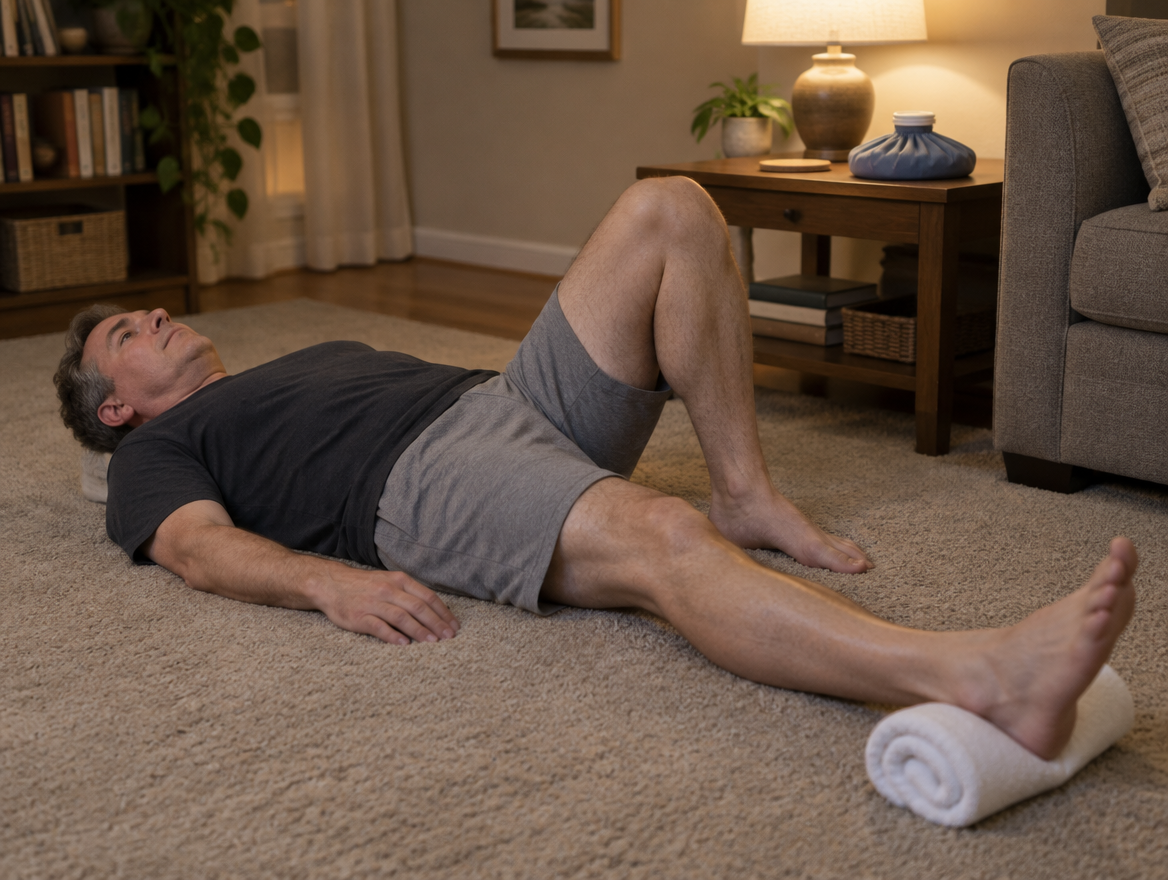
These are what the protocols and leaflets list. They are not a plan for you. Your surgeon’s protocol comes first, and after a repair, ask before you do any of them.
- Heel prop and prone hang. Low-intensity, long-hold stretches for straightening. (Mass General Brigham, 2024) In one home program, a rolled towel goes under the heel and the leg is left to straighten for 3 to 5 minutes. (University of Utah Orthopaedics) In one NHS leaflet, you lie face down with your feet off the end of the bed, for up to 10 minutes, 3 to 4 times a day. (Royal United Hospitals Bath, 2022)
- Quad sets. Tighten the thigh and push the back of the knee down into the bed. One leaflet suggests holding 5 to 10 seconds, 10 times, 3 to 4 times a day. (Gateshead Health NHS, 2025; Mass General Brigham, 2024)
- No pillow under the knee. Resting a pillow under the knee for long periods can make it harder to get the knee straight, one leaflet says. (Royal United Hospitals Bath, 2022) To raise the leg, MedlinePlus says to put pillows under the foot or calf. (MedlinePlus, 2024)
- Swelling control. Ice, compression and raising the leg. (Mass General Brigham, 2024) One NHS leaflet suggests an ice pack 3 to 4 times a day for 15 to 20 minutes. (Gateshead Health NHS, 2025) If swelling goes up, it may be the knee telling you to do less. (Royal United Hospitals Bath, 2022)
After a repair, one protocol says not to do straight-leg raises while the knee still sags as it lifts. (Mass General Brigham, 2021)
The side-by-side check
A practical structure, not a tested protocol. It tracks change. It doesn’t diagnose anything.
- Same time each day. First thing in the morning, before work.
- Sit on the floor or bed, both legs out, heels on the same towel.
- Look and feel. Does the back of the knee settle as low as the other side? Can you slide a flat hand under one and not the other?
- Take a phone photo from the side. Same spot, same angle.
- Write one line: better, same or worse, and how swollen it looks.
Bring the photos to your PT. Getting worse, or worse after a twist or pop? Call your PT or surgeon’s office. See below.
Calm the swelling, keep the pillow out from under the knee, and let the protocol’s stretches do the slow work.
What to ask your PT or surgeon
- How many degrees short am I, compared with my other knee?
- Is this swelling and guarding, or do you think something is blocking it?
- Which straightening exercises are safe with my surgery, and how long should I hold them?
- When should it be fully straight, and what happens if it isn’t?
More on getting real answers in five questions to ask before you leave.
Ask for a number in degrees, not “it’s coming along.”
When not to wait
Call your surgeon’s office the same day if you have any of these. If you can’t reach them, go to urgent care or the ER.
- A knee that locks: it suddenly gets stuck and you can’t straighten it.
- Suddenly being unable to straighten your knee after a pop or tearing feeling, or a dent above the kneecap. It can mean a torn tendon.
- A knee that won’t fully straighten and feels blocked, not just stiff.
- A fever above 101°F (38.3°C), or redness, pain, swelling or yellowish discharge at an incision.
- Bleeding that soaks through the dressing and doesn’t stop with pressure.
- Pain that pain medicine doesn’t ease, or that keeps getting worse.
- A foot or toes that look darker than normal or feel cool to the touch.
- Pain or swelling in one calf or thigh, or red or darkened skin there. If you also feel short of breath or have chest pain, call 911.
Sources: MedlinePlus; NHS on DVT; AAOS OrthoInfo on quadriceps tendon tears; Australian Family Physician, 2012. Think you may have re-torn it? Read signs you retore your knee.
Back on the bedroom floor
Dale doesn’t text a yes. He sends a photo of both knees to his PT.
At the visit, she measures it: 6 degrees short of the left. The knee is puffy from the two job days. No catching, no locking.
She has him ice after work, do quad sets every hour on a break, and spend ten minutes face down on the bed each night. No pillow under the knee in the recliner.
He tells his foreman Thursday is out. He’ll do layout and cuts, not the floor. By week five, the photos match.
Your next step: tomorrow morning, take the side-by-side photo. If the knee won’t go flat, bring it to your next PT visit and ask for the number.
Dale is a composite, drawn from the kinds of stories tradespeople describe after knee surgery. The details are illustrative.
Free · Your Before-You-Leave Card
Don’t leave your next appointment with “rest it.”
Get the questions for your injury in 8 taps.
Get my card →Questions readers ask
- Why won’t my knee straighten after meniscus surgery?
- Often it’s swelling, pain and guarding, not something blocking the joint. Fluid in the knee and pain can hold the thigh muscle back, and tight, guarding hamstrings can keep the knee bent. Less often, a loose piece of meniscus or scar tissue blocks it. A knee that suddenly locks, or feels blocked rather than stiff, needs a call to your surgeon the same day.
- How long does it take to get full extension after a meniscus trim?
- One hospital protocol aims for motion from straight to 90 degrees in the first week, and full, pain-free motion by the end of week 2. After a repair, one protocol wants the knee at 0 degrees within about the first 3 weeks and matching the other knee by about week 6. Your surgeon’s protocol comes first.
- What helps a knee straighten after arthroscopy?
- Rehab protocols list long, gentle straightening stretches such as a heel prop or lying face down with the lower leg off the bed, quad sets, keeping pillows out from under the knee, and ice, compression and elevation for swelling. Ask your PT or surgeon which are safe for your surgery, especially after a repair.
Sources & references (15)
- Meniscal tear: presentation, diagnosis and management · Australian Family Physician, 2012
- Arthrogenic Muscle Inhibition Following Knee Injury or Surgery: Pathophysiology, Classification, and Treatment · Video Journal of Sports Medicine, 2022
- Knee Arthroscopy · AAOS OrthoInfo
- International consensus on the definition and classification of fibrosis of the knee joint · The Bone & Joint Journal, 2016
- Cyclops Lesions of the Knee: A Narrative Review of the Literature · Orthopaedic Journal of Sports Medicine, 2020
- Rehabilitation Protocol for Arthroscopic Partial Meniscectomy · Mass General Brigham Sports Medicine, 2024
- Rehabilitation Protocol for Arthroscopic Meniscal Repair · Mass General Brigham Sports Medicine, 2021
- Post-operative Rehabilitation Protocol: Meniscal Repair · University of Virginia Department of Orthopaedic Surgery
- Post-Operative Meniscectomy · Gateshead Health NHS Foundation Trust, 2025
- Post-operative physiotherapy advice following a knee arthroscopy · Royal United Hospitals Bath NHS Foundation Trust, 2022
- Your Home Exercise Program Following Arthroscopic Knee Surgery · University of Utah Orthopaedics
- Analysis of knee-joint forces during flexed-knee stance · Journal of Bone and Joint Surgery, 1975
- Knee arthroscopy: discharge · MedlinePlus, 2024
- Quadriceps Tendon Tear · AAOS OrthoInfo
- Deep vein thrombosis (DVT) · NHS
The Series
45 articlesPart 1: Understanding Your Injury (1 to 19)
- After the MRI: How to Read a Rotator Cuff Report Without Getting Sold a Surgery
- Told to “Just Rest It”? Five Questions to Ask Before You Leave
- When Shoulder Pain Keeps Waking You Up
- Meniscus Surgery Recovery: When Can You Return to Your Kind of Work?
- Rotator Cuff Surgery or More Physical Therapy? Questions That Clarify the Decision
- Achilles Tendon Pain: Why This Tendon Is a Different Problem
- Four Months After Rotator Cuff Repair and It Still Hurts: Normal, or a Retear?
- Your Knee Feels Worse After the Meniscus Scope. What Could Be Going On?
- Hip Flexor Pain After Hip Arthroscopy: Why It Shows Up and When It Settles
- Tennis Elbow That Won’t Go Away: Why Rest and Shots Stall, and What Helps
- Knee Swelling After Meniscus Surgery: How Long Is Normal, and When to Call
- Quad Won’t Fire After Knee Surgery? What Quad Shutdown Is and How to Get It Back
- Walking After Meniscus Surgery: When You Can, How Far, and When to Drop the Crutches
- How to Sleep After Rotator Cuff Surgery, and When Nights Get Easier
- Felt a Pop After Knee Surgery? Re-Tear or Setback, and When to Call
- Home After a Microdiscectomy: How Much to Walk and How Long to Sit
- Running After ACL Surgery: When Your First Jog Comes, and What It Tells You About Work
- When Can You Drive After Rotator Cuff Surgery and Get Back in the Work Truck?
- Knee Won’t Straighten After Meniscus Surgery? Why It Happens and What Helps
Part 2: Work and Real Life (20 to 29)
- You Can Still Work. But What Is Your Injury Costing You?
- Self-Employed and Injured: How to Plan for Time Away From Work
- Your Job and Your Workouts Are Loading the Same Injury
- How to Take Time to Recover When Everyone Depends on You
- What Do You Still Want to Be Able to Do in Ten Years?
- Microdiscectomy Recovery: When Can You Go Back to Heavy Work?
- Kneeling After Knee Surgery: Why It Comes Back Last and How to Retrain It
- Rotator Cuff Surgery Recovery: When Can You Go Back to Work?
- When Can You Drive After Knee Surgery and Get Back in the Work Van?
- When Can You Go Back to Physical Work After ACL Surgery?
Part 3: Back to Training (30 to 34)
Part 4: Reading the Evidence (35 to 45)
- Your Watch Says You’re Recovered. Your Shoulder Disagrees.
- Recovery Is Taking Longer Than You Expected. What Counts as Progress?
- Before You Buy Another Recovery Tool, Decide What You Need It to Do
- “It Worked for Me”: How to Evaluate a Recovery Claim
- BPC-157 After an Orthopedic Procedure: What Does the Research Actually Show?
- TB-500 vs. BPC-157: What the Research Actually Compares
- How to Read a Peptide COA: What It Proves and What It Doesn’t
- The Research Stack People Ask About After a Scope, and the Gaps in the Human Data
- What the Tendon Research on BPC-157 Actually Measured
- What’s in the Other 1%? Peptide Impurities, Explained
- Approved, Compounded or “Research Use Only”: What a Peptide’s Label Means in 2026
Free · 60-second recovery check
What’s really holding your recovery back?
Eight quick taps. Find the one thing stalling your recovery, then get the three moves to work on first, picked from 30 guides and 100+ cited sources.
- Your bottleneck, named in 60 seconds
- 3 moves for this week, fitted to your job
- Your Before-You-Leave Card: the questions for your next appointment
What got hurt?
Free. No sign-up to start. Not medical advice.
Keep reading
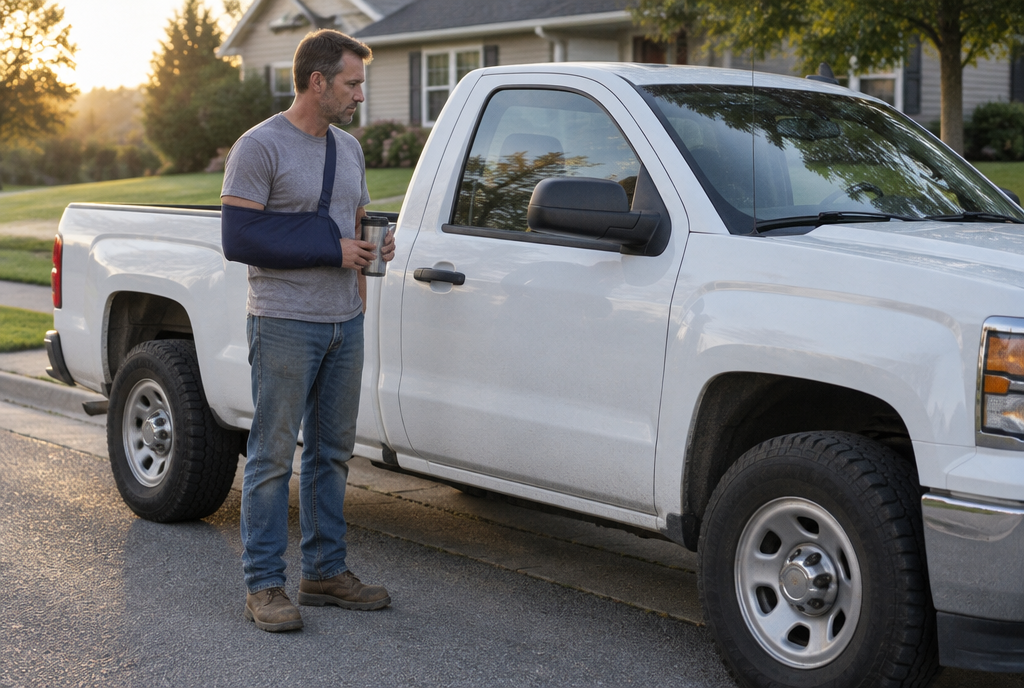
When Can You Drive After Rotator Cuff Surgery and Get Back in the Work Truck?
Dispatch wants you back on the road, and your arm is still strapped to your belly. What the sling means for driving after a rotator cuff repair, what the few driving studies found, and a check to run before your first…
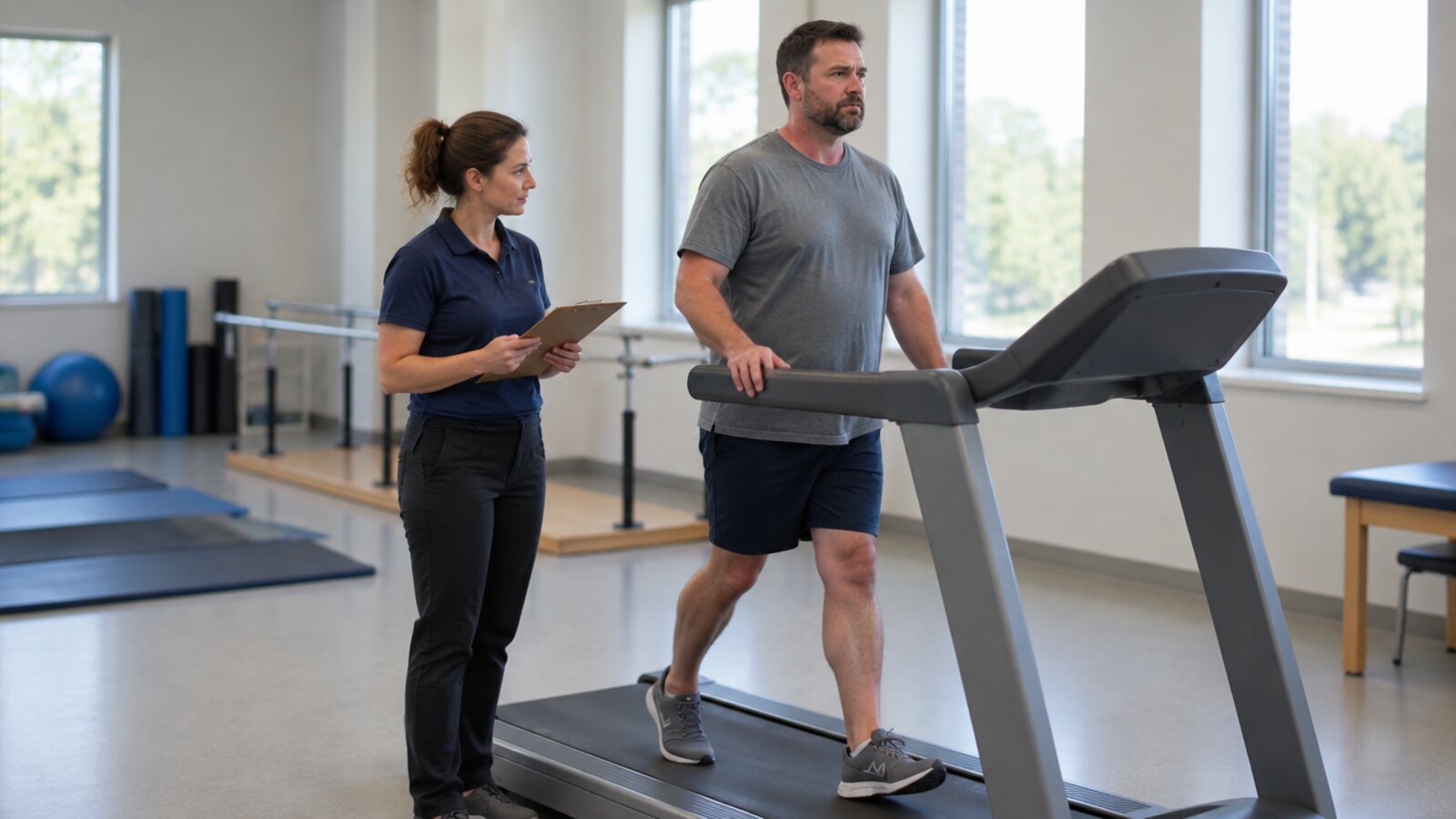
Running After ACL Surgery: When Your First Jog Comes, and What It Tells You About Work
Your PT says you can try a jog. You’re wondering if ladders are next. When the first run usually comes after ACL reconstruction, what clinics test first, what a first run-walk looks like, and what it does and doesn’t …
Home After a Microdiscectomy: How Much to Walk and How Long to Sit
The leg pain is nearly gone, the back aches, and every twinge feels like you undid the surgery. How much to walk and sit in the first six weeks, which aches are normal, and a ladder to start tomorrow.