Knee Swelling After Meniscus Surgery: How Long Is Normal, and When to Call
Fine in the morning, puffy by the end of every shift? How long swelling usually lasts after a meniscus trim or repair, why work brings it back, how to track it, and when to call.
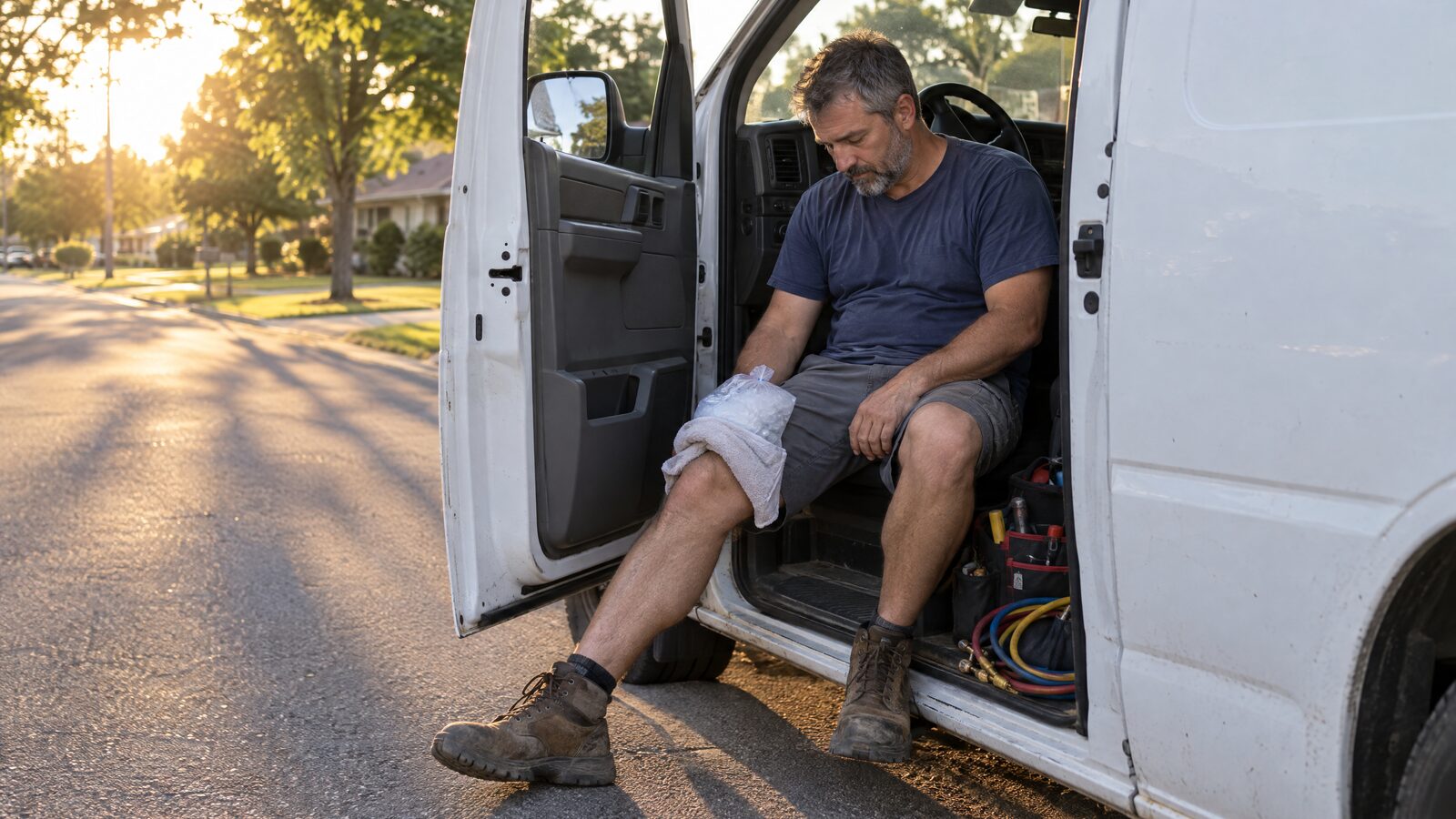
The story below is a composite of real experiences; details changed.
Dale’s knee is fine at 7 a.m. By 4 p.m., it’s tight and puffy, like the skin shrank a size.
He’s 46 and fixes heating and cooling systems. His day is ladders, attics, crawlspaces and stairs.
Ten weeks ago, a surgeon trimmed a torn meniscus in his right knee. The surgery went fine. The swelling keeps coming back.
Every shift ends the same way. Dale sits in the truck with a bag of gas-station ice on his knee and wonders if this is normal.
Here’s how long swelling usually lasts after a meniscus scope, why it shows up after work, and when to call.
How long swelling usually lasts after a meniscus scope
Hospital leaflets give different windows, which tells you how much knees vary.
- The first few days. Swelling can build before it starts to settle. (University Hospitals Plymouth NHS Trust)
- About 2 to 6 weeks. One NHS physio team’s estimate for a scoped knee to get less swollen. Another hospital says 3 to 4 weeks. (NHS Fife, 2019; Royal National Orthopaedic Hospital, 2025)
- Up to about 3 months. Others say anywhere from a week to 12 weeks, or “up to a few months.” (Plymouth; Gateshead Health NHS Foundation Trust, 2026)
A repair runs slower than a trim. AAOS puts recovery from a trim at about 3 to 6 weeks, and rehab after a repair at about 3 to 6 months. (AAOS OrthoInfo)
Heavy work stretches it too. One NHS trust says people with heavy manual jobs may need up to 12 weeks off. (Gateshead, 2026) For timing by job, see when you can return to your kind of work after meniscus surgery.
These windows come from leaflets, not trials. We found no solid study tracking how long the fluid lasts after a trim.
At ten weeks, Dale is near the long end of those windows. Direction matters more than the date. Leaflets flag swelling that isn’t improving, or is getting worse. (RNOH; Gateshead)
Puffy at week 10 can be normal with a heavy job. Swelling that’s stuck or getting worse needs a look.
Why it swells after a workday
Your knee is lined with a thin membrane. It makes the fluid that keeps the joint slippery. (AAOS OrthoInfo)
Surgery stirs that lining up, and swelling is a normal part of healing. (Gateshead) Clinicians call the extra fluid an effusion.
Load turns it up. One NHS leaflet for meniscus repair puts it bluntly: “Excessive swelling may mean that you are doing too much.” Its advice isn’t to stop. It’s to change how much you do. (East Kent Hospitals) Swelling after a pop or a twist? See signs you re-tore your knee after surgery.
Deep squatting matters too. One NHS team says people who can’t avoid it at work may not go back until 3 months after surgery. (NHS Fife, 2019) Attics and crawlspaces are squatting jobs.
So the evening knee is a receipt for the shift. The next morning tells you whether it recovered.
Read the swelling before you ice it. It’s your knee’s report on the day.
Swelling can switch your thigh muscle off
Fluid in the knee can make your nervous system hold back the quadriceps, the big muscle on the front of your thigh. Researchers call it arthrogenic muscle inhibition. (Arthritis Research & Therapy, 2014)
In lab studies, researchers injected salt water into healthy knees. As little as 10 ml, about two teaspoons, may trigger it. Amounts of 20 to 60 ml cut max-effort quad strength by 30% to 40%, roughly a third. (Arthritis Research & Therapy, 2014)
Those were healthy volunteers. Weakness shows up after a trim too. In 14 people about six months out, the operated thigh was about 12% to 15% weaker, roughly an eighth. (Clinical Orthopaedics and Related Research, 2010)
Ultrasound found no clear difference in muscle size, so the authors concluded the muscle wasn’t fully switching on. The study didn’t measure swelling, and it was small.
Draining can help. In 13 people with long-lasting knee swelling, draining the fluid raised quad strength about 14%, roughly a seventh. A small study from 1988. (Journal of Bone & Joint Surgery, 1988)
Thigh still not firing? Here’s why a quad won’t fire after knee surgery.
Less fluid gives your quad a better chance to switch back on.
The evidence, without the theater
What the research shows
- Hospital leaflets expect swelling for weeks after a scope, sometimes up to about 3 months.
- In lab studies, small amounts of knee fluid turned the quad down.
- After surgery, ice and compression gave small, short-term help at best.
What it doesn’t show
- A tested swelling timeline after a trim for people with heavy jobs.
- That icing after work changes how the knee does months later.
- When your own swelling will stop.
How to read your own swelling
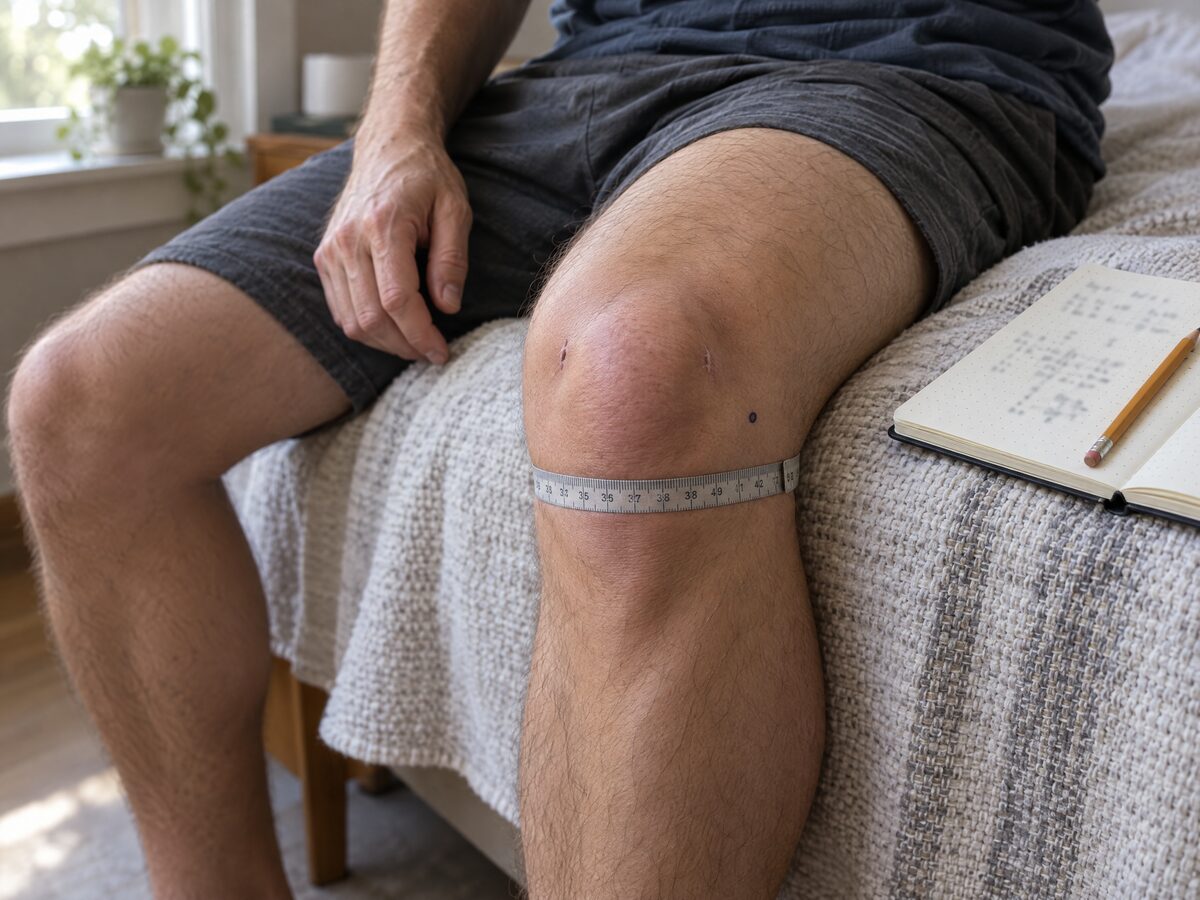
Eyeballing it is a poor gauge. In studies of arthritic knees, bedside checks for fluid were often unreliable, and small amounts were the easiest to miss. (Seminars in Arthritis and Rheumatism, 2016)
Many physical therapists use a stroke test. They sweep fluid out of one side of the knee and watch how much bulges back. (Physio-pedia) Some rehab protocols want no bulge before you move up a stage. (Mass General Brigham, 2024) Ask your PT to grade yours.
At home, a tape measure does the job. In 19 people after knee replacement, physical therapists’ tape measurements were reliable. But changes under about 1 cm (3/8 inch) could be noise. (Physiotherapy Research International, 2010)
The one-week swelling log
Set it up. Pick one spot, across or just below the kneecap, with the leg straight. Mark it with a pen. Measure both knees when you wake up and right after work.
Each day, write down:
- Morning and evening measurements, both knees.
- Hours on the job.
- The hard parts: ladders, attics or crawlspaces, stairs, kneeling or squatting.
- End-of-day tightness, 0 to 10.
- Next morning: back to your usual number? Yes or no.
Settling: back within 1 cm of your usual number by morning, and morning numbers flat or falling. Keep going, and spread out the hardest tasks.
Bring it in: morning numbers up 1 cm or more over the week, or three mornings not back to your usual. Same if tightness hits 7 or more most nights.
This is a practical structure, not a tested protocol. Adjust it with your PT.
Let the morning number, not the evening one, tell you how the week went.
What helps, and how good the evidence is
The main lever is load. Keep walking and doing your exercises, but change how much you do. (East Kent Hospitals) Lighter duties for a while, like more sitting and less carrying, can help. (Royal College of Surgeons of England)
- Elevation. Raise the leg straight, with pillows under the calf or foot, not under a bent knee. (MedlinePlus; Gateshead) We found no trial testing it after a scope.
- Cold. A 2026 review pooled 28 trials of cold therapy after bone and joint surgery, mostly knee operations. Pain fell by less than 1 point out of 10, below what patients usually notice. Effects on swelling were small, brief and low certainty, and only 2 trials were knee scopes. (British Journal of Sports Medicine, 2026) Wrap the ice and keep it to 20 minutes. (RNOH)
- Compression. Added to cold, it shrank the knee only on days 1 and 2 after surgery, across 10 small trials. (SpringerPlus, 2016)
- Quad work. Keep at it. Protocols tie moving up a stage to good quad control and no swelling after exercise. (Mass General Brigham, 2024)
- Draining. If the knee stays full, a clinician may draw the fluid off with a needle. It can ease symptoms, and the fluid can be tested for causes like infection. Serious complications are uncommon. (MedlinePlus)
Treat ice as comfort, not a fix. The bigger lever is how much you ask of the knee.
When the swelling won’t settle
If it isn’t improving, take three questions to your follow-up:
- Trim or repair? Ask for the operative report. A repair heals more slowly. (AAOS OrthoInfo)
- Can I get X-rays, taken standing? For ongoing knee pain, radiologists call X-rays the most useful first test. (American College of Radiology)
- If they’re clean, is an MRI worth it? MRI is best at finding hidden fractures and bone marrow edema, a buildup of fluid inside the bone. (American College of Radiology)
Bone trouble after a scope is uncommon. One review cites up to 4%, about 1 in 25, from one small series of 50 people. It often starts as sudden pain 6 to 8 weeks after surgery. (Annals of Translational Medicine, 2015)
For the full list of causes, read about a knee that feels worse after a meniscus scope.
Swelling that won’t settle is a question to answer, not something to grit through.
When not to wait
Call your surgeon’s office the same day if you have any of these. If you can’t reach them, go to urgent care or the ER.
- A fever above 101°F (38.3°C) or chills, or redness, swelling or yellowish discharge at an incision.
- Bleeding that soaks through the dressing.
- A hot, red, swollen knee, especially with fever or chills. It can mean infection.
- Pain or swelling in your calf or thigh. For chest pain or shortness of breath, call 911.
- A leg that suddenly turns swollen, red, hot or painful.
- A foot or toes that look darker than normal or feel cool to the touch.
- A knee that locks or gives way.
- A knee that swells up badly or changes shape, especially after a twist, or that you can’t bend, straighten or put weight on.
- Pain that keeps getting worse.
Sources: MedlinePlus on knee arthroscopy and joint swelling; NHS on knee pain, septic arthritis and DVT; Gateshead Health NHS Foundation Trust.
Back in the truck
Dale keeps the ice. He adds a tape measure to the glovebox.
A week of logging tells the story. Most evenings, the knee measures 1 to 2 cm bigger. By morning, it’s back to his usual number. Crawlspace days take two mornings.
So he spreads crawlspace calls across the week and eats lunch with his leg up. His PT adjusts his quad work to match.
The ice is for comfort now. The tape measure keeps score.
Your next step: tonight, mark one spot and measure both knees. Measure again tomorrow, before work.
Dale is a composite, drawn from the kinds of stories tradespeople describe after meniscus surgery. The details are illustrative.
Free · Your Before-You-Leave Card
Don’t leave your next appointment with “rest it.”
Get the questions for your injury in 8 taps.
Get my card →Questions readers ask
- How long does knee swelling last after meniscus surgery?
- Hospital leaflets give different windows: often 2 to 6 weeks after a scope, and up to about 3 months for some people. A repair heals more slowly than a trim, and heavy work can keep swelling going longer. Swelling that isn’t improving, or is getting worse, should be checked.
- Is it normal for my knee to swell after work weeks after a scope?
- It can be. Swelling is part of healing, and one NHS leaflet says excessive swelling may mean you’re doing too much. Track it with a tape measure. As a rule of thumb, not a tested protocol: if the knee is back within 1 cm of its usual size by morning, and morning numbers are flat or falling, it’s probably settling. If not, bring your log to your follow-up.
- When should I call about swelling after knee arthroscopy?
- Call your surgeon the same day for a fever above 101°F (38.3°C) or chills, a hot, red, swollen knee, or redness or discharge at an incision. The same goes for pain or swelling in your calf or thigh, a knee that locks or gives way, or pain that keeps getting worse. Call 911 for chest pain or shortness of breath.
Sources & references (25)
- Recovering from an Arthroscopy · University Hospitals Plymouth NHS Trust
- Post-Operative Knee Arthroscopy: Service User Information Leaflet · NHS Fife Musculoskeletal Physiotherapy, 2019
- Knee Arthroscopy: Patient information · Royal National Orthopaedic Hospital NHS Trust, 2025
- Post Operative: Meniscectomy · Gateshead Health NHS Foundation Trust, 2026
- Meniscus Tears · AAOS OrthoInfo
- Arthritis of the Knee · AAOS OrthoInfo
- Meniscal repair: aftercare advice · East Kent Hospitals University NHS Foundation Trust
- Quadriceps arthrogenic muscle inhibition: the effects of experimental knee joint effusion on motor cortex excitability · Arthritis Research & Therapy, 2014
- Neuromuscular function after arthroscopic partial meniscectomy · Clinical Orthopaedics and Related Research, 2010
- Knee effusion and reflex inhibition of the quadriceps: a bar to effective retraining · Journal of Bone & Joint Surgery (British Volume), 1988
- Clinical assessment of effusion in knee osteoarthritis: a systematic review · Seminars in Arthritis and Rheumatism, 2016
- Sweep test · Physio-pedia
- Rehabilitation Protocol for Arthroscopic Partial Meniscectomy · Mass General Brigham Sports Medicine, 2024
- Reliability of knee joint range of motion and circumference measurements after total knee arthroplasty: does tester experience matter? · Physiotherapy Research International, 2010
- Get Well Soon: helping you make a speedy recovery after arthroscopic operations on your knee for meniscal tears · Royal College of Surgeons of England
- Knee arthroscopy: discharge · MedlinePlus, 2024
- Effectiveness of cryotherapy on pain intensity, range of motion, swelling and function in the postoperative care of musculoskeletal disorders: a systematic review and meta-analysis of randomised controlled trials · British Journal of Sports Medicine, 2026
- Compressive cryotherapy versus cryotherapy alone in patients undergoing knee surgery: a meta-analysis · SpringerPlus, 2016
- Synovial Fluid Analysis · MedlinePlus
- ACR Appropriateness Criteria: Chronic Knee Pain · American College of Radiology
- Osteonecrosis of the knee: review · Annals of Translational Medicine, 2015
- Joint swelling · MedlinePlus
- Knee pain · NHS
- Septic arthritis · NHS
- Deep vein thrombosis (DVT) · NHS, 2026
The Series
45 articlesPart 1: Understanding Your Injury (1 to 19)
- After the MRI: How to Read a Rotator Cuff Report Without Getting Sold a Surgery
- Told to “Just Rest It”? Five Questions to Ask Before You Leave
- When Shoulder Pain Keeps Waking You Up
- Meniscus Surgery Recovery: When Can You Return to Your Kind of Work?
- Rotator Cuff Surgery or More Physical Therapy? Questions That Clarify the Decision
- Achilles Tendon Pain: Why This Tendon Is a Different Problem
- Four Months After Rotator Cuff Repair and It Still Hurts: Normal, or a Retear?
- Your Knee Feels Worse After the Meniscus Scope. What Could Be Going On?
- Hip Flexor Pain After Hip Arthroscopy: Why It Shows Up and When It Settles
- Tennis Elbow That Won’t Go Away: Why Rest and Shots Stall, and What Helps
- Knee Swelling After Meniscus Surgery: How Long Is Normal, and When to Call
- Quad Won’t Fire After Knee Surgery? What Quad Shutdown Is and How to Get It Back
- Walking After Meniscus Surgery: When You Can, How Far, and When to Drop the Crutches
- How to Sleep After Rotator Cuff Surgery, and When Nights Get Easier
- Felt a Pop After Knee Surgery? Re-Tear or Setback, and When to Call
- Home After a Microdiscectomy: How Much to Walk and How Long to Sit
- Running After ACL Surgery: When Your First Jog Comes, and What It Tells You About Work
- When Can You Drive After Rotator Cuff Surgery and Get Back in the Work Truck?
- Knee Won’t Straighten After Meniscus Surgery? Why It Happens and What Helps
Part 2: Work and Real Life (20 to 29)
- You Can Still Work. But What Is Your Injury Costing You?
- Self-Employed and Injured: How to Plan for Time Away From Work
- Your Job and Your Workouts Are Loading the Same Injury
- How to Take Time to Recover When Everyone Depends on You
- What Do You Still Want to Be Able to Do in Ten Years?
- Microdiscectomy Recovery: When Can You Go Back to Heavy Work?
- Kneeling After Knee Surgery: Why It Comes Back Last and How to Retrain It
- Rotator Cuff Surgery Recovery: When Can You Go Back to Work?
- When Can You Drive After Knee Surgery and Get Back in the Work Van?
- When Can You Go Back to Physical Work After ACL Surgery?
Part 3: Back to Training (30 to 34)
Part 4: Reading the Evidence (35 to 45)
- Your Watch Says You’re Recovered. Your Shoulder Disagrees.
- Recovery Is Taking Longer Than You Expected. What Counts as Progress?
- Before You Buy Another Recovery Tool, Decide What You Need It to Do
- “It Worked for Me”: How to Evaluate a Recovery Claim
- BPC-157 After an Orthopedic Procedure: What Does the Research Actually Show?
- TB-500 vs. BPC-157: What the Research Actually Compares
- How to Read a Peptide COA: What It Proves and What It Doesn’t
- The Research Stack People Ask About After a Scope, and the Gaps in the Human Data
- What the Tendon Research on BPC-157 Actually Measured
- What’s in the Other 1%? Peptide Impurities, Explained
- Approved, Compounded or “Research Use Only”: What a Peptide’s Label Means in 2026
Free · 60-second recovery check
What’s really holding your recovery back?
Eight quick taps. Find the one thing stalling your recovery, then get the three moves to work on first, picked from 30 guides and 100+ cited sources.
- Your bottleneck, named in 60 seconds
- 3 moves for this week, fitted to your job
- Your Before-You-Leave Card: the questions for your next appointment
What got hurt?
Free. No sign-up to start. Not medical advice.
Keep reading
Knee Won’t Straighten After Meniscus Surgery? Why It Happens and What Helps
Three weeks out, the other knee lies flat and yours won’t. Why a knee stays bent after a meniscus trim or repair, when protocols expect it straight, what rehab teams use to get it back, and the signs that mean call to…
When Can You Drive After Rotator Cuff Surgery and Get Back in the Work Truck?
Dispatch wants you back on the road, and your arm is still strapped to your belly. What the sling means for driving after a rotator cuff repair, what the few driving studies found, and a check to run before your first…
Running After ACL Surgery: When Your First Jog Comes, and What It Tells You About Work
Your PT says you can try a jog. You’re wondering if ladders are next. When the first run usually comes after ACL reconstruction, what clinics test first, what a first run-walk looks like, and what it does and doesn’t …