When Can You Drive After Rotator Cuff Surgery and Get Back in the Work Truck?
Dispatch wants you back on the road, and your arm is still strapped to your belly. What the sling means for driving after a rotator cuff repair, what the few driving studies found, and a check to run before your first trip.
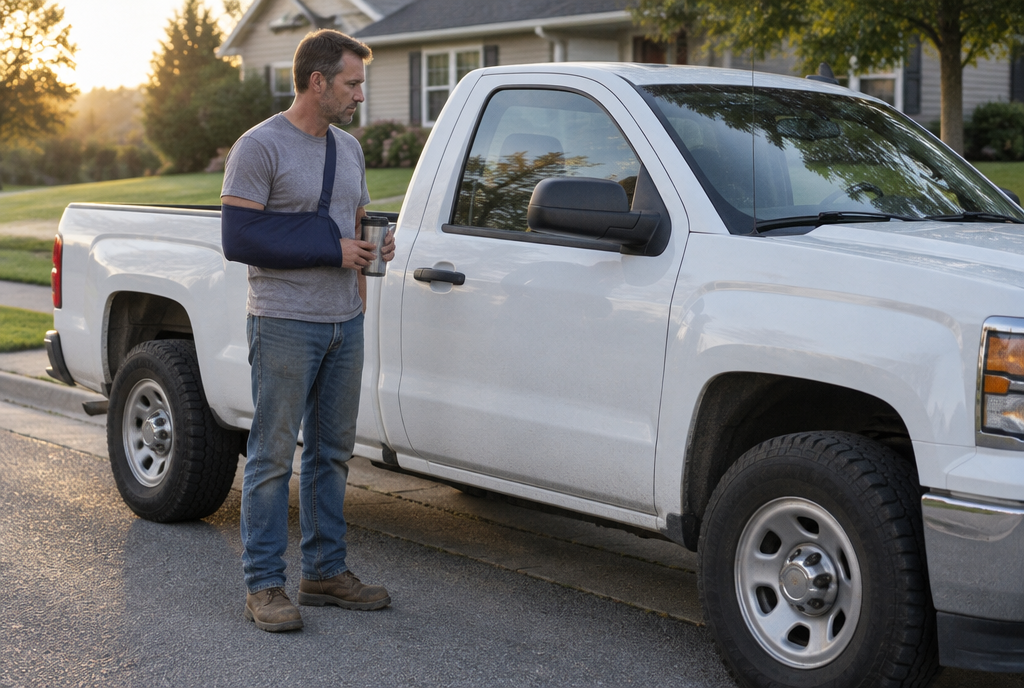
The story below is a composite of real experiences; details changed.
Ray stands in his driveway at 7 a.m., coffee in his left hand. His right arm is strapped to his belly in a sling.
He’s 46, a service electrician. Three weeks ago, a surgeon sewed a torn tendon back onto his right shoulder.
The company pickup sits at the curb. It’s an automatic. He’s done the math: left hand on the wheel, right arm tucked in. How hard can it be?
His phone buzzes. Dispatch: “Can you at least drive to the shop and run the board?”
His wife drove him to his follow-up. She can’t drive him to work every day.
Here’s what the sling means for driving, what the few driving studies found, and a check to run before your first trip.
The short answer: the sling comes first
AAOS says you’ll most likely use a sling and avoid using the arm for the first 4 to 6 weeks. How long depends on the tear, your tissue and the repair. (AAOS OrthoInfo)
The UK hospital leaflets we read tie driving to that sling. One NHS hospital says don’t try until after six weeks, and after the sling is off entirely. (University Hospital Southampton)
Another says you won’t drive for at least 6 weeks, and normally start between 6 and 12. (Royal Berkshire NHS, 2025) A third gives 8 to 12 weeks, once you can control the vehicle and do an emergency stop. (NHS Lothian, 2025)
A US surgery department is less fixed. It says the decision rests on your comfort driving “essentially one-handed.” But it says to wait at least until your first post-op visit with your surgeon. (WashU Medicine Orthopedics)
The same page warns that if you crash or get pulled over in a sling, authorities may consider it driving while impaired. (WashU Medicine Orthopedics)
Two UK leaflets call driving in a sling illegal there. (Royal Berkshire NHS, 2025; NHS Lothian, 2025) A 2022 US study says driving with a sling has no legal ramifications in the United States. (Journal of Bone and Joint Surgery, 2022) Legal isn’t the same as safe.
A 2013 literature review in the AAOS journal said that, at the time, there were no laws, and no well-established insurance or medical guidelines, on when it’s safe to drive after bone and joint surgery. (AAOS via EurekAlert, 2013)
The calendar is a guess. The sling is the first gate, and your surgeon holds the key.
What the driving studies found
There isn’t much research, and it points two ways.
In a 2015 simulator study, 21 healthy volunteers drove with and without a sling on their dominant, driving arm. They had 36 collisions in all without the sling, and 73 with it. That’s about 1.7 each versus 3.7. (Journal of Shoulder and Elbow Surgery, 2015)
A 2022 study took real patients out on real roads. Twenty-seven people, average age about 59, drove before a cuff repair and at 2, 4, 6 and 12 weeks after, with a safety monitor on board. They wore their slings at the 2- and 4-week drives. (Journal of Bone and Joint Surgery, 2022)
From week 2, they generally braked less aggressively and steered more smoothly. The authors reported no clinically important hit to driving fitness as early as 2 weeks. None were taking narcotics on any drive. (Journal of Bone and Joint Surgery, 2022)
But read the fine print. There was no emergency maneuver. No stick shifts. Nearly 9 in 10 were right-handed. (Journal of Bone and Joint Surgery, 2022)
What did people actually do? A survey of 54 patients 4 months after a cuff repair found they went back to driving anywhere from the same day to 4 months. A third of those back behind the wheel reported driving in the sling. (Journal of Surgical Orthopaedic Advances, 2015; HCPLive, 2015)
Pain mattered more than the date. Drivers with pain were more likely to feel unsafe and to report trouble handling the vehicle. (Journal of Surgical Orthopaedic Advances, 2015) A news report on the study put that at 3.7 times as likely, and said feeling safe didn’t track with time since surgery. (HCPLive, 2015)
A 2025 records review gave its findings in its title: 23%, 70% and 99% back to driving at 1, 2 and 6 months. (Journal of Experimental Orthopaedics, 2025)
Plenty of people drive early. That’s not proof it’s safe for you, and no study tested a panic stop in a sling.
The evidence, without the theater
What the research shows
- In a simulator, healthy drivers with a sling on the driving arm had about twice the collisions.
- In one small road study, patients drove carefully, not worse, from 2 weeks.
- Many patients drive before the sling comes off.
What it doesn’t show
- How a sling affects an emergency stop or swerve on a real road.
- Stick shifts, left-handed drivers, or a full day in a work truck.
- A safe date for you.
Right shoulder, left shoulder, stick shift
The road study included 14 right shoulders and 13 left. The authors said it may not apply to left-handed people, and it didn’t test manual transmissions, which ask more of the arms. (Journal of Bone and Joint Surgery, 2022)
A follow-up look at that data found workarounds. People used the good hand for the turn signal or the shifter. One-handed steering was more common in the sling. (Virginia Tech thesis, 2023)
No study we found tested a stick shift in a sling.
Ray’s truck is an automatic. But his repair is on the arm he shifts and steers with, and he’s right-handed.
Left or right, a sling means one arm on the wheel. Talk to your surgeon before you assume either side is the easy one.
Pain pills and the wheel
MedlinePlus is plain: don’t drive if you’re taking narcotic pain medicine like codeine, hydrocodone or oxycodone. (MedlinePlus, 2024)
The FDA says opioids and muscle relaxants can cause drowsiness or slowed, uncoordinated movement. For some, the effects can last for hours, even into the next day. (FDA, 2024)
Driving impaired by any substance, legal or illegal, is against the law in all 50 states. (NHTSA)
Ray takes a pain pill at night so he can sleep. That alone keeps him out of the truck the next morning until he asks his pharmacist how long it lasts.
Still on narcotic pain pills? The truck stays parked.
The work truck: insurance, dispatch and a note
One NHS leaflet says it’s wise to talk with your insurance company before driving again. (Sherwood Forest Hospitals, 2025)
A US orthopedic surgeon who co-wrote the 2013 review said insurers and police treat fitness to drive as the driver’s responsibility alone. There’s no such thing as “clearance” from a surgeon, he added. (MedicalResearch.com, 2013)
So a note records your surgeon’s view. It doesn’t lift the decision off you, and rules can vary by state, insurer and employer.
If dispatch, HR or a fleet manager wants a note, ask your surgeon to put the driving advice in writing. The five questions to ask before you leave can help.
Driving to the shop isn’t the same as working. One hospital says jobs with heavy lifting often need at least three to four months off. (University Hospital Southampton) For timing by job, read going back to work after rotator cuff surgery.
The decision stays in the driver’s seat.
Before your first drive
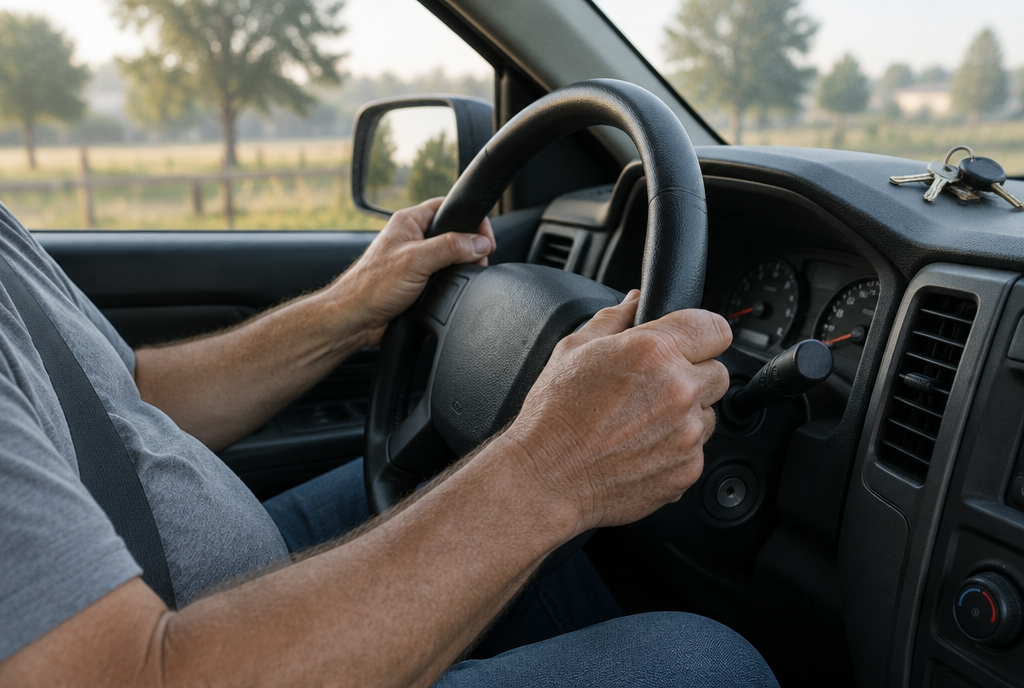
The before-you-drive check
Start once your surgeon is OK with it. Pass each step before the next.
- Sling status. Know what your surgeon wants. Most leaflets say no driving until it’s off. (University Hospital Southampton)
- Clear head. Off narcotic pain pills, and no other medicine that makes you drowsy.
- Keys out. Engine off, in the driver’s seat. Turn the wheel lock to lock with both hands, reach the signal and the shifter, and buckle up. Any sharp pain means not yet.
- Look back. Turn to check your blind spot and reverse out of a parking spot in your head. Can you do it without guarding the arm?
- Tell people. Talk to your insurer before your first drive. Then tell dispatch your plan.
- Empty lot. With a licensed driver beside you, make a few hard stops and tight turns at low speed. You should be able to do an emergency stop. (NHS Lothian, 2025)
- Short first trip. Start with short journeys, with someone along at first. (University Hospital Southampton)
This is a practical structure, not a tested protocol. If a step hurts, wait a few days.
Earn the first drive in the driveway, not on the highway.
When not to wait
When not to wait
Chest pain or shortness of breath? Call 911. Don’t drive yourself.
Call your surgeon’s office the same day for any of these. Can’t reach them? Go to urgent care or the ER.
- A fever above 101°F (38.3°C).
- Redness, pain, swelling or yellowish discharge at any of the wounds.
- Bleeding that soaks through the dressing and doesn’t stop with pressure.
- Numbness or tingling in your fingers or hand.
- A hand or fingers that look darker or feel cool.
- Swelling in your arm, or pain your pain medicine doesn’t touch.
- Pain or swelling in one calf or thigh, or red or darkened skin there.
Sources: MedlinePlus on shoulder surgery; NHS on DVT.
Back in the driveway
Ray doesn’t text dispatch a yes. He sends a plan.
His wife drives him to the shop three mornings a week so he can run the board. He calls his insurer, and he stops the night pill.
At his 6-week visit, the sling comes off. He asks his surgeon to write down the driving advice.
His first trip is a Sunday loop to the hardware store, his wife in the passenger seat. Both hands on the wheel.
Worried about the paycheck in the meantime? Read how to plan for time away from work. Can’t sleep in the sling? See how to sleep after rotator cuff surgery.
Your next step: tonight, text your boss a plan, not a date: “Driving once the sling is off, my surgeon agrees, and I pass a parking-lot check.”
Ray is a composite, drawn from the kinds of stories tradespeople describe after rotator cuff surgery. The details are illustrative.
Free · Your Before-You-Leave Card
Don’t leave your next appointment with “rest it.”
Get the questions for your injury in 8 taps.
Get my card →Questions readers ask
- How long after rotator cuff surgery can I drive?
- There’s no fixed date. AAOS says you’ll most likely be in a sling for the first 4 to 6 weeks, and the UK hospital leaflets we read tie driving to that sling. One NHS hospital says not to try until after six weeks and after the sling is off entirely. Others give 6 to 12 weeks, or 8 to 12, once you can control the vehicle and do an emergency stop. Your surgeon sets your date.
- Can I drive with my arm in a sling?
- Most leaflets say no. In a simulator study, 21 healthy volunteers with a sling on their driving arm had 73 collisions, against 36 without it. A small 2022 road study found patients in slings drove more carefully, not worse, from 2 weeks, but it tested no emergency maneuver and no stick shifts. One US surgery department warns that if you crash or get pulled over in a sling, authorities may consider it driving while impaired.
- Can I drive while taking pain medicine after rotator cuff surgery?
- MedlinePlus says not to drive if you’re taking narcotic pain medicine like codeine, hydrocodone or oxycodone. The FDA says opioids and muscle relaxants can cause drowsiness or slowed, uncoordinated movement, and for some the effects last into the next day. Driving impaired by any substance, legal or illegal, is against the law in all 50 states.
Sources & references (18)
- Rotator Cuff Tears: Surgical Treatment Options · AAOS OrthoInfo
- Rotator cuff repair: after surgery care · University Hospital Southampton NHS Foundation Trust
- Rotator cuff repair · Royal Berkshire NHS Foundation Trust, 2025
- Rotator Cuff Repair: Patient Information Sheet · NHS Lothian, 2025
- Rotator cuff operation · Sherwood Forest Hospitals NHS Foundation Trust, 2025
- Rotator Cuff Repair: Postoperative Care · WashU Medicine Orthopedics
- News release on “Driving after orthopaedic surgery” (Marecek and Schafer, Journal of the American Academy of Orthopaedic Surgeons) · American Academy of Orthopaedic Surgeons via EurekAlert, 2013
- When Is It Safe to Drive After Orthopedic Surgery? · MedicalResearch.com, 2013
- The effect of shoulder immobilization on driving performance · Journal of Shoulder and Elbow Surgery, 2015
- Patients Who Undergo Rotator Cuff Repair Can Safely Return to Driving at 2 Weeks Postoperatively · Journal of Bone and Joint Surgery, 2022
- Return to Driving After Arthroscopic Rotator Cuff Repair: Patient-Reported Safety and Maneuverability · Journal of Surgical Orthopaedic Advances, 2015
- Rotator Cuff Surgery: Hide the Car Keys? · HCPLive, 2015
- Return to driving following rotator cuff repair: 23%, 70% and 99% at 1, 2 and 6 months · Journal of Experimental Orthopaedics, 2025
- Effectiveness of Compensatory Vehicle Control Techniques Exhibited by Drivers after Arthroscopic Rotator Cuff Surgery · Virginia Tech (master’s thesis), 2023
- Shoulder surgery: discharge · MedlinePlus, 2024
- Some Medicines and Driving Don’t Mix · US Food and Drug Administration, 2024
- Drug-Impaired Driving · National Highway Traffic Safety Administration
- Deep vein thrombosis (DVT) · NHS
The Series
45 articlesPart 1: Understanding Your Injury (1 to 19)
- After the MRI: How to Read a Rotator Cuff Report Without Getting Sold a Surgery
- Told to “Just Rest It”? Five Questions to Ask Before You Leave
- When Shoulder Pain Keeps Waking You Up
- Meniscus Surgery Recovery: When Can You Return to Your Kind of Work?
- Rotator Cuff Surgery or More Physical Therapy? Questions That Clarify the Decision
- Achilles Tendon Pain: Why This Tendon Is a Different Problem
- Four Months After Rotator Cuff Repair and It Still Hurts: Normal, or a Retear?
- Your Knee Feels Worse After the Meniscus Scope. What Could Be Going On?
- Hip Flexor Pain After Hip Arthroscopy: Why It Shows Up and When It Settles
- Tennis Elbow That Won’t Go Away: Why Rest and Shots Stall, and What Helps
- Knee Swelling After Meniscus Surgery: How Long Is Normal, and When to Call
- Quad Won’t Fire After Knee Surgery? What Quad Shutdown Is and How to Get It Back
- Walking After Meniscus Surgery: When You Can, How Far, and When to Drop the Crutches
- How to Sleep After Rotator Cuff Surgery, and When Nights Get Easier
- Felt a Pop After Knee Surgery? Re-Tear or Setback, and When to Call
- Home After a Microdiscectomy: How Much to Walk and How Long to Sit
- Running After ACL Surgery: When Your First Jog Comes, and What It Tells You About Work
- When Can You Drive After Rotator Cuff Surgery and Get Back in the Work Truck?
- Knee Won’t Straighten After Meniscus Surgery? Why It Happens and What Helps
Part 2: Work and Real Life (20 to 29)
- You Can Still Work. But What Is Your Injury Costing You?
- Self-Employed and Injured: How to Plan for Time Away From Work
- Your Job and Your Workouts Are Loading the Same Injury
- How to Take Time to Recover When Everyone Depends on You
- What Do You Still Want to Be Able to Do in Ten Years?
- Microdiscectomy Recovery: When Can You Go Back to Heavy Work?
- Kneeling After Knee Surgery: Why It Comes Back Last and How to Retrain It
- Rotator Cuff Surgery Recovery: When Can You Go Back to Work?
- When Can You Drive After Knee Surgery and Get Back in the Work Van?
- When Can You Go Back to Physical Work After ACL Surgery?
Part 3: Back to Training (30 to 34)
Part 4: Reading the Evidence (35 to 45)
- Your Watch Says You’re Recovered. Your Shoulder Disagrees.
- Recovery Is Taking Longer Than You Expected. What Counts as Progress?
- Before You Buy Another Recovery Tool, Decide What You Need It to Do
- “It Worked for Me”: How to Evaluate a Recovery Claim
- BPC-157 After an Orthopedic Procedure: What Does the Research Actually Show?
- TB-500 vs. BPC-157: What the Research Actually Compares
- How to Read a Peptide COA: What It Proves and What It Doesn’t
- The Research Stack People Ask About After a Scope, and the Gaps in the Human Data
- What the Tendon Research on BPC-157 Actually Measured
- What’s in the Other 1%? Peptide Impurities, Explained
- Approved, Compounded or “Research Use Only”: What a Peptide’s Label Means in 2026
Free · 60-second recovery check
What’s really holding your recovery back?
Eight quick taps. Find the one thing stalling your recovery, then get the three moves to work on first, picked from 30 guides and 100+ cited sources.
- Your bottleneck, named in 60 seconds
- 3 moves for this week, fitted to your job
- Your Before-You-Leave Card: the questions for your next appointment
What got hurt?
Free. No sign-up to start. Not medical advice.
Keep reading

Knee Won’t Straighten After Meniscus Surgery? Why It Happens and What Helps
Three weeks out, the other knee lies flat and yours won’t. Why a knee stays bent after a meniscus trim or repair, when protocols expect it straight, what rehab teams use to get it back, and the signs that mean call to…
Running After ACL Surgery: When Your First Jog Comes, and What It Tells You About Work
Your PT says you can try a jog. You’re wondering if ladders are next. When the first run usually comes after ACL reconstruction, what clinics test first, what a first run-walk looks like, and what it does and doesn’t …

Home After a Microdiscectomy: How Much to Walk and How Long to Sit
The leg pain is nearly gone, the back aches, and every twinge feels like you undid the surgery. How much to walk and sit in the first six weeks, which aches are normal, and a ladder to start tomorrow.