When Can You Go Back to Physical Work After ACL Surgery?
Your foreman wants a date, and you can’t even jog yet. How long physical jobs take after ACL reconstruction, why ladders and heavy loads come later, and a plan he can schedule around.
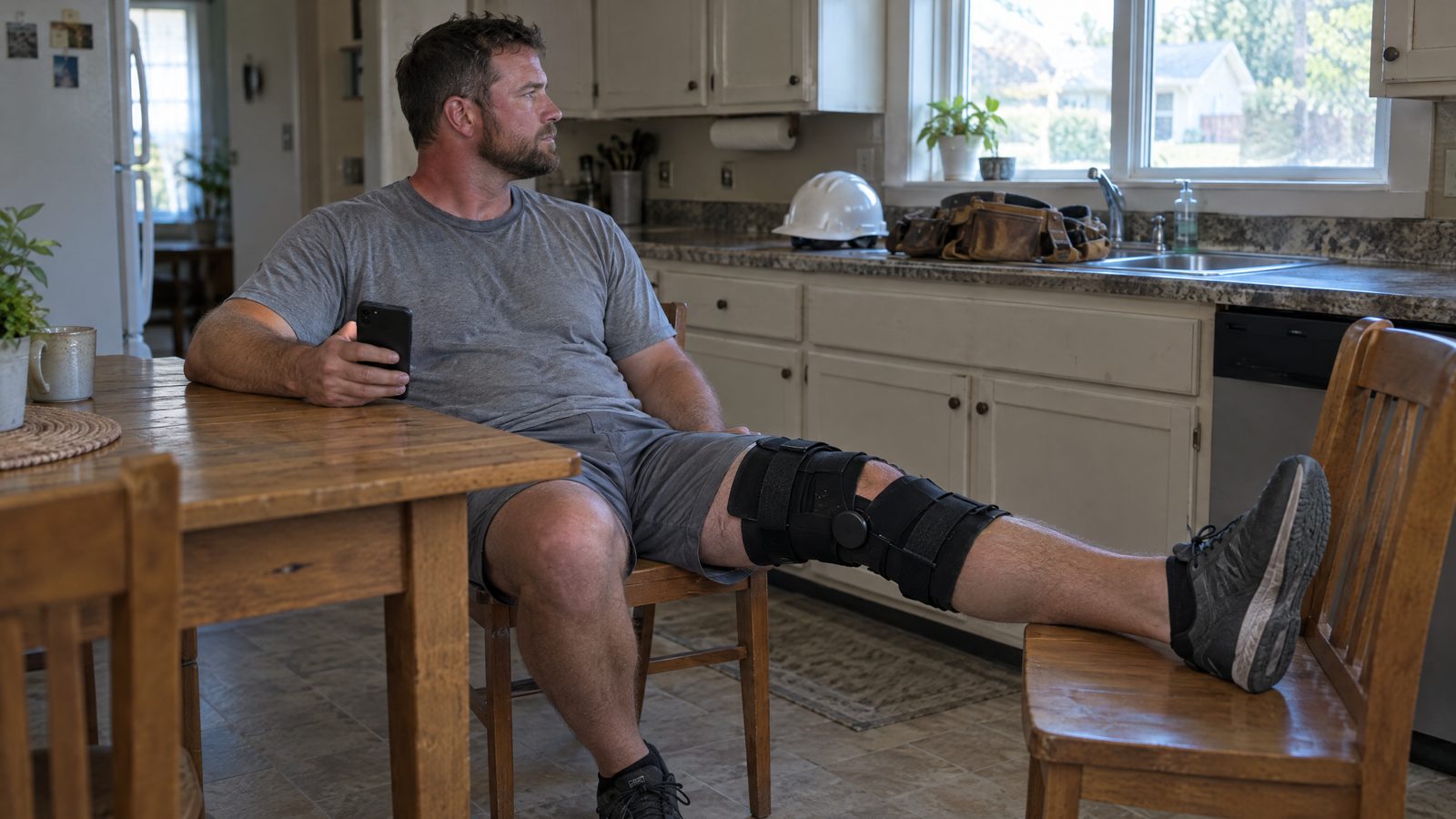
The story below is a composite of real experiences; details changed.
Week 6. Marcus is on the leg press at PT when his foreman texts a photo: the crew carrying plywood up the stairwell, one man short.
“Third floor’s ready for framing. Any word?”
Marcus is 38, a union carpenter on commercial jobs. A surgeon rebuilt the ACL he tore at his son’s rec soccer game.
He can do stairs again, one at a time. His PT still won’t let him jog. His short-term disability runs out in three weeks.
He types “soon,” then deletes it. If he can’t jog yet, how can he carry sheets to the third floor?
Here’s how long physical jobs take after ACL surgery, why ladders come later, and a plan you can hand your foreman this week.
How long until you’re back? It depends on your job
The clearest ranges come from ACC, New Zealand’s injury insurer, for ACL reconstruction alone. They reflect the New Zealand Knee Society’s expert opinion, not trial data. (ACC New Zealand)
| Kind of work | Full return |
|---|---|
| Desk work | 2 to 4 weeks |
| Light work: mainly standing and walking | 4 to 8 weeks |
| Medium work: often lifting 11 lb (5 kg) or more | 8 to 10 weeks |
| Heavy work: often lifting 20 lb (9 kg) or more, like a builder | 10 to 16 weeks |
| Very heavy work: often lifting 48 lb (22 kg) or more | 16 to 30 weeks |
| Uneven ground, in medium or heavier work | 8 to 16 weeks |
A meniscus repair adds time to light and medium work, and its crutch or brace rules can stretch any row. (ACC New Zealand)
ACC lists builders in the heavy row, so at week 6 Marcus has 4 to 10 weeks to go. Often lift 48 lb (22 kg) or more? Use the very heavy row. (ACC New Zealand)
If your job is heavy, plan in months, not weeks.
What happened to workers in the studies
In Finland, 803 public-sector workers, average age 41, were tracked after ACL surgery. Manual workers, like cleaners and maintenance workers, were off about 11 weeks on average (78 days). Managers and professionals, like teachers and doctors, were off about 7 (50 days).
Almost all (99%) were back within a year. But the records showed job class, not knee demands. (Acta Orthopaedica, 2022)
A Dutch hospital surveyed ACL patients, and 68% answered. Of 89 workers, median age 31, more than 9 in 10 (92%) were fully back, at a midpoint of about 11 weeks. Heavy knee-demanding work went with a slower return. (Archives of Orthopaedic and Trauma Surgery, 2017)
Closest to a trade: 33 Turkish coal miners averaged 15.3 weeks, in one center’s records. (Pan African Medical Journal, 2015)
In both bigger studies, 9 in 10 or more got back. Manual and knee-demanding jobs took longer.
The evidence, without the theater
What the research shows
- In two worker studies, 92% to 99% got back. Manual and knee-demanding jobs took longer.
- In 230 men aged 18 to 30 with hamstring grafts, heavy manual jobs didn’t worsen knee results at a year. (Orthopaedic Journal of Sports Medicine, 2023)
What it doesn’t show
- Your date. The miners alone ranged from 10 to 27 weeks.
- Whether ladders or heavy work sooner raises your risk of a graft tear. We found no study that tested it.
- Which test should clear you for site work. Even for running and training, a 2023 sports medicine guideline found no evidence on which criteria to use. (British Journal of Sports Medicine, 2023)
Why ladders and uneven ground come later
Your new ACL is a graft, and it gets weaker before it gets stronger. One NHS physical therapy team says it’s at its weakest 6 to 12 weeks after surgery, when work duties may need to change. (University Hospitals Sussex, 2025)
| What the job asks | What patient guides say |
|---|---|
| Carrying loads on uneven ground, climbing ladders | After 2 to 3 months |
| A slow jog | About 3 months |
| Twisting and pivoting | Avoid for the first 4 to 6 months |
So Marcus’s question has an answer: not jogging at week 6 is on schedule. (New Zealand ACL Registry; University Hospitals Sussex, 2025; West Suffolk NHS, 2024)
One US hospital’s sports medicine protocol uses tests, not just dates. It wants quad strength over 80% of your other leg to move past weeks 9 to 12. Later, hop tests need 90% or more to start its return-to-sport phase. (Mass General Brigham, 2024)
Dates tell you when to ask. Tests help your PT decide when you climb.
Your quad, your graft, and kneeling
ACC says big swelling, ongoing pain, an unstable knee or a weak quad can slow recovery. Quad won’t switch on? See why a quad won’t fire after knee surgery. (ACC New Zealand)
Among the coal miners, 3 in 4 (75%) had muscular atrophy (muscle wasting), which the authors linked to delays in going back. (Pan African Medical Journal, 2015)
Your graft matters too, because carpenters kneel. In New Zealand’s ACL registry, about 1 in 5 (21.3%) people with a kneecap-tendon graft had severe or extreme trouble kneeling at 2 years.
With a hamstring graft, it was about 1 in 10 (9.4%). Overall knee pain was no different. The limit: only about 4 in 10 (41%) answered the survey at 2 years. (American Journal of Sports Medicine, 2023)
Our guide to kneeling after knee surgery has a retraining ladder.
Ask which graft you got. If it was the kneecap tendon, give kneeling its own rung.
Light duty now, and the real re-injury risk
ACC says an early return on modified duties or hours should be encouraged, when appropriate. One NHS physical therapy team says light duties may be possible after 2 weeks, though you’ll likely still be on crutches. It puts light manual work at 6 weeks. (ACC New Zealand; University Hospitals Sussex, 2025)
Right knee? See when you can drive after knee surgery.
The re-injury numbers come from athletes, not workers. In 106 people in pivoting sports, the re-injury rate fell 51% for each month they delayed returning to sport, up to 9 months. (British Journal of Sports Medicine, 2016)
A 2016 review focused on younger athletes. Overall, across 14 studies, about 1 in 14 (7%) tore their graft, so more than 9 in 10 didn’t. Under age 25, it was 1 in 10 (10%). (American Journal of Sports Medicine, 2016)
No study we found tested return timing and re-tears in workers. Turning on a ladder can twist the knee, so ask your PT to check you for it before you climb.
Ladders scarier than your tests say? Read you used to trust your body.
Early light duty is encouraged when it’s appropriate. An early return to pivoting sport is what the athlete data warn about.
Turn “soon” into a plan your foreman can use
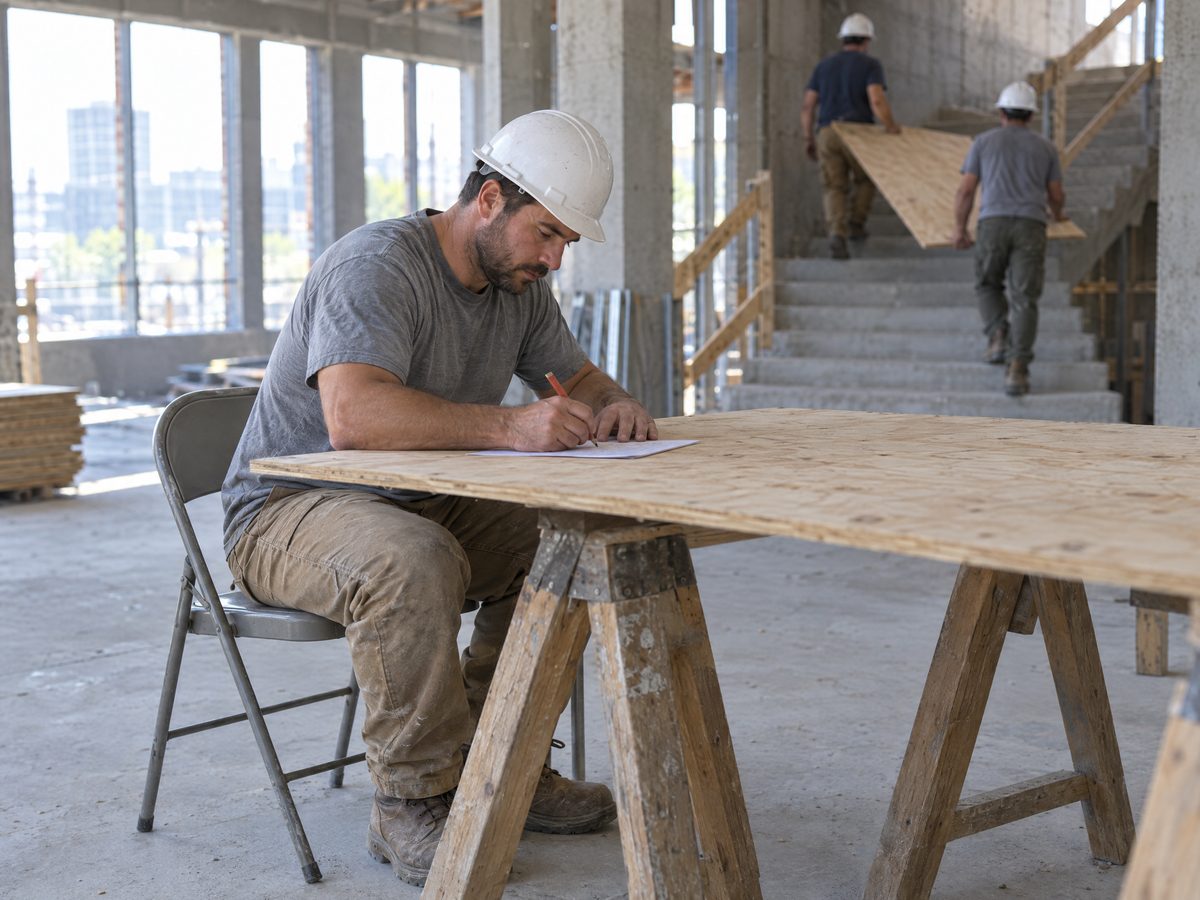
Your back-to-work ladder
Sort your tasks onto four rungs. Your PT names each test, and your surgeon dates it.
A practical structure, not a tested protocol. We found no validated test for clearing site work, so adjust it with your PT.
- Seated work: takeoffs and cut lists. Guide range: 2 to 4 weeks. Gate: your surgeon’s crutch and brace rules. (ACC New Zealand)
- On your feet, flat floors: layout and finish work, no ladders. Guide range: 4 to 8 weeks. Gate: full straightening, a normal walk, and small, stable swelling. (ACC New Zealand; Mass General Brigham, 2024)
- Stairs with loads, ladders, uneven ground: Guide range: 8 to 16 weeks. Gate: no swelling or pain after exercise, no giving way, quad strength over 80% of your other leg. (ACC New Zealand; New Zealand ACL Registry; Mass General Brigham, 2024)
- Full duty: sheet goods, step-downs and squatting. Guide range: 10 to 16 weeks for heavy work. Gate: hop and strength tests. In one study, miners were cleared after knee stability tests and a single-leg hop score of 75% or more. (ACC New Zealand; Pan African Medical Journal, 2015)
Kneeling and twisting get their own dates, even at full duty. One NHS leaflet says to avoid both for the first 4 to 6 months. Ask your surgeon for yours. (West Suffolk NHS, 2024)
Get in writing at each visit:
- A lifting limit: pounds, distance, and stairs or not.
- Ladders: yes or no, and how high.
- Hours per day on your feet, on uneven ground, kneeling and squatting.
- A review date.
Family counting on your paycheck? Read how to take time to recover when everyone depends on you.
Your foreman can schedule rungs. He can’t schedule “soon.”
What should make you call early
If your knee isn’t healing on schedule, don’t wait for your next visit.
When not to wait
Call your surgeon’s office right away for any of these. If you can’t reach them, go to urgent care or the ER.
- A temperature higher than 101°F (38.3°C).
- Redness, pain, swelling or yellowish discharge at an incision.
- Bleeding that soaks through the dressing and doesn’t stop with pressure.
- Pain that doesn’t ease after you take your pain medicine.
- A knee that gets more swollen, hotter or redder.
- Pain or swelling in one calf or thigh. A clot can show up weeks after surgery. With chest pain or shortness of breath, call 911.
- Toes that look darker or feel cool, or new numbness or tingling in your foot.
- A pop and the knee giving way, then swelling within a day: signs of an ACL tear.
- A knee that locks, gives way under you, or can’t take your weight.
Sources: MedlinePlus; NHS on DVT and knee pain; AAOS OrthoInfo; University Hospitals Sussex.
Back on the third floor
That night, Marcus draws four rungs at the kitchen table. Cut lists at the bottom. Plywood up the stairwell at the top.
At PT, he asks for a test next to each rung. His surgeon’s office adds a range.
Then he answers the foreman with a photo of the page. Cut lists now, layout once he walks normally, ladders when the tests say so.
The reply comes fast: “Can you run the cut list Monday?”
He types “Yes.” This time he hits send.
Marcus scrolls up to the photo of the crew on the stairs. He knows what it takes to get back in that line.
Your next step: tonight, sort your tasks onto four rungs. At PT, ask: “What test clears each one, and when can we run it?”
Marcus is a composite, drawn from the kinds of stories tradespeople describe after ACL surgery. The details are illustrative.
Free · Your Before-You-Leave Card
Don’t leave your next appointment with “rest it.”
Get the questions for your injury in 8 taps.
Get my card →Questions readers ask
- How long after ACL surgery can you go back to physical work?
- It depends on how heavy your job is. ACC, New Zealand’s injury insurer, gives ranges based on the New Zealand Knee Society’s expert opinion. For a full return, it’s 4 to 8 weeks for light work and 8 to 10 weeks for medium work. Heavy work, like a builder’s, takes 10 to 16 weeks, and very heavy work 16 to 30. In a Finnish study of 803 workers, manual workers were off about 11 weeks on average. Your surgeon sets your own dates.
- Can I go back on light duty after ACL surgery?
- ACC, New Zealand’s injury insurer, says an early return on modified duties or hours should be encouraged when appropriate. Whether light duty is available depends on your employer. One NHS physical therapy team says light duties may be possible after 2 weeks, though you’ll likely still be on crutches. It puts light manual work at 6 weeks. Get your limits in writing at each visit: pounds, ladders, uneven ground, kneeling and hours on your feet.
- When can I climb ladders after ACL surgery?
- New Zealand’s ACL registry puts carrying loads on uneven ground and climbing ladders at 2 to 3 months, and jogging after 3 months. One NHS physical therapy team says the graft is at its weakest 6 to 12 weeks after surgery. One US hospital protocol also uses tests, like quad strength over 80% of your other leg, to move past weeks 9 to 12. We found no study that tested whether an earlier return to ladders raises the risk of a graft tear.
Sources & references (17)
- RTW ACL reconstruction (return-to-work guidance) · ACC (Accident Compensation Corporation, New Zealand)
- Return to work following anterior cruciate ligament reconstruction · Acta Orthopaedica, 2022
- Beneficial and limiting factors for return to work following anterior cruciate ligament reconstruction: a retrospective cohort study · Archives of Orthopaedic and Trauma Surgery, 2017
- Return to work in miners following anterior cruciate ligament reconstruction · Pan African Medical Journal, 2015
- Impact of Occupation on 12-Month Outcomes After Anterior Cruciate Ligament Reconstruction in Male Patients · Orthopaedic Journal of Sports Medicine, 2023
- Aspetar clinical practice guideline on rehabilitation after anterior cruciate ligament reconstruction · British Journal of Sports Medicine, 2023
- Physiotherapy advice after your anterior cruciate ligament (ACL) reconstruction · University Hospitals Sussex NHS Foundation Trust, 2025
- Advice to patients undergoing anterior cruciate ligament (ACL) reconstruction surgery · West Suffolk NHS Foundation Trust, 2024
- Patients · New Zealand ACL Registry
- Rehabilitation Protocol for ACL Reconstruction · Mass General Brigham Sports Medicine, 2024
- Comparison of Knee Pain and Difficulty With Kneeling Between Patellar Tendon and Hamstring Tendon Autografts After Anterior Cruciate Ligament Reconstruction: A Study From the New Zealand ACL Registry · The American Journal of Sports Medicine, 2023
- Simple decision rules can reduce reinjury risk by 84% after ACL reconstruction: the Delaware-Oslo ACL cohort study · British Journal of Sports Medicine, 2016
- Risk of Secondary Injury in Younger Athletes After Anterior Cruciate Ligament Reconstruction: A Systematic Review and Meta-analysis · The American Journal of Sports Medicine, 2016
- ACL reconstruction: discharge · MedlinePlus, 2024
- Deep vein thrombosis (DVT) · NHS
- Knee pain · NHS
- Anterior Cruciate Ligament (ACL) Injuries · AAOS OrthoInfo
The Series
45 articlesPart 1: Understanding Your Injury (1 to 19)
- After the MRI: How to Read a Rotator Cuff Report Without Getting Sold a Surgery
- Told to “Just Rest It”? Five Questions to Ask Before You Leave
- When Shoulder Pain Keeps Waking You Up
- Meniscus Surgery Recovery: When Can You Return to Your Kind of Work?
- Rotator Cuff Surgery or More Physical Therapy? Questions That Clarify the Decision
- Achilles Tendon Pain: Why This Tendon Is a Different Problem
- Four Months After Rotator Cuff Repair and It Still Hurts: Normal, or a Retear?
- Your Knee Feels Worse After the Meniscus Scope. What Could Be Going On?
- Hip Flexor Pain After Hip Arthroscopy: Why It Shows Up and When It Settles
- Tennis Elbow That Won’t Go Away: Why Rest and Shots Stall, and What Helps
- Knee Swelling After Meniscus Surgery: How Long Is Normal, and When to Call
- Quad Won’t Fire After Knee Surgery? What Quad Shutdown Is and How to Get It Back
- Walking After Meniscus Surgery: When You Can, How Far, and When to Drop the Crutches
- How to Sleep After Rotator Cuff Surgery, and When Nights Get Easier
- Felt a Pop After Knee Surgery? Re-Tear or Setback, and When to Call
- Home After a Microdiscectomy: How Much to Walk and How Long to Sit
- Running After ACL Surgery: When Your First Jog Comes, and What It Tells You About Work
- When Can You Drive After Rotator Cuff Surgery and Get Back in the Work Truck?
- Knee Won’t Straighten After Meniscus Surgery? Why It Happens and What Helps
Part 2: Work and Real Life (20 to 29)
- You Can Still Work. But What Is Your Injury Costing You?
- Self-Employed and Injured: How to Plan for Time Away From Work
- Your Job and Your Workouts Are Loading the Same Injury
- How to Take Time to Recover When Everyone Depends on You
- What Do You Still Want to Be Able to Do in Ten Years?
- Microdiscectomy Recovery: When Can You Go Back to Heavy Work?
- Kneeling After Knee Surgery: Why It Comes Back Last and How to Retrain It
- Rotator Cuff Surgery Recovery: When Can You Go Back to Work?
- When Can You Drive After Knee Surgery and Get Back in the Work Van?
- When Can You Go Back to Physical Work After ACL Surgery?
Part 3: Back to Training (30 to 34)
Part 4: Reading the Evidence (35 to 45)
- Your Watch Says You’re Recovered. Your Shoulder Disagrees.
- Recovery Is Taking Longer Than You Expected. What Counts as Progress?
- Before You Buy Another Recovery Tool, Decide What You Need It to Do
- “It Worked for Me”: How to Evaluate a Recovery Claim
- BPC-157 After an Orthopedic Procedure: What Does the Research Actually Show?
- TB-500 vs. BPC-157: What the Research Actually Compares
- How to Read a Peptide COA: What It Proves and What It Doesn’t
- The Research Stack People Ask About After a Scope, and the Gaps in the Human Data
- What the Tendon Research on BPC-157 Actually Measured
- What’s in the Other 1%? Peptide Impurities, Explained
- Approved, Compounded or “Research Use Only”: What a Peptide’s Label Means in 2026
Free · 60-second recovery check
What’s really holding your recovery back?
Eight quick taps. Find the one thing stalling your recovery, then get the three moves to work on first, picked from 30 guides and 100+ cited sources.
- Your bottleneck, named in 60 seconds
- 3 moves for this week, fitted to your job
- Your Before-You-Leave Card: the questions for your next appointment
What got hurt?
Free. No sign-up to start. Not medical advice.
Keep reading
When Can You Drive After Knee Surgery and Get Back in the Work Van?
Dispatch wants a date, and your right knee isn’t ready to give one. When people drive again after a knee scope or ACL surgery, why the right knee takes longer, and a brake check to run first.
Rotator Cuff Surgery Recovery: When Can You Go Back to Work?
Your foreman wants a date, and your job is overhead. Typical return times after a rotator cuff repair, why heavy and overhead work come last, and a plan he can schedule around.

Kneeling After Knee Surgery: Why It Comes Back Last and How to Retrain It
Your surgeon is happy with the knee. You still can’t put it on the floor. Why kneeling lags after a scope, an ACL graft or a knee replacement, what the research shows, and a ladder to retrain it.