Running After ACL Surgery: When Your First Jog Comes, and What It Tells You About Work
Your PT says you can try a jog. You’re wondering if ladders are next. When the first run usually comes after ACL reconstruction, what clinics test first, what a first run-walk looks like, and what it does and doesn’t say about your job.
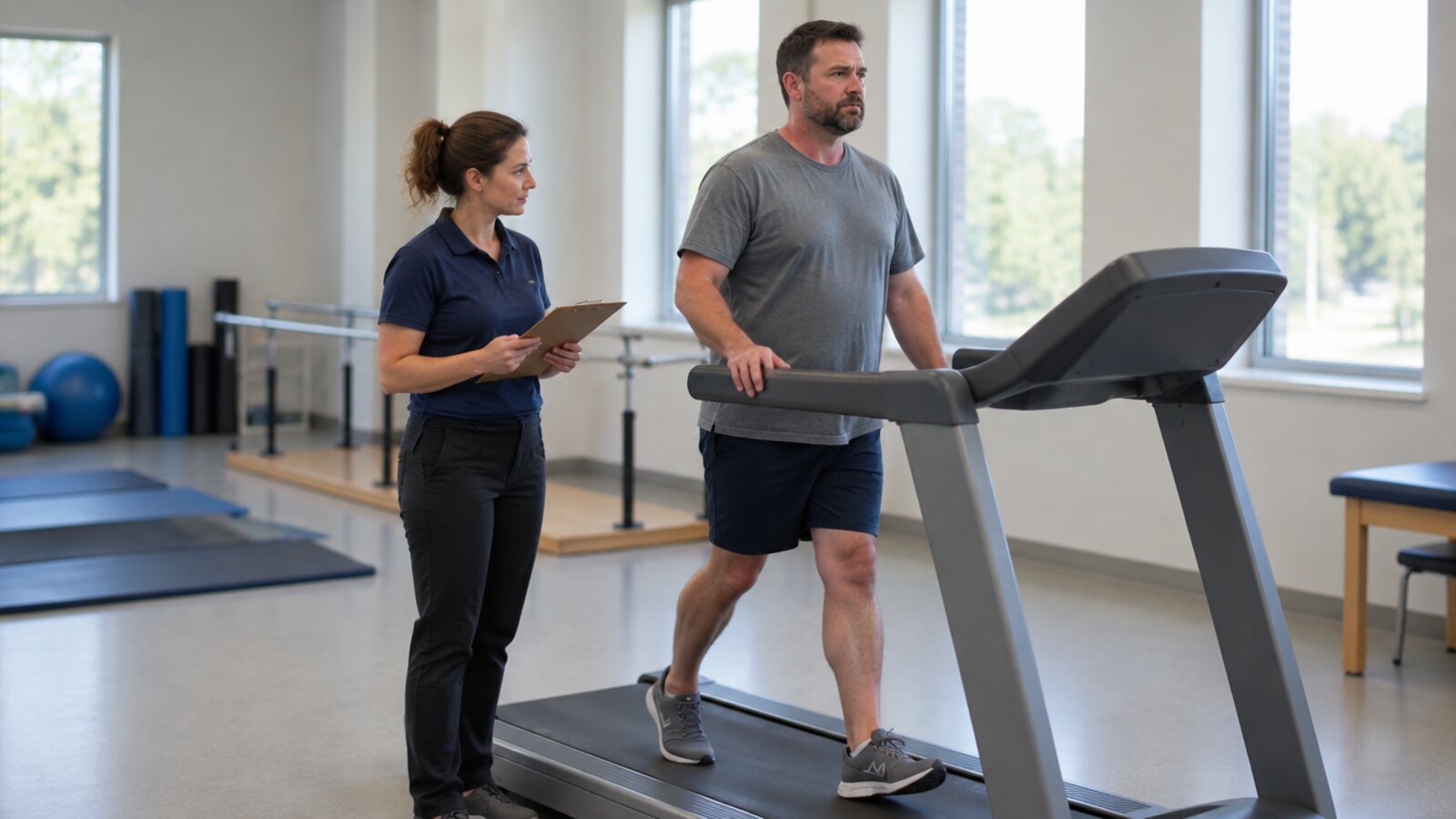
The story below is a composite of real experiences; details changed.
Week 13. Marcus finishes his single-leg squats, and his PT writes something on the clipboard.
“If your numbers hold, we’ll try a jog on the treadmill next week.”
Marcus is 38, a union carpenter on commercial jobs, three months out from ACL surgery. He’s on light duty, running cut lists from a folding table.
His first thought isn’t the treadmill. It’s the ladder by the stairwell.
“So if I can jog, can I climb?”
His PT shakes her head. “Different test.”
Here’s when the first jog usually comes, what clinics check before they clear it, what a first run-walk looks like, and what it does and doesn’t tell you about ladders, step-downs and uneven ground.
When the first jog usually comes
Patient guides cluster around month 3. New Zealand’s ACL registry says jogging comes after 3 months, “in general terms.” (New Zealand ACL Registry)
One NHS physical therapy team has you working toward a slow treadmill jog by the end of its 6-week-to-3-month stage. Starting to jog is an aim of its next stage, 3 to 6 months. Its rule: don’t move on until your outpatient physical therapist says so. (University Hospitals Sussex, 2025)
One US hospital’s protocol puts its return-to-running program in a phase that runs 3 to 5 months after surgery. (Mass General Brigham, 2024)
The research says the same. A 2018 scoping review looked at 201 studies of adults with grafts from their own tissue. The median time programs allowed running was 12 weeks. The range ran from 5 to 39 weeks. Studies of only patients over 40 were left out. (British Journal of Sports Medicine, 2018)
A 2023 sports medicine guideline noted that 12 weeks was the proposed minimum, but some studies suggested 8 or 16. It found no conclusive results on whether running at or before 12 weeks is safe. (British Journal of Sports Medicine, 2023)
Month 3 is when the jog comes up. It’s a time to ask, not a green light.
What clinics check before they clear it
Most programs go by the calendar. In that 2018 review, fewer than 1 in 5 studies named any clinical, strength or performance test for running. The most common checks were knee bend, swelling and pain. (British Journal of Sports Medicine, 2018)
The 2023 guideline’s panel went further. Its authors said they had no research findings to lean on, but felt a test list was warranted. Before running, it suggests:
- A knee that straightens fully, and bends at least 95% as far as your other one.
- No swelling, or only a trace.
- Quad strength over 80% of your other leg.
- Over 80% even between legs in the force of the dip of a two-footed jump.
- Pain-free jogging in a pool or on an anti-gravity treadmill.
- Pain-free repeated small hops on the operated leg.
Twenty-nine reviewers, mostly physical therapists and surgeons, rated those criteria. Average agreement was 87.8%. (British Journal of Sports Medicine, 2023)
Before its running phase, the Mass General Brigham protocol asks for quad strength over 80% of your other leg, and hamstring and glute strength of at least 80%. To leave the phase before running, it also asks for no episodes of the knee giving way and 10 single-leg squats with good form. (Mass General Brigham, 2024)
Your graft can change the quad number. In a records study of 125 patients, quad strength was more even between legs with a hamstring graft than with a kneecap-tendon or quad-tendon graft. (International Journal of Sports Physical Therapy, 2022)
Quad stuck below the line? Read why a quad won’t fire after knee surgery.
The calendar tells you when to ask. Your knee’s numbers tell your PT whether to say yes.
The evidence, without the theater
What the research shows
- Across 201 studies, programs most often allowed the first run around 12 weeks, with a range of 5 to 39. (British Journal of Sports Medicine, 2018)
- A 2023 guideline panel agreed on a test list for starting to run: full motion, little or no swelling, and quad strength over 80% of the other leg, among others. (British Journal of Sports Medicine, 2023)
What it doesn’t show
- Which tests make running safe. The 2023 guideline says it had no research findings to base its criteria on. The 2018 review says it’s unclear whether any of them relate to a safe return to running.
- Whether running at or before 12 weeks is safe. No conclusive results either way.
- Anything about tradesmen. We found no study of running criteria in workers, and the 2018 review left out studies of only patients over 40.
- Whether passing a jog means you’re ready for ladders. We found no study that tested it.
What a first run-walk looks like

A first run is mostly walking. Here’s week 1 of the Mass General Brigham return-to-running program:
- Walk 15 minutes to warm up.
- Walk 5 minutes, jog 1 minute. Do that 5 times.
- Walk 10 minutes to cool down.
Later in week 1, it shifts to walk 4, jog 2. By week 3 it reaches walk 1, jog 5, before moving to continuous runs. It says to progress only if there’s no pain or swelling during or after the run.
It also says to run on softer surfaces early, do non-impact work on off days, add distance before pace, and raise weekly mileage by no more than 10%. (Mass General Brigham, 2024)
A 2023 review in Aspetar’s sports medicine journal gives a back-off rule. If pain goes up during or after a run, or swelling is more than a trace, stop running for 2 days. Cross-train, like a stationary bike. Then restart one step back. Its author has runners check swelling with a swipe test. Ask your PT to show you. (Aspetar Sports Medicine Journal, 2023)
Your first-week run-walk check
Run it past your PT before your first session.
A practical structure, not a tested protocol. The intervals, pain cutoff and back-off rule come from the sources cited. The limp rule and the next-morning check are ours.
- Before: get the OK from your PT, and ask which tests you passed. Use a treadmill or flat, soft ground. Plan the bike or pool for your off days.
- During: keep pain at 2 out of 10 or lower while you run. (Aspetar Sports Medicine Journal, 2023) Stop the jog part if you start to limp.
- The next-morning rule: before work, check three things against the morning before. Swelling (the swipe test). Pain. How the stairs feel.
- All the same? Run the next session as written.
- Any of them worse? Two days off running, cross-train, then restart one step back. (Aspetar Sports Medicine Journal, 2023)
- Change one thing at a time: more time, or more speed, never both. (Mass General Brigham, 2024)
Log each session:
- The date, and the walk and jog minutes.
- Pain during, out of 10.
- Swelling, pain and stairs the next morning: same or worse.
Bring the log to PT. It shows your trend, not just how one day felt. More on that in what counts as progress.
What the jog tells you about work
A run-walk is a straight-line test. If pain and swelling don’t go up, your knee handled that load. That’s real progress.
But Marcus’s job asks other questions. Here’s our read of what each task needs. It’s not from a study.
| On the job | What it asks of the knee | Does a jog test it? |
|---|---|---|
| Climbing a ladder | Single-leg strength, control on a narrow rung | Not really. Single-leg squats come closer. |
| Stepping down off a tailgate or slab edge | Absorbing a landing on one leg | No. Landing and hop tests come closer. |
| Uneven ground with a load | Balance and quick corrections | No. A jog is on flat ground. |
| Pivoting to set a sheet or turn on a rung | Twisting with the foot planted | No. |
The guides treat them as separate tracks too. New Zealand’s registry lists carrying loads on uneven ground and climbing ladders at 2 to 3 months, before jogging at 3. With very heavy duties, or work that needs agility on uneven ground, full duty may take 4 months or more. (New Zealand ACL Registry)
Twisting comes later. One NHS leaflet says to avoid twisting and kneeling for the first 4 to 6 months. The registry says a full return to pivoting sports usually takes at least 9 months. (West Suffolk NHS, 2024; New Zealand ACL Registry)
In the Mass General Brigham protocol, the run program sits inside a phase you leave only after hop tests at 90% or more of your other leg. In that protocol, the jog comes first, the hop tests after. (Mass General Brigham, 2024)
Planning the rest of the climb? See going back to physical work after ACL surgery. And if the jog feels fine but the ladder still scares you, read you used to trust your body.
A good jog says your knee can take straight-line impact. Ask your PT which test stands for each job you do.
What should make you call early
Pain or swelling that creeps up after a run means back off, using the rule above. These signs are different. Don’t wait for your next visit.
When not to wait
Call your surgeon’s office right away for any of these. If you can’t reach them, go to urgent care or the ER.
- A loud pop or popping feeling, then the knee gives out, swells fast or loses motion: signs of an ACL injury.
- A knee that locks, gives way, clicks painfully, or can’t take your weight.
- A knee that is badly swollen or has changed shape.
- A temperature higher than 101°F (38.3°C).
- A fever or chills with redness or heat around the knee.
- Pain or swelling in one calf or thigh, or red or darkened skin over the sore area. A clot can show up weeks after surgery. With chest pain or shortness of breath, call 911.
- Toes that look darker than normal or feel cool.
- Redness, pain, swelling or yellowish discharge at an incision.
Felt a pop on a run? Read the signs you retore your knee.
Sources: MedlinePlus; NHS on DVT and knee pain; Mayo Clinic.
Walk five, jog one
The next Thursday, Marcus steps onto the treadmill. Walk 5, jog 1. The first jog minute feels clumsy, like his legs forgot the beat.
By the fifth round, it feels like running.
The next morning, he checks before work. Swelling the same. Pain the same. Stairs the same. He writes it down.
The foreman texts: “Heard you’re running. Ladders next week?”
Marcus types back: “Jogging a minute at a time. Ladders get their own test. Asking my PT which one on Thursday.”
“Copy that,” comes the reply.
Your next step: at your next PT visit, ask, “Which test clears me to jog, and which test stands for ladders?”
Marcus is a composite, drawn from the kinds of stories tradespeople describe after ACL surgery. The details are illustrative.
Free · Your Before-You-Leave Card
Don’t leave your next appointment with “rest it.”
Get the questions for your injury in 8 taps.
Get my card →Questions readers ask
- When can you start running after ACL surgery?
- Patient guides cluster around month 3. New Zealand’s ACL registry says jogging comes after 3 months in general terms, and one NHS physical therapy team lists starting to jog as an aim of its 3-to-6-month stage. A 2018 scoping review of 201 studies found a median of 12 weeks, with a range of 5 to 39 weeks. A 2023 guideline found no conclusive results on whether running at or before 12 weeks is safe. Your surgeon and PT decide your date.
- What tests do you need to pass before running after ACL surgery?
- It varies by clinic, and fewer than 1 in 5 studies in a 2018 review named any test beyond time. A 2023 sports medicine guideline suggested full knee straightening, at least 95% of the other knee’s bend, no swelling or only a trace, quad strength over 80% of the other leg, and pain-free hopping, while saying it had no research findings to base its criteria on. One US hospital protocol asks for quad strength over 80% of the other leg, and hamstring and glute strength of at least 80%, before its running phase.
- If I can jog after ACL surgery, can I climb ladders at work?
- Not necessarily. A jog is straight-line running on flat ground. Ladders, step-downs, uneven ground and pivoting ask for single-leg control, landing and twisting. New Zealand’s ACL registry lists ladders and loads on uneven ground at 2 to 3 months and jogging at 3, so the guides treat them as separate. We found no study that tested whether passing a jog means you’re ready for ladders. Ask your PT which test stands for each task you do.
Sources & references (12)
- Criteria for return to running after anterior cruciate ligament reconstruction: a scoping review · British Journal of Sports Medicine, 2018
- Aspetar clinical practice guideline on rehabilitation after anterior cruciate ligament reconstruction · British Journal of Sports Medicine, 2023
- The latest guidance on return to run after ACL reconstruction · Aspetar Sports Medicine Journal, 2023
- Rehabilitation Protocol for ACL Reconstruction · Mass General Brigham Sports Medicine, 2024
- Patients · New Zealand ACL Registry
- Physiotherapy advice after your anterior cruciate ligament (ACL) reconstruction · University Hospitals Sussex NHS Foundation Trust, 2025
- Advice to patients undergoing anterior cruciate ligament (ACL) reconstruction surgery · West Suffolk NHS Foundation Trust, 2024
- Quadriceps Strength following Anterior Cruciate Ligament Reconstruction: Normative Values based on Sex, Graft Type and Meniscal Status at 3, 6 & 9 Months · International Journal of Sports Physical Therapy, 2022
- ACL reconstruction: discharge · MedlinePlus, 2024
- Deep vein thrombosis (DVT) · NHS
- Knee pain · NHS
- ACL injury: symptoms and causes · Mayo Clinic
The Series
45 articlesPart 1: Understanding Your Injury (1 to 19)
- After the MRI: How to Read a Rotator Cuff Report Without Getting Sold a Surgery
- Told to “Just Rest It”? Five Questions to Ask Before You Leave
- When Shoulder Pain Keeps Waking You Up
- Meniscus Surgery Recovery: When Can You Return to Your Kind of Work?
- Rotator Cuff Surgery or More Physical Therapy? Questions That Clarify the Decision
- Achilles Tendon Pain: Why This Tendon Is a Different Problem
- Four Months After Rotator Cuff Repair and It Still Hurts: Normal, or a Retear?
- Your Knee Feels Worse After the Meniscus Scope. What Could Be Going On?
- Hip Flexor Pain After Hip Arthroscopy: Why It Shows Up and When It Settles
- Tennis Elbow That Won’t Go Away: Why Rest and Shots Stall, and What Helps
- Knee Swelling After Meniscus Surgery: How Long Is Normal, and When to Call
- Quad Won’t Fire After Knee Surgery? What Quad Shutdown Is and How to Get It Back
- Walking After Meniscus Surgery: When You Can, How Far, and When to Drop the Crutches
- How to Sleep After Rotator Cuff Surgery, and When Nights Get Easier
- Felt a Pop After Knee Surgery? Re-Tear or Setback, and When to Call
- Home After a Microdiscectomy: How Much to Walk and How Long to Sit
- Running After ACL Surgery: When Your First Jog Comes, and What It Tells You About Work
- When Can You Drive After Rotator Cuff Surgery and Get Back in the Work Truck?
- Knee Won’t Straighten After Meniscus Surgery? Why It Happens and What Helps
Part 2: Work and Real Life (20 to 29)
- You Can Still Work. But What Is Your Injury Costing You?
- Self-Employed and Injured: How to Plan for Time Away From Work
- Your Job and Your Workouts Are Loading the Same Injury
- How to Take Time to Recover When Everyone Depends on You
- What Do You Still Want to Be Able to Do in Ten Years?
- Microdiscectomy Recovery: When Can You Go Back to Heavy Work?
- Kneeling After Knee Surgery: Why It Comes Back Last and How to Retrain It
- Rotator Cuff Surgery Recovery: When Can You Go Back to Work?
- When Can You Drive After Knee Surgery and Get Back in the Work Van?
- When Can You Go Back to Physical Work After ACL Surgery?
Part 3: Back to Training (30 to 34)
Part 4: Reading the Evidence (35 to 45)
- Your Watch Says You’re Recovered. Your Shoulder Disagrees.
- Recovery Is Taking Longer Than You Expected. What Counts as Progress?
- Before You Buy Another Recovery Tool, Decide What You Need It to Do
- “It Worked for Me”: How to Evaluate a Recovery Claim
- BPC-157 After an Orthopedic Procedure: What Does the Research Actually Show?
- TB-500 vs. BPC-157: What the Research Actually Compares
- How to Read a Peptide COA: What It Proves and What It Doesn’t
- The Research Stack People Ask About After a Scope, and the Gaps in the Human Data
- What the Tendon Research on BPC-157 Actually Measured
- What’s in the Other 1%? Peptide Impurities, Explained
- Approved, Compounded or “Research Use Only”: What a Peptide’s Label Means in 2026
Free · 60-second recovery check
What’s really holding your recovery back?
Eight quick taps. Find the one thing stalling your recovery, then get the three moves to work on first, picked from 30 guides and 100+ cited sources.
- Your bottleneck, named in 60 seconds
- 3 moves for this week, fitted to your job
- Your Before-You-Leave Card: the questions for your next appointment
What got hurt?
Free. No sign-up to start. Not medical advice.
Keep reading
Knee Won’t Straighten After Meniscus Surgery? Why It Happens and What Helps
Three weeks out, the other knee lies flat and yours won’t. Why a knee stays bent after a meniscus trim or repair, when protocols expect it straight, what rehab teams use to get it back, and the signs that mean call to…
When Can You Drive After Rotator Cuff Surgery and Get Back in the Work Truck?
Dispatch wants you back on the road, and your arm is still strapped to your belly. What the sling means for driving after a rotator cuff repair, what the few driving studies found, and a check to run before your first…
Home After a Microdiscectomy: How Much to Walk and How Long to Sit
The leg pain is nearly gone, the back aches, and every twinge feels like you undid the surgery. How much to walk and sit in the first six weeks, which aches are normal, and a ladder to start tomorrow.