Tennis Elbow That Won’t Go Away: Why Rest and Shots Stall, and What Helps
Rest calmed it, the shot bought a few good weeks, and it’s back. What the trials show about cortisone, exercise, straps, PRP and surgery for stubborn tennis elbow, and how to keep working while it settles.
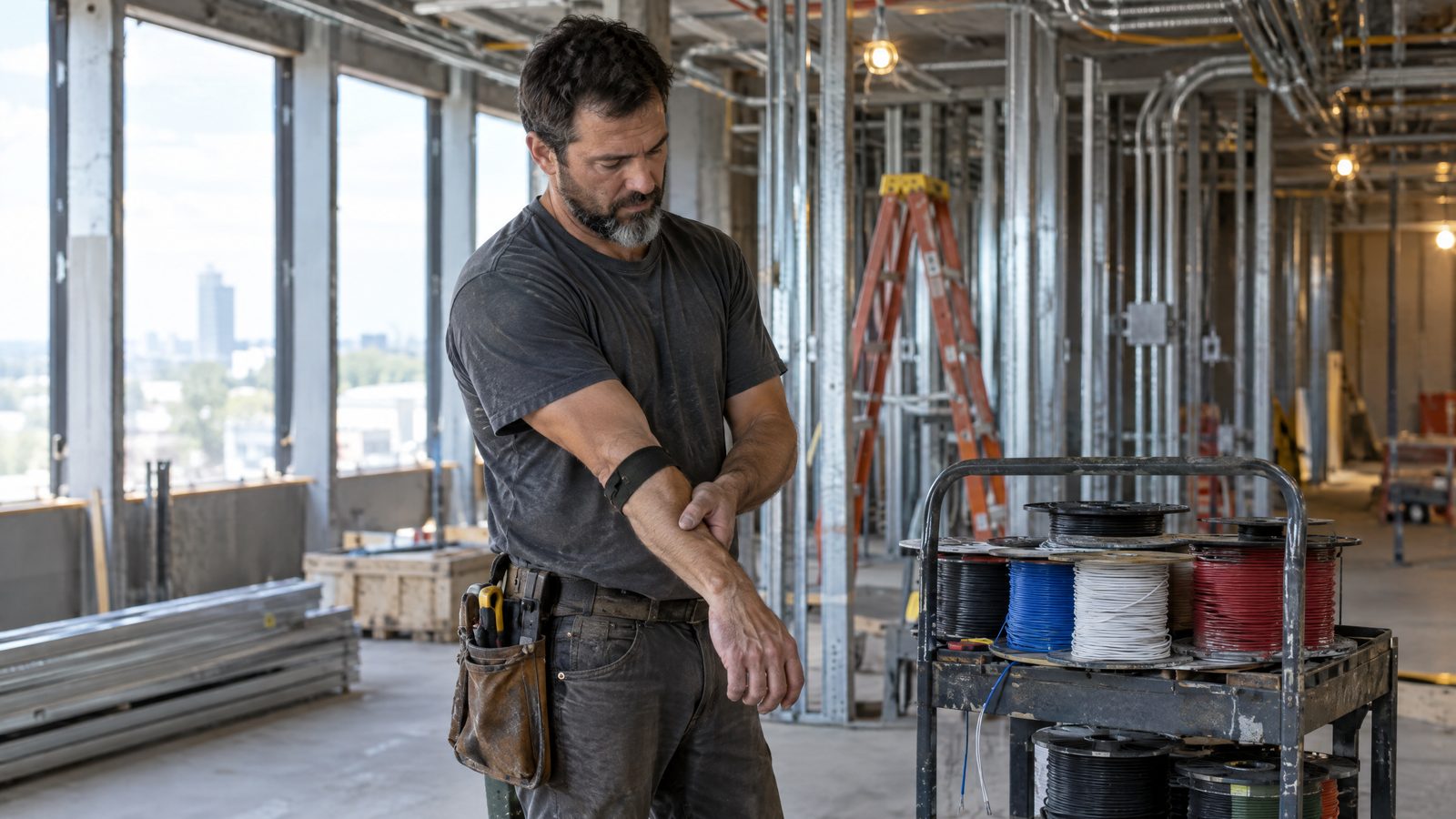
The story below is a composite of real experiences; details changed.
Marco can wire a whole floor. Lately, a coffee mug beats him.
He’s 44, a commercial electrician. He pulls wire, twists wire nuts and drives screws overhead from 6:30 until the gang box gets locked.
Seven months ago, the outside of his right elbow started to burn. Now it flares when he squeezes his lineman’s pliers or shakes the foreman’s hand. Rows at the gym light it up too.
Two weeks off over the holidays calmed it. The first Monday back undid it. A cortisone shot in month four bought five good weeks. Then it came back worse.
If that’s your elbow, you did what you were told. It came back anyway.
Here’s why that often stalls, what the trials found, and how to keep working while the tendon catches up.
Why it hangs on when your hands are your living
Tennis elbow is pain at the bony bump on the outside of your elbow. That’s where the forearm muscles that extend your wrist and fingers attach. You may also hear lateral epicondylitis or lateral elbow tendinopathy.
Most people who get it are 30 to 50. Painters, plumbers and carpenters are particularly prone. (AAOS OrthoInfo)
A 2022 physical therapy guideline reports rates as high as 29% in some hand-heavy jobs. That’s nearly one in three workers, at the top of the reported range. (JOSPT clinical guideline)
Its risk list reads like a job description: heavy tools and loads, hours of repeated wrist and elbow bending, and twisting or screwing.
Rest lowers the irritation, so time off feels like progress. But it doesn’t build the tendon up. And Monday asks for the same grips all day.
If you lift too, here’s why your job and your workouts are loading the same injury.
Time off calms it. It doesn’t get it ready for Monday.
What the shot actually buys you
Cortisone works fast. Three trials tracked what happens over a year.
| Trial | Early on | At one year |
|---|---|---|
| Lancet, 2002 (185 people) | Success at 6 weeks: shot 92% (9 in 10), PT 47% (about half), wait-and-see 32% (1 in 3) | Shot 69% (7 in 10), PT 91% (9 in 10), wait-and-see 83% (about 8 in 10) |
| BMJ, 2006 (198 people) | The shot was best at 6 weeks | 47 of the 65 people given the shot slid back: about 7 in 10. The shot did worse than PT |
| JAMA, 2013 (165 people) | PT plus a placebo shot: 39% (about 4 in 10) recovered or much better at 4 weeks, vs 10% (1 in 10) with the placebo shot alone | Recovered or much better: real shot 83% (about 8 in 10), placebo shot 96% (nearly all). Symptoms came back: 54% (over half) vs 12% (about 1 in 8) |
Sources: The Lancet; BMJ; JAMA.
In plain terms, the shot won the first six weeks. By one year, it trailed PT or a placebo shot in all three trials, each under 200 people.
AAOS says steroid shots “should be used very sparingly” for tennis elbow. Excessive use can weaken the bony bump the tendon anchors to. (AAOS OrthoInfo)
A shot can buy a few good weeks. In these trials, people paid for them at the one-year mark.
Waiting it out vs. doing the work
Time helps most people. In the 2002 trial, about 8 in 10 (83%) of the wait-and-see group were a success at one year. An NHS leaflet says symptoms clear within a year in nine of ten cases. (Newcastle Hospitals NHS)
But at 6 to 12 months, 20% to 38% aren’t fully clear or have relapsed, the 2022 guideline says. That’s one in five to nearly two in five, across studies. (JOSPT)
PT gets people better sooner, but the gap closes. In the 2006 and 2013 trials, PT and no PT were about level at one year. (BMJ; JAMA)
A 2021 review of 30 trials found exercise beat passive treatments, but “the effect is small.” It also beat steroid shots on nearly every measure except short-term pain, on low-certainty evidence. (British Journal of Sports Medicine)
The guideline backs isometric, concentric and/or eccentric wrist-extensor exercises. That means holds, lifts and slow lowers. It doesn’t crown one type. (JOSPT)
Weeks of exercises and nothing moving? Read why tendons plateau.
Exercise isn’t magic. It’s the option that doesn’t borrow against next year.
The evidence, without the theater
What the research shows
- Steroid shots work best early, but were linked to worse one-year results and more relapses.
- Most people are recovered or much better within a year, even with wait-and-see.
- Exercise speeds early recovery and beats passive treatments by a small margin.
What it doesn’t show
- Which exercise type works best.
- That PRP beats a placebo shot.
- Who will still be hurting at a year.
Straps, PRP and surgery: where they fit
- The strap. The guideline says a forearm strap or wrist brace may be worn during activity for quick relief. For the long run, the evidence conflicts. (JOSPT)
- PRP. Platelet-rich plasma comes from your own blood. AAOS says some studies look promising and others are inconclusive. A 2021 Cochrane review of 32 trials found it probably gives little or no meaningful benefit over a placebo shot. (AAOS OrthoInfo; Cochrane)
- Surgery. About 80% to 95% of people do well without it: at least 8 in 10. It usually comes up only after 6 to 12 months of nonsurgical care. (AAOS OrthoInfo)
A 2018 trial tested surgery against a sham. Twenty-six people with stubborn tennis elbow got either the real operation or an incision with the tendon left alone.
Both groups improved. There was no significant difference at any point, up to two and a half years. (American Journal of Sports Medicine)
The trial was small and stopped early, so it can’t rule out a small benefit.
Each has its moment. None replaces loading the tendon.
How to keep working without feeding it
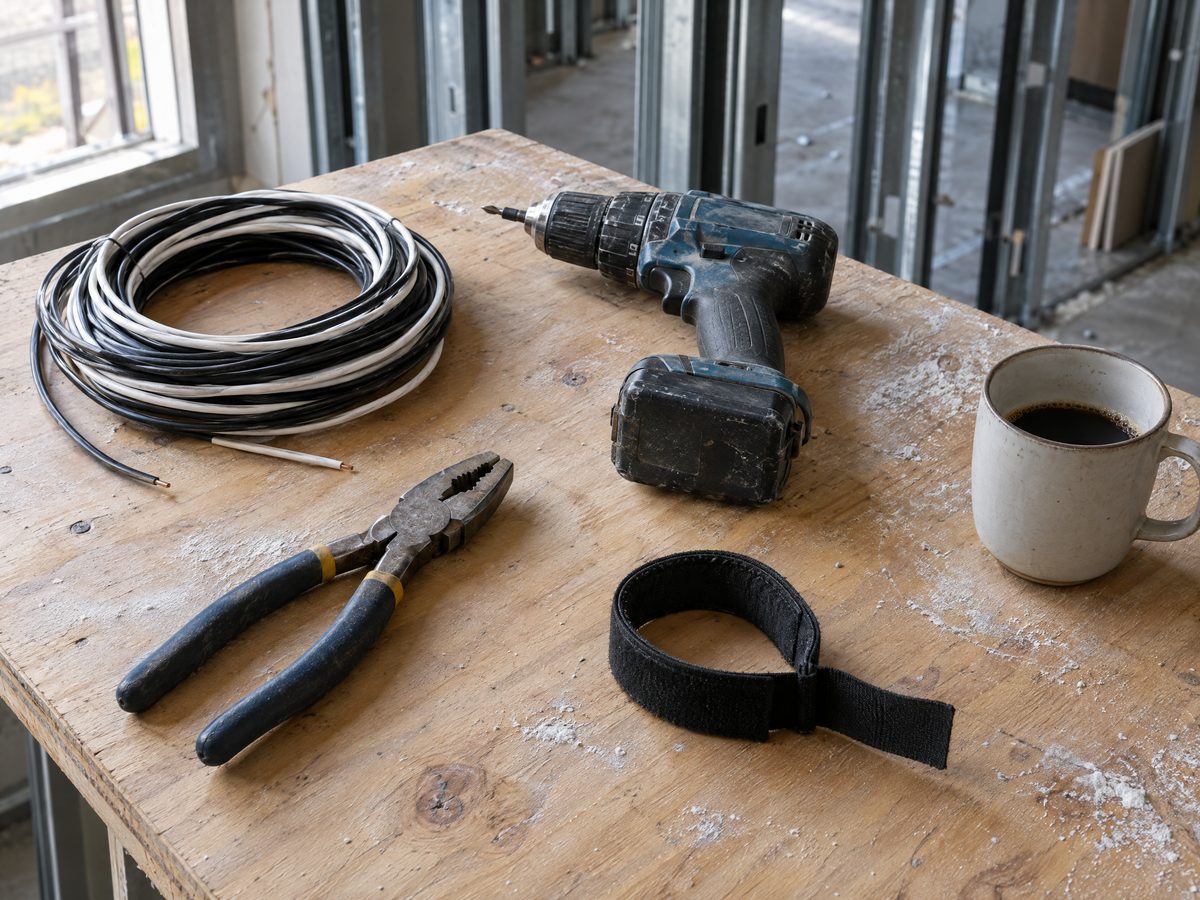
The goal is fewer hard grips and less force in each one.
- Palms up. Lift with your palms facing up, like carrying a tray, to ease strain on the wrist muscles. (Newcastle Hospitals NHS)
- Lighter tools, bigger handles. The same leaflet suggests lightweight tools with a larger grip, regular breaks from repetitive tasks and, if needed, lighter duties for a while.
- Fewer twists. Where a powered tool can take over a long run of hand twisting, let it.
- Strap for the hard part. Save it for the tasks that set the elbow off.
You don’t have to stop working. You have to stop paying full price for every grip.
A two-minute check, once a week
The weekly elbow check
Same day, same way, every week:
- Mug test: Lift a full coffee mug, arm straight, palm down. Rate the pain from 0 to 10.
- Squeeze test: Squeeze a rolled towel until it starts to hurt. Rate how hard you squeezed, 0 to 10. It’s a rough version of the trials’ pain-free grip test.
- Work test: Rate your hardest task of the week, 0 to 10.
- Next morning: Was it worse after your heaviest day? Did it wake you at night?
Read three or four weeks together, not one bad Tuesday. Here’s more on what counts as progress.
Your numbers, not your worst day, tell you whether the plan is working.
What to ask at your next appointment
- Are you sure it’s the tendon, and not a pinched nerve in my neck or forearm? The guideline lists both as look-alikes.
- If you’re offering a shot, what do the one-year results mean for me?
- Can I start a progressive exercise plan with a PT, and how will we measure it?
- What should I change at work, and for how long?
“Rest it” isn’t a plan. Leave with exercises, a work change and a way to measure both.
When not to wait
Go to urgent care or the ER if (NHS):
- You hurt your arm and heard a snap, or it changed shape.
- The pain is severe and the arm is hard to move.
- Your arm tingles or feels numb.
Get seen the same day if:
- Your arm is swollen and you have a very high temperature, or feel hot, cold or shivery.
- It hurts when you exert yourself and eases when you rest.
Call 911 if arm pain comes on suddenly with pressure, heaviness or squeezing across your chest.
What changes for Marco
Marco holds off on a second shot and books a physical therapist. On site, he carries conduit palms up and lets the driver handle long runs of screws.
His first mug test is a 6. Six weeks later, it’s a 3. He still feels it after a long day. But the mug is losing, and he has the numbers to prove it.
Your next step: pick a day this week, run the two-minute check and write the numbers down.
Marco is a composite, drawn from the kinds of stories tradesmen and lifters describe with tennis elbow that won’t settle. The details are illustrative. Nothing here is medical advice.
Free · Your Before-You-Leave Card
Don’t leave your next appointment with “rest it.”
Get the questions for your injury in 8 taps.
Get my card →Questions readers ask
- Why won’t my tennis elbow go away?
- Rest lowers the irritation, but it doesn’t build the tendon up, and hand-heavy work loads it again every day. Most people are recovered or much better within a year, but a 2022 physical therapy guideline cites 20% to 38% whose symptoms haven’t fully cleared, or have come back, at 6 to 12 months. The guideline backs progressive resisted exercise for the wrist extensors.
- Does a cortisone shot help tennis elbow?
- Often in the short term: in trials, shots worked best at about six weeks. But in a 2013 JAMA trial, people given a steroid shot were less likely to be recovered or much better at one year than those given a placebo shot (83% vs 96%), and symptoms came back in 54% vs 12%. AAOS says steroid shots should be used very sparingly for tennis elbow.
- When is surgery considered for tennis elbow?
- AAOS says 80% to 95% of people do well without surgery, and it usually comes up only after 6 to 12 months of nonsurgical care hasn’t worked. In a small 2018 trial, the operation did no better than a sham operation, though the trial was too small to rule out a small benefit.
Sources & references (10)
- Effect of corticosteroid injection, physiotherapy, or both on clinical outcomes in patients with unilateral lateral epicondylalgia: a randomized controlled trial · JAMA, 2013
- Mobilisation with movement and exercise, corticosteroid injection, or wait and see for tennis elbow: randomised trial · BMJ, 2006
- Corticosteroid injections, physiotherapy, or a wait-and-see policy for lateral epicondylitis: a randomised controlled trial · The Lancet, 2002
- Exercise interventions in lateral elbow tendinopathy have better outcomes than passive interventions, but the effects are small: a systematic review and meta-analysis of 2123 subjects in 30 trials · British Journal of Sports Medicine, 2021
- Lateral Elbow Pain and Muscle Function Impairments: Clinical Practice Guidelines Linked to the International Classification of Functioning, Disability and Health from the Academy of Hand and Upper Extremity Physical Therapy and the Academy of Orthopaedic Physical Therapy of the American Physical Therapy Association · Journal of Orthopaedic & Sports Physical Therapy, 2022
- Autologous blood and platelet-rich plasma injection therapy for lateral elbow pain · Cochrane Database of Systematic Reviews, 2021
- Surgical Treatment of Lateral Epicondylitis: A Prospective, Randomized, Double-Blinded, Placebo-Controlled Clinical Trial · The American Journal of Sports Medicine, 2018
- Tennis Elbow (Lateral Epicondylitis) · AAOS OrthoInfo
- Tennis Elbow (Occupational Health Service leaflet) · Newcastle upon Tyne Hospitals NHS Foundation Trust
- Elbow and arm pain · NHS
The Series
45 articlesPart 1: Understanding Your Injury (1 to 19)
- After the MRI: How to Read a Rotator Cuff Report Without Getting Sold a Surgery
- Told to “Just Rest It”? Five Questions to Ask Before You Leave
- When Shoulder Pain Keeps Waking You Up
- Meniscus Surgery Recovery: When Can You Return to Your Kind of Work?
- Rotator Cuff Surgery or More Physical Therapy? Questions That Clarify the Decision
- Achilles Tendon Pain: Why This Tendon Is a Different Problem
- Four Months After Rotator Cuff Repair and It Still Hurts: Normal, or a Retear?
- Your Knee Feels Worse After the Meniscus Scope. What Could Be Going On?
- Hip Flexor Pain After Hip Arthroscopy: Why It Shows Up and When It Settles
- Tennis Elbow That Won’t Go Away: Why Rest and Shots Stall, and What Helps
- Knee Swelling After Meniscus Surgery: How Long Is Normal, and When to Call
- Quad Won’t Fire After Knee Surgery? What Quad Shutdown Is and How to Get It Back
- Walking After Meniscus Surgery: When You Can, How Far, and When to Drop the Crutches
- How to Sleep After Rotator Cuff Surgery, and When Nights Get Easier
- Felt a Pop After Knee Surgery? Re-Tear or Setback, and When to Call
- Home After a Microdiscectomy: How Much to Walk and How Long to Sit
- Running After ACL Surgery: When Your First Jog Comes, and What It Tells You About Work
- When Can You Drive After Rotator Cuff Surgery and Get Back in the Work Truck?
- Knee Won’t Straighten After Meniscus Surgery? Why It Happens and What Helps
Part 2: Work and Real Life (20 to 29)
- You Can Still Work. But What Is Your Injury Costing You?
- Self-Employed and Injured: How to Plan for Time Away From Work
- Your Job and Your Workouts Are Loading the Same Injury
- How to Take Time to Recover When Everyone Depends on You
- What Do You Still Want to Be Able to Do in Ten Years?
- Microdiscectomy Recovery: When Can You Go Back to Heavy Work?
- Kneeling After Knee Surgery: Why It Comes Back Last and How to Retrain It
- Rotator Cuff Surgery Recovery: When Can You Go Back to Work?
- When Can You Drive After Knee Surgery and Get Back in the Work Van?
- When Can You Go Back to Physical Work After ACL Surgery?
Part 3: Back to Training (30 to 34)
Part 4: Reading the Evidence (35 to 45)
- Your Watch Says You’re Recovered. Your Shoulder Disagrees.
- Recovery Is Taking Longer Than You Expected. What Counts as Progress?
- Before You Buy Another Recovery Tool, Decide What You Need It to Do
- “It Worked for Me”: How to Evaluate a Recovery Claim
- BPC-157 After an Orthopedic Procedure: What Does the Research Actually Show?
- TB-500 vs. BPC-157: What the Research Actually Compares
- How to Read a Peptide COA: What It Proves and What It Doesn’t
- The Research Stack People Ask About After a Scope, and the Gaps in the Human Data
- What the Tendon Research on BPC-157 Actually Measured
- What’s in the Other 1%? Peptide Impurities, Explained
- Approved, Compounded or “Research Use Only”: What a Peptide’s Label Means in 2026
Free · 60-second recovery check
What’s really holding your recovery back?
Eight quick taps. Find the one thing stalling your recovery, then get the three moves to work on first, picked from 30 guides and 100+ cited sources.
- Your bottleneck, named in 60 seconds
- 3 moves for this week, fitted to your job
- Your Before-You-Leave Card: the questions for your next appointment
What got hurt?
Free. No sign-up to start. Not medical advice.
Keep reading
Knee Won’t Straighten After Meniscus Surgery? Why It Happens and What Helps
Three weeks out, the other knee lies flat and yours won’t. Why a knee stays bent after a meniscus trim or repair, when protocols expect it straight, what rehab teams use to get it back, and the signs that mean call to…
When Can You Drive After Rotator Cuff Surgery and Get Back in the Work Truck?
Dispatch wants you back on the road, and your arm is still strapped to your belly. What the sling means for driving after a rotator cuff repair, what the few driving studies found, and a check to run before your first…
Running After ACL Surgery: When Your First Jog Comes, and What It Tells You About Work
Your PT says you can try a jog. You’re wondering if ladders are next. When the first run usually comes after ACL reconstruction, what clinics test first, what a first run-walk looks like, and what it does and doesn’t …