What’s in the Other 1%? Peptide Impurities, Explained
The badge says “99% pure.” That’s one number from one test. What else is in a synthetic peptide, why regulators flag it, and what a complete certificate of analysis should list.
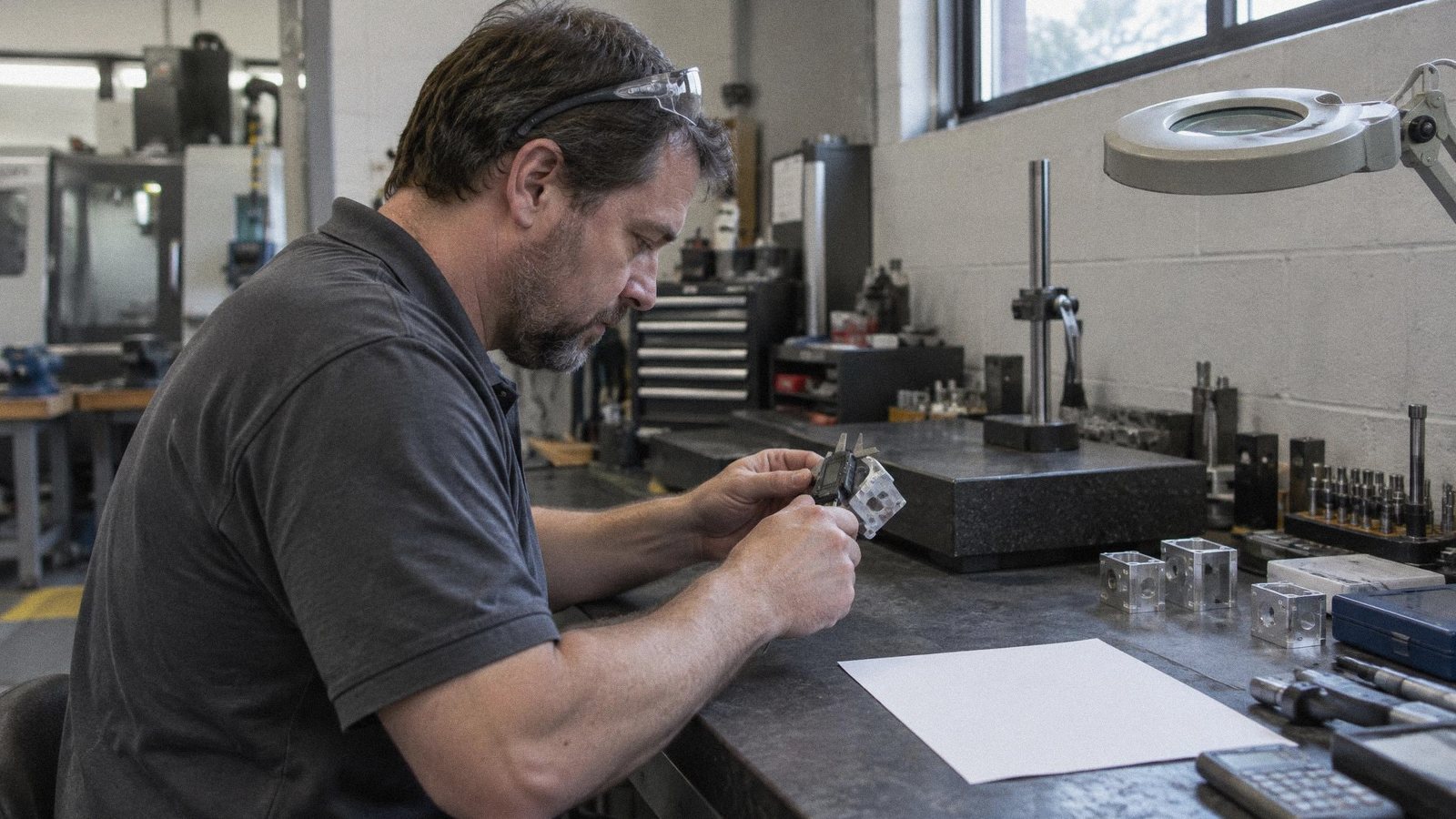
The story below is a composite of real experiences; details changed.
Owen Hart, 41, spends his workday with calipers in his hand. He runs quality control at a machine shop. No part leaves his bench until he’s measured it.
For the last year, he’s spent his evenings reading peptide research. Every supplier site shows him the same badge: 99% pure.
To Owen, a number without a spec sheet is a sales pitch. In his shop, a part nobody can check doesn’t ship.
So he asks what he’d ask about any part: What’s in the other 1%, and how would I know?
Good question. Here’s what’s in the other 1%, why “99% pure” can still mean 90% peptide, and what a complete certificate of analysis (COA) should list.
How a peptide is built, and where errors creep in
Most synthetic peptides are built one amino acid at a time on a resin, then cut free and purified using an acid called TFA. (Pharmaceuticals, 2020) Every step can misfire:
- A failed step leaves a chain missing an amino acid. Too much reagent can add an extra one.
- Some amino acids flip into their mirror-image form.
- Chemical “protecting groups” used during building can be left behind.
- After synthesis, peptides can oxidize or break down during manufacturing and storage.
- Solvents and other process chemicals can remain.
Detecting them is the hard part. FDA says these impurities “are typically similar in structure to the target peptide and may be difficult to identify and quantify without sophisticated analytical methods.” (FDA)
| Impurity | What it is | Why a basic test can miss it |
|---|---|---|
| Deletion or insertion peptides | One amino acid missing or extra | Can come off the HPLC column almost alongside the real peptide |
| Mirror-image forms | Same sequence, one amino acid flipped | Same weight, so mass spec struggles to tell them apart |
| Oxidized or broken-down forms | Chemical changes during making or storage | Can form after the batch was made |
| Aggregates | Peptide chains stuck together | Need separate methods to detect |
| TFA and other counter-ions | Salt left over from purification | Not counted in the HPLC purity number |
| Water and residual solvents | Moisture and leftover process chemicals | Measured by separate tests |
| Endotoxin | Material from the outer membrane of certain bacteria | Needs its own test, called the LAL test |
Why “99% pure” can still be 90% peptide

HPLC purity answers one question: of the peptide material, how much is the right peptide? It “does not include any water and trifluoroacetate salt.” (AltaBioscience)
How much of the powder is peptide at all is a different number, called net peptide content. One manufacturer puts the typical range at 70 to 90%.
Here’s what that gap looks like. In a 2020 study, a synthetic glucagon came with a reported purity of 983.72 mg/g. Researchers measured everything else in it and subtracted.
The real figure was 896.36 mg/g, or about 90%, not 98%. TFA made up about a tenth of the weight, and water about 5%. (Scientific Reports)
Purity tells you what kind of peptide is there. It doesn’t tell you how much. For the line-by-line version, read how to read a peptide COA.
Why impurities matter in research
A review of peptide impurities warns that they can greatly influence early lab studies, “possibly resulting in erroneous conclusions.” Two examples show how.
TFA. In bone-cell cultures, tiny amounts of TFA slowed cell growth. When peptides were tested as TFA salts, researchers either missed a real growth effect or saw a false anti-growth effect. The authors’ fix was to switch the peptide to a different salt before testing. (Am J Physiol, 1999)
TFA isn’t even consistent: in another cell type, it stimulated growth. (Pharmaceuticals)
Endotoxin. A protein once looked like it switched on an inflammation signal in immune cells. That effect turned out to be “entirely due to the contaminating LPS,” a bacterial endotoxin. (J Biol Chem, 2003)
That was a protein, not a synthetic peptide, but the lesson carries. Endotoxin is hard to remove once it’s there, and it can fake the very inflammation signals researchers measure. (FDA)
An impurity doesn’t sit quietly in the vial. It can change the answer.
What FDA flagged about popular research peptides
- On its compounding safety page, FDA says BPC-157 “may have complexities with regard to peptide-related impurities” and possible immune reactions. It notes similar concerns for TB-500 and injectable GHK-Cu, including aggregation. (FDA)
- Thin paperwork. In July 2026, FDA reviewers wrote that “most CoAs for BPC-157 (free base) only contain purity testing results.” (FDA) For TB-500, “assay, impurities, bacterial endotoxins, and aggregates are not tested or controlled.” One TB-500 certificate allowed a single impurity of up to 1.0%. (FDA)
- The medicine benchmark. For generic peptide drugs, FDA expects every impurity at 0.10% or more to be identified. It treats a new one above 0.5% as a possible immune-reaction concern. That’s a standard for medicines, not a rule for research chemicals. It shows how closely the pros look. (FDA guidance, 2021)
- Spot checks back this up. Researchers bought semaglutide from online sellers that used “research”-style disclaimers. All three vials that arrived contained endotoxin, and the peptide content ran 29% to 39% above the label. (J Med Internet Res, 2024)
For a researcher, the reason is simple: you can’t interpret a result if you don’t know what was in the vial.
The evidence, without the theater
What testing can show
- That the molecule has the expected mass.
- How much look-alike peptide and non-peptide material is present.
- Contamination such as endotoxin, if it was tested.
What it can’t show
- That a compound works, or that it’s safe in people.
- Anything about a different lot.
- How the vial was stored after testing.
What a complete COA should list
The core, on every lot
- A lot number that matches the label, a named lab and a test date.
- Identity by mass spectrometry, with the spectrum.
- HPLC purity with the chromatogram, not just a percentage.
- Net peptide content, or the measured amount per vial.
The extra mile, worth asking for in cell or immune experiments
- Endotoxin, by the LAL test.
- Counter-ion content (TFA or acetate) and water.
- Residual solvents.
- The largest single impurity, plus aggregates for peptides that clump.
- A testing lab accredited to ISO/IEC 17025, the international standard for testing labs.
Walk away if
- There’s a purity number but no chart, no lab name or no date.
- The same COA shows up for every lot.
- The name or form on the COA doesn’t match the product, such as free base versus acetate.
- Anyone suggests a COA means a product is safe or approved for people.
Owen’s spec sheet
Owen builds a sheet: one row per supplier, one column per test. Most rows have a lot of empty cells.
It’s the rule from his bench: no data, no sign-off. He isn’t looking for a badge anymore. He’s looking for data he can check.
A purity badge answers one question. A complete COA answers the rest.
Your next step: take the next COA you see and check it against the four core lines above. Mark every line it leaves blank.
Owen is a composite, drawn from the kinds of questions careful readers ask. The details are illustrative. Research compounds are sold for laboratory research only. Nothing here is medical advice or a recommendation to use any compound.
Free · Your Before-You-Leave Card
Don’t leave your next appointment with “rest it.”
Get the questions for your injury in 8 taps.
Get my card →THE RESEARCH DESK
Looking into peptides beyond the exam room? Start with these three steps.
01 · READ
Peptides Made Simple
The three-book series our readers ask about most. Plain-English background for anyone reading peptide research: Kindle and print on Amazon, or all three ebooks together.
See the books →02 · VERIFY
How to Read a Peptide COA
Quick checks that show what a lab report proves, and what it doesn’t.
Read the guide →03 · SOURCE
SCSigma Compounds
The research supplier we point to
Third-party tested. The research supplier we trust.
Disclosure: Peptides Made Simple is written by the team behind After the Scope, and we earn money when you buy it. After the Scope is an affiliate of Sigma Compounds. Sigma Compounds products are sold strictly for laboratory research use, not for human consumption. Nothing on this site is medical advice.
Questions readers ask
- What does “99% purity” mean on a peptide COA?
- It usually refers to HPLC purity: of the peptide material, how much is the target sequence rather than look-alike peptides. It does not include water or the TFA salt left from purification, so it doesn’t tell you how much of the powder is peptide.
- What is net peptide content?
- Net peptide content is the share of the powder’s weight that is actually peptide. The rest is water, counter-ions such as TFA, salts and solvents. One manufacturer puts the typical range at 70 to 90%.
- Why does endotoxin testing matter for research peptides?
- Endotoxin comes from the outer membrane of certain bacteria, is hard to remove once present, and has produced false inflammation results in lab experiments. It needs its own test, usually the LAL test, so ask whether it was run.
Sources & references (15)
- ANDAs for Certain Highly Purified Synthetic Peptide Drug Products That Refer to Listed Drugs of rDNA Origin (final guidance) · U.S. Food and Drug Administration, 2021
- FDA Briefing Document: BPC-157, Pharmacy Compounding Advisory Committee, July 23–24, 2026 · U.S. Food and Drug Administration, 2026
- FDA Briefing Document: TB-500, Pharmacy Compounding Advisory Committee, July 23–24, 2026 · U.S. Food and Drug Administration, 2026
- Certain Bulk Drug Substances for Use in Compounding that May Present Significant Safety Risks · U.S. Food and Drug Administration, 2026
- Related impurities in peptide medicines · Journal of Pharmaceutical and Biomedical Analysis, 2014
- Immunogenicity of therapeutic peptide products: bridging the gaps regarding the role of product-related risk factors · Frontiers in Immunology, 2025
- Purity determination of synthetic glucagon using a mass balance approach · Scientific Reports, 2020
- The Role of Counter-Ions in Peptides—An Overview · Pharmaceuticals, 2020
- Trifluoroacetate, a contaminant in purified proteins, inhibits proliferation of osteoblasts and chondrocytes · American Journal of Physiology, 1999
- Endotoxin contamination in recombinant human Hsp70 preparation is responsible for the induction of TNFα release by murine macrophages · Journal of Biological Chemistry, 2003
- Seeing the Invisibles: Detection of Peptide Enantiomers, Diastereomers, and Isobaric Ring Formation in Lanthipeptides Using Nanopores · Journal of the American Chemical Society, 2023
- Bacterial Endotoxins/Pyrogens (Inspection Technical Guide) · U.S. Food and Drug Administration
- Multifactor Quality and Safety Analysis of Semaglutide Products Sold by Online Sellers Without a Prescription · Journal of Medical Internet Research, 2024
- Peptide Synthesis, Purification and Product Analysis · AltaBioscience
- ISO/IEC 17025: Testing and calibration laboratories · International Organization for Standardization
The Series
45 articlesPart 1: Understanding Your Injury (1 to 19)
- After the MRI: How to Read a Rotator Cuff Report Without Getting Sold a Surgery
- Told to “Just Rest It”? Five Questions to Ask Before You Leave
- When Shoulder Pain Keeps Waking You Up
- Meniscus Surgery Recovery: When Can You Return to Your Kind of Work?
- Rotator Cuff Surgery or More Physical Therapy? Questions That Clarify the Decision
- Achilles Tendon Pain: Why This Tendon Is a Different Problem
- Four Months After Rotator Cuff Repair and It Still Hurts: Normal, or a Retear?
- Your Knee Feels Worse After the Meniscus Scope. What Could Be Going On?
- Hip Flexor Pain After Hip Arthroscopy: Why It Shows Up and When It Settles
- Tennis Elbow That Won’t Go Away: Why Rest and Shots Stall, and What Helps
- Knee Swelling After Meniscus Surgery: How Long Is Normal, and When to Call
- Quad Won’t Fire After Knee Surgery? What Quad Shutdown Is and How to Get It Back
- Walking After Meniscus Surgery: When You Can, How Far, and When to Drop the Crutches
- How to Sleep After Rotator Cuff Surgery, and When Nights Get Easier
- Felt a Pop After Knee Surgery? Re-Tear or Setback, and When to Call
- Home After a Microdiscectomy: How Much to Walk and How Long to Sit
- Running After ACL Surgery: When Your First Jog Comes, and What It Tells You About Work
- When Can You Drive After Rotator Cuff Surgery and Get Back in the Work Truck?
- Knee Won’t Straighten After Meniscus Surgery? Why It Happens and What Helps
Part 2: Work and Real Life (20 to 29)
- You Can Still Work. But What Is Your Injury Costing You?
- Self-Employed and Injured: How to Plan for Time Away From Work
- Your Job and Your Workouts Are Loading the Same Injury
- How to Take Time to Recover When Everyone Depends on You
- What Do You Still Want to Be Able to Do in Ten Years?
- Microdiscectomy Recovery: When Can You Go Back to Heavy Work?
- Kneeling After Knee Surgery: Why It Comes Back Last and How to Retrain It
- Rotator Cuff Surgery Recovery: When Can You Go Back to Work?
- When Can You Drive After Knee Surgery and Get Back in the Work Van?
- When Can You Go Back to Physical Work After ACL Surgery?
Part 3: Back to Training (30 to 34)
Part 4: Reading the Evidence (35 to 45)
- Your Watch Says You’re Recovered. Your Shoulder Disagrees.
- Recovery Is Taking Longer Than You Expected. What Counts as Progress?
- Before You Buy Another Recovery Tool, Decide What You Need It to Do
- “It Worked for Me”: How to Evaluate a Recovery Claim
- BPC-157 After an Orthopedic Procedure: What Does the Research Actually Show?
- TB-500 vs. BPC-157: What the Research Actually Compares
- How to Read a Peptide COA: What It Proves and What It Doesn’t
- The Research Stack People Ask About After a Scope, and the Gaps in the Human Data
- What the Tendon Research on BPC-157 Actually Measured
- What’s in the Other 1%? Peptide Impurities, Explained
- Approved, Compounded or “Research Use Only”: What a Peptide’s Label Means in 2026
Free · 60-second recovery check
What’s really holding your recovery back?
Eight quick taps. Find the one thing stalling your recovery, then get the three moves to work on first, picked from 30 guides and 100+ cited sources.
- Your bottleneck, named in 60 seconds
- 3 moves for this week, fitted to your job
- Your Before-You-Leave Card: the questions for your next appointment
What got hurt?
Free. No sign-up to start. Not medical advice.
More in Reading the Evidence

Approved, Compounded or “Research Use Only”: What a Peptide’s Label Means in 2026
Heard FDA “approved” BPC-157? It didn’t. A panel voted in July to let pharmacies compound six peptides, and nothing has legally changed yet. The three lanes a peptide can sit in, and where BPC-157 and TB-500 stand as …

What the Tendon Research on BPC-157 Actually Measured
Seen BPC-157 pitched for tendon pain that won’t quit? More than two decades of rat studies, a 2026 head-to-head with TB-500 and a 2025 review of 36 studies: what was measured, what was found and where the evidence stops.

The Research Stack People Ask About After a Scope, and the Gaps in the Human Data
BPC-157, TB-500, GHK-Cu, collagen: the group chat is sure. Here’s what’s actually been studied in people, what hasn’t, and what to ask at your next post-op visit.