When Shoulder Pain Keeps Waking You Up
The injury used to be a daytime problem. Now it owns the night. Why shoulders hurt more at night, how sleep and pain feed each other, and a log to break the loop.
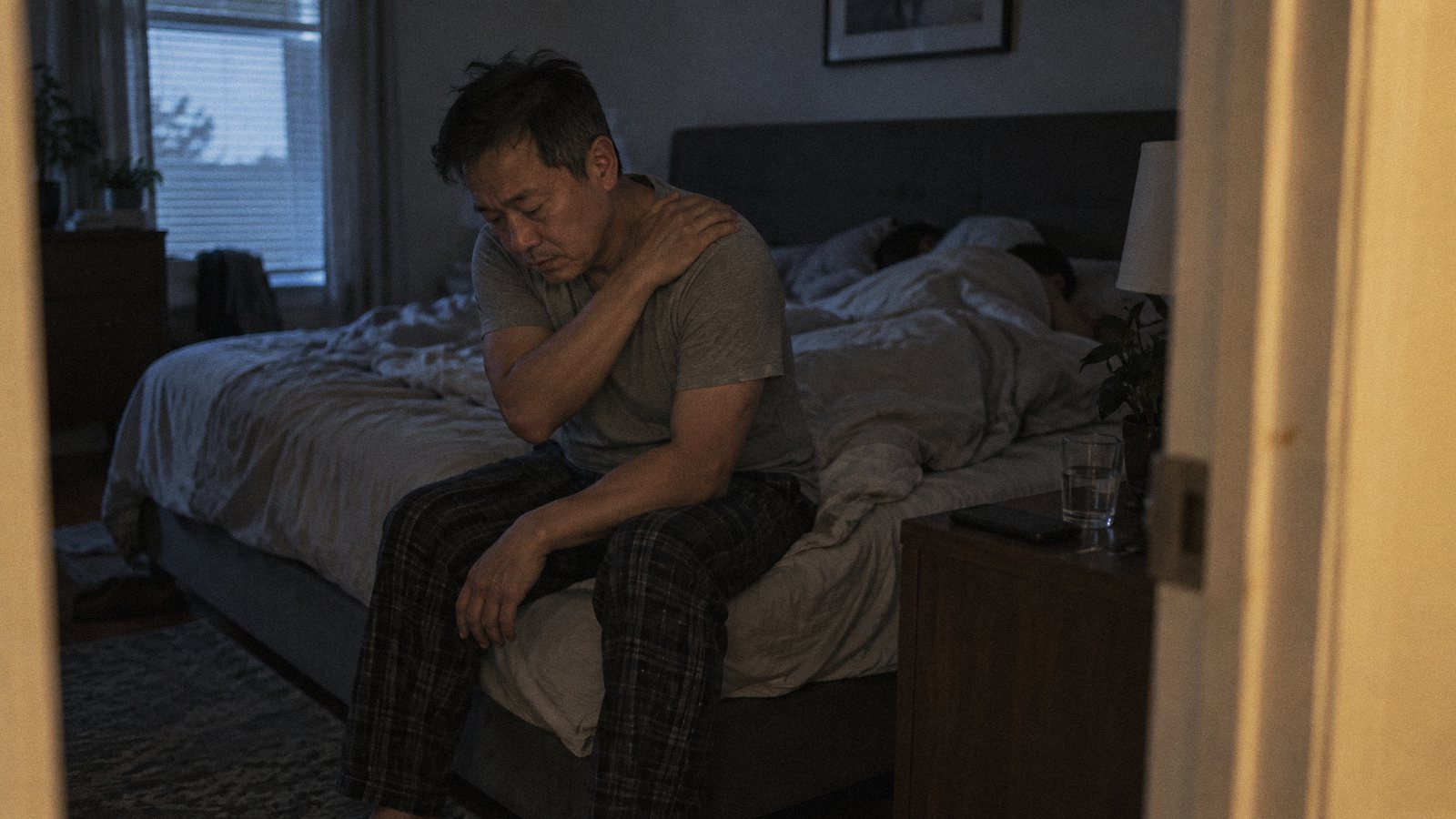
The story below is a composite of real experiences; details changed.
1:40. 3:15. 4:50.
If you know those numbers, your shoulder has taken over the one time you’re supposed to recover.
Mike Tran, 45, owns two restaurants and can’t remember the last time he slept through. Every time he rolls onto his right side, his shoulder wakes him like a smoke alarm.
By the lunch rush he’s short with the line cooks. By dinner he’s on his third coffee. He skipped the gym again, because what’s the point on four hours of sleep?
Here’s why shoulders hurt more at night, and how to start taking the night back.
Why shoulders hurt more at night
This isn’t in your head. Night pain is one of the classic signs of a rotator cuff problem.
The American Academy of Orthopaedic Surgeons agrees. Its patient guide lists pain at rest and at night, especially when lying on the affected shoulder, as a common symptom of rotator cuff tears. (AAOS OrthoInfo)
Lying on your side puts direct pressure on the joint. And at night there’s nothing else to pull your attention away.
Night pain alone doesn’t diagnose a tear. Other shoulder problems cause it, too. But it’s worth describing clearly to whoever examines you.
Pain breaks the night. The broken night turns up the pain. Break the loop anywhere you can.
The loop that keeps you stuck
Sleep and pain feed each other.
In a 2019 UC Berkeley study, one sleepless night made 25 healthy adults feel pain sooner. In 60 people living with pain, worse sleep one night was followed by more pain the next day. (Krause et al., 2019)
The CDC recommends at least seven hours of sleep for adults 18 to 60. It also points out that how well you sleep matters, not just how long. (CDC)
Those studies were small, and a lab all-nighter is extreme. But the takeaway is practical. Better nights can mean better days, and better days can mean better rehab.
What if surgery is on the table?
Many people hope surgery will fix the sleep right away. Usually it doesn’t, at least not at first.
A 2026 study followed people after rotator cuff repair. Sleep was worst around two weeks after surgery, then improved. By 24 weeks, 55% reported no nighttime disturbance. (2026 prospective cohort)
It was a small single-center study (50 people finished), with no comparison group. So it’s a rough expectation, not a promise. If you’re weighing surgery, read rotator cuff surgery or more physical therapy.
The evidence, without the theater
What the research shows
- Night pain is a common rotator cuff symptom.
- Poor sleep and next-day pain travel together.
- After repair, sleep often dips first, then improves over months.
What it doesn’t show
- That night pain means you have a tear.
- That surgery fixes sleep problems on a set timeline.
- That sleep medicine is right for you. That’s a conversation with your doctor.
If night pain comes back months after a repair, read what’s normal four months after rotator cuff repair.
Keep a seven-night log
“I sleep badly” doesn’t give anyone much to work with. A week of notes does.
Seven-night sleep and shoulder log
- Bedtime and wake time.
- How many times you woke, and roughly when.
- What woke you: rolling onto that side, ache, needing to move, other.
- Position you fell asleep in, and woke up in.
- What helped: a pillow under the arm, a recliner, ice, timing of medicine you’ve been prescribed.
- Next-day cost: energy, mood, focus, skipped training.
Then bring these questions to your appointment:
- What positions are safe and helpful for my shoulder?
- Would a pillow or wedge setup help?
- Should the timing of my medicine change?
- Could something else be hurting my sleep, like snoring or stress?
If you’re in a sling after surgery, don’t change how you use it without asking your surgeon. For nights in the sling, see how to sleep after rotator cuff surgery. For the bigger picture of what the injury is costing you, count the costs you’ve stopped counting.
When not to wait
See your clinician soon if:
- Night pain is getting worse week after week.
- You have pain at night along with fever, chills or unexplained weight loss.
- The shoulder is red, hot and swollen.
- You notice new weakness, or numbness into the hand.
- Someone says you stop breathing or snore heavily in your sleep.
Night seven

Mike brings the log to his appointment. Seven nights. Nineteen wake-ups. Fourteen of them rolling onto the right side.
His doctor looks at it for a long moment. Then they build a plan: pillows to keep him off that side, new medicine timing and a strength program for the shoulder.
Two weeks later, the clock reads 5:30 when he opens his eyes. First time since spring.
You can’t fix what you can’t describe. Tonight, put a notepad by the bed. Start night one.
Mike is a composite, drawn from the kinds of stories people describe with shoulder pain. The details are illustrative. The pattern is real.
Free · Your Before-You-Leave Card
Don’t leave your next appointment with “rest it.”
Get the questions for your injury in 8 taps.
Get my card →Questions readers ask
- Why does my shoulder hurt more at night?
- Lying on the shoulder puts pressure on the joint, and there are fewer distractions at night. Pain at rest and at night, especially lying on the affected side, is a common symptom of rotator cuff tears, though other shoulder problems can cause it too.
- Does poor sleep make pain worse?
- Research suggests it can. In a 2019 study, one night of sleep loss lowered pain thresholds in healthy adults, and in people living with pain, worse sleep quality was followed by more pain the next day.
- Will rotator cuff surgery fix my sleep?
- Not right away. In a small 2026 study, sleep was worst about two weeks after repair and improved later; by 24 weeks, 55% reported no nighttime disturbance.
Sources & references (4)
- Rotator Cuff Tears · AAOS OrthoInfo
- The Pain of Sleep Loss: A Brain Characterization in Humans · Journal of Neuroscience, 2019
- About Sleep · CDC, 2024
- How Patients Sleep After Rotator Cuff Repair: A Prospective Analysis of Pain, Position, and Recovery · Prospective cohort study, 2026
The Series
45 articlesPart 1: Understanding Your Injury (1 to 19)
- After the MRI: How to Read a Rotator Cuff Report Without Getting Sold a Surgery
- Told to “Just Rest It”? Five Questions to Ask Before You Leave
- When Shoulder Pain Keeps Waking You Up
- Meniscus Surgery Recovery: When Can You Return to Your Kind of Work?
- Rotator Cuff Surgery or More Physical Therapy? Questions That Clarify the Decision
- Achilles Tendon Pain: Why This Tendon Is a Different Problem
- Four Months After Rotator Cuff Repair and It Still Hurts: Normal, or a Retear?
- Your Knee Feels Worse After the Meniscus Scope. What Could Be Going On?
- Hip Flexor Pain After Hip Arthroscopy: Why It Shows Up and When It Settles
- Tennis Elbow That Won’t Go Away: Why Rest and Shots Stall, and What Helps
- Knee Swelling After Meniscus Surgery: How Long Is Normal, and When to Call
- Quad Won’t Fire After Knee Surgery? What Quad Shutdown Is and How to Get It Back
- Walking After Meniscus Surgery: When You Can, How Far, and When to Drop the Crutches
- How to Sleep After Rotator Cuff Surgery, and When Nights Get Easier
- Felt a Pop After Knee Surgery? Re-Tear or Setback, and When to Call
- Home After a Microdiscectomy: How Much to Walk and How Long to Sit
- Running After ACL Surgery: When Your First Jog Comes, and What It Tells You About Work
- When Can You Drive After Rotator Cuff Surgery and Get Back in the Work Truck?
- Knee Won’t Straighten After Meniscus Surgery? Why It Happens and What Helps
Part 2: Work and Real Life (20 to 29)
- You Can Still Work. But What Is Your Injury Costing You?
- Self-Employed and Injured: How to Plan for Time Away From Work
- Your Job and Your Workouts Are Loading the Same Injury
- How to Take Time to Recover When Everyone Depends on You
- What Do You Still Want to Be Able to Do in Ten Years?
- Microdiscectomy Recovery: When Can You Go Back to Heavy Work?
- Kneeling After Knee Surgery: Why It Comes Back Last and How to Retrain It
- Rotator Cuff Surgery Recovery: When Can You Go Back to Work?
- When Can You Drive After Knee Surgery and Get Back in the Work Van?
- When Can You Go Back to Physical Work After ACL Surgery?
Part 3: Back to Training (30 to 34)
Part 4: Reading the Evidence (35 to 45)
- Your Watch Says You’re Recovered. Your Shoulder Disagrees.
- Recovery Is Taking Longer Than You Expected. What Counts as Progress?
- Before You Buy Another Recovery Tool, Decide What You Need It to Do
- “It Worked for Me”: How to Evaluate a Recovery Claim
- BPC-157 After an Orthopedic Procedure: What Does the Research Actually Show?
- TB-500 vs. BPC-157: What the Research Actually Compares
- How to Read a Peptide COA: What It Proves and What It Doesn’t
- The Research Stack People Ask About After a Scope, and the Gaps in the Human Data
- What the Tendon Research on BPC-157 Actually Measured
- What’s in the Other 1%? Peptide Impurities, Explained
- Approved, Compounded or “Research Use Only”: What a Peptide’s Label Means in 2026
Free · 60-second recovery check
What’s really holding your recovery back?
Eight quick taps. Find the one thing stalling your recovery, then get the three moves to work on first, picked from 30 guides and 100+ cited sources.
- Your bottleneck, named in 60 seconds
- 3 moves for this week, fitted to your job
- Your Before-You-Leave Card: the questions for your next appointment
What got hurt?
Free. No sign-up to start. Not medical advice.
Keep reading

Knee Won’t Straighten After Meniscus Surgery? Why It Happens and What Helps
Three weeks out, the other knee lies flat and yours won’t. Why a knee stays bent after a meniscus trim or repair, when protocols expect it straight, what rehab teams use to get it back, and the signs that mean call to…
When Can You Drive After Rotator Cuff Surgery and Get Back in the Work Truck?
Dispatch wants you back on the road, and your arm is still strapped to your belly. What the sling means for driving after a rotator cuff repair, what the few driving studies found, and a check to run before your first…
Running After ACL Surgery: When Your First Jog Comes, and What It Tells You About Work
Your PT says you can try a jog. You’re wondering if ladders are next. When the first run usually comes after ACL reconstruction, what clinics test first, what a first run-walk looks like, and what it does and doesn’t …