Walking After Meniscus Surgery: When You Can, How Far, and When to Drop the Crutches
Trim or repair changes everything. When you can put weight on the leg, when the crutches can go, why a limp hangs on, and a walking ladder from the hallway to a full day on your feet.
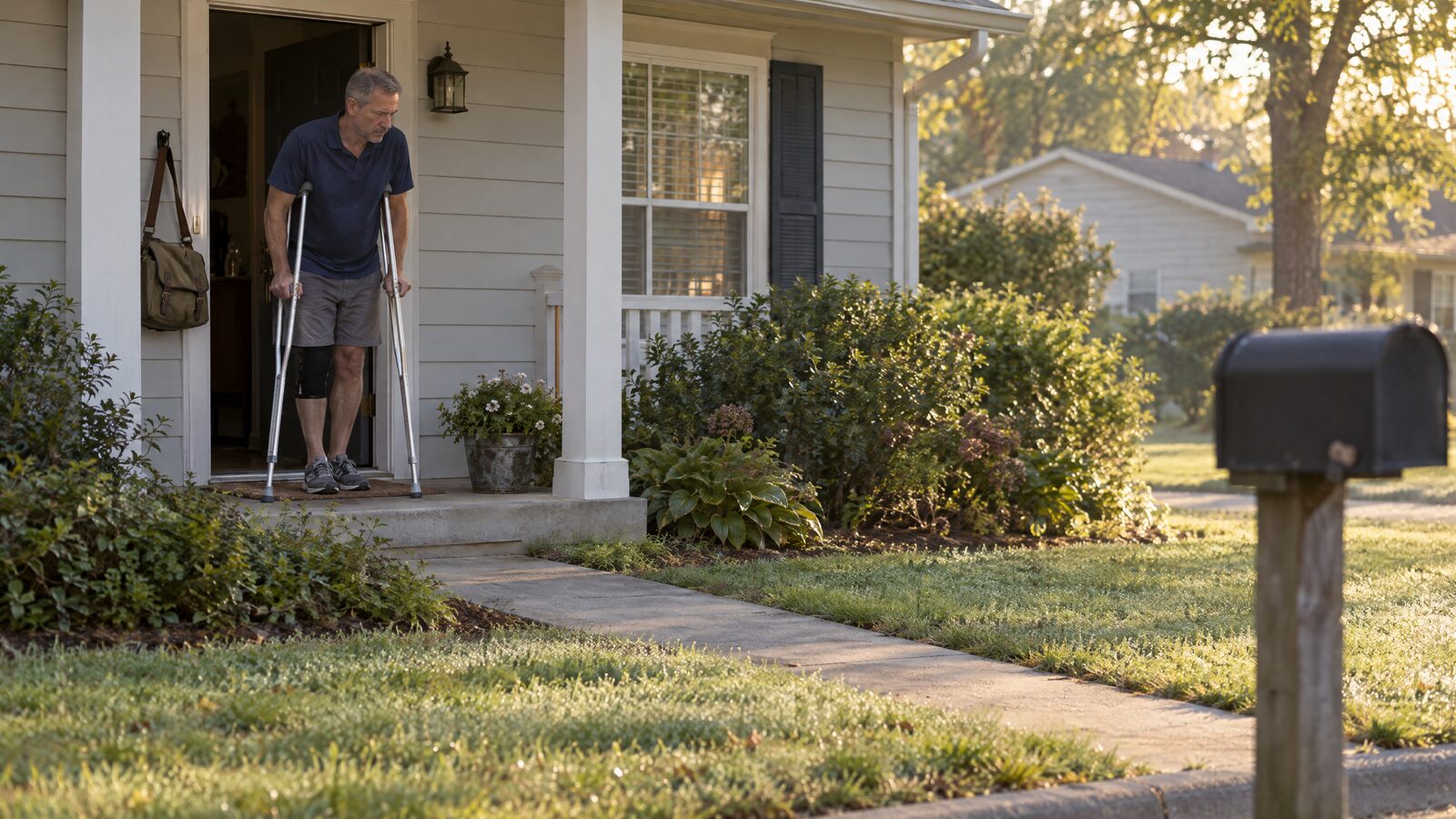
The story below is a composite of real experiences; details changed.
Gary is 52. He has carried mail for 23 years: miles of sidewalk a day, curbs, porch steps, and one long hill at the end.
Two days after his knee scope, he stands in the doorway on crutches. The mailbox is 40 steps away. He counts them twice.
His discharge sheet says “weight bearing as tolerated.” His brother-in-law had meniscus surgery and spent six weeks in a brace. His supervisor wants a date.
Here’s when you can walk after meniscus surgery, when the crutches can go, and how to build back to a full day on your feet.
First question: did they trim it or repair it?
A trim (partial meniscectomy) removes the torn piece. A repair stitches the tear so it can heal. The walking plans differ a lot.
After a trim, you can usually put weight on the leg right away. (AAOS OrthoInfo) After a repair, many protocols limit weight and keep you on crutches for about six weeks. (Wrightington, Wigan and Leigh NHS, 2026; University of Virginia)
Root and radial tears break the ring of fibers that holds the meniscus together. Those repairs are often protected longer. (University of Virginia; Journal of Experimental Orthopaedics, 2022)
| Surgery | Weight on the leg | Crutches | Brace | When protocols aim for a normal walk |
|---|---|---|---|---|
| Trim | As much as is comfortable, right away | Often 2 to 7 days | Usually none | By about week 2 |
| Repair | Often limited, such as half your weight, for about 6 weeks | About 6 weeks in many protocols; some say 2 to 4 | Often, letting the knee bend only to 90 degrees; some lock it straight for walking | Often around weeks 6 to 10 |
| Root or radial repair | None to half your weight, for about 6 weeks, depending on the protocol | About 6 weeks, then a slow taper | Often | Weeks 6 to 12 in one protocol, sometimes later |
Sources: AAOS OrthoInfo on meniscus tears and knee arthroscopy; ColumbiaDoctors health library, 2026; Mass General Brigham protocols for a trim and a repair; University of Virginia protocols for a repair and a root repair; NHS leaflets from Liverpool, Wrightington, Wigan and Leigh and James Paget; Journal of Experimental Orthopaedics, 2022. These are typical ranges. Your surgeon’s protocol comes first.
Surgeons disagree on how strict to be. A review of 17 studies (798 patients) found faster programs with early weight bearing weren’t linked to more failed repairs. Most studies were small and at risk of bias. (BMJ Open Sport & Exercise Medicine, 2018)
Read your operative note, or ask: “Trim or repair? How much weight, and for how long?”
After a trim: what the first weeks usually look like
- Days 1 to 2. Walk around the house, then rest with the leg up. Try not to stand for long. (MedlinePlus)
- Days 3 to 7. Short walks. An older Royal College of Surgeons guide suggested 5 to 10 minutes on day 3, a little longer each day. (Royal College of Surgeons of England) Crutches often go this week, as swelling settles. (ColumbiaDoctors; Mass General Brigham, 2024)
- Week 2. The goal is a normal walk with no crutches. (Mass General Brigham, 2024) After 1 to 2 weeks, go longer as comfort allows. (Gateshead Health NHS Foundation Trust, 2025)
- Weeks 2 to 6. Short walks get easier, but a long one can bring the limp back. (RCS England) Swelling can take 2 to 6 weeks to calm down. (NHS Fife, 2019) Many people are back to most activities by 6 to 8 weeks. (AAOS OrthoInfo)
Some knees take 6 to 12 weeks or longer to settle. (Gateshead, 2025) Getting worse instead? Read about a knee that feels worse after a meniscus scope.
After a trim, short walks start in days. Long ones take weeks.
When to drop the crutches: a checklist, not a date
Rehab protocols tie the crutches to what your knee can do, not just the calendar. Check for all four. (Mass General Brigham, 2024; Mass General Brigham, 2021; University of Virginia)
- No limp. Both steps look and feel the same.
- A straight knee. It straightens as fully as the other one, without pain.
- A thigh that works. You can lift the leg straight off the bed without the knee sagging.
- Calm swelling. Little or none, and walking doesn’t bring more.
Almost there? Use one crutch, in the hand opposite your operated leg. (Gateshead, 2025)
After a repair, the rules change. One NHS trust tells patients to keep their crutches for six weeks, even if the pain has settled. (Wrightington, Wigan and Leigh NHS, 2026)
Drop the crutches when you walk well without them, not when you’re sick of them.
Why you limp, and how to fix it
A limp is a symptom with a cause. Four are common after a scope:
- The knee won’t fully straighten. You end up walking on a bent knee, which one NHS team tells patients to avoid. (Gateshead, 2025)
- The thigh is weak. In 82 people around age 49 with worn (degenerative) tears, the thigh on the torn side was 13% weaker than the other one. That’s about an eighth, before surgery even started. (British Journal of Sports Medicine, 2014)
- Swelling. Fluid in the joint can stop the thigh muscle from switching on fully. (Arthritis Research & Therapy, 2014) More on that in why a quad won’t fire after knee surgery.
- Fear. In 25 people after a trim, less fear of movement went along with less knee pain, and more confidence with better function. A small study, and a link rather than proof of cause. (International Journal of Sports Physical Therapy, 2020)
To fix the walk itself, land on your heel, roll through, and push off your toes. Make both steps the same length. (Gateshead, 2025; OrthoArizona gait handout)
A mirror helps. One gait handout for joint replacement suggests practicing in front of one. (OrthoArizona gait handout)
Find the cause of your limp and fix that, not just the look of it.
The evidence, without the theater
What the research shows
- Weight on the leg right away is the usual plan after a trim.
- Repair protocols range from no weight to full weight.
- In small studies, early weight bearing after some repairs didn’t raise failure rates.
What it doesn’t show
- One best plan after a repair. There’s no consensus.
- That early loading is safe after root or radial repairs.
- A tested walking schedule after a trim.
- When you, personally, will walk a full day.
How far, and how fast to build
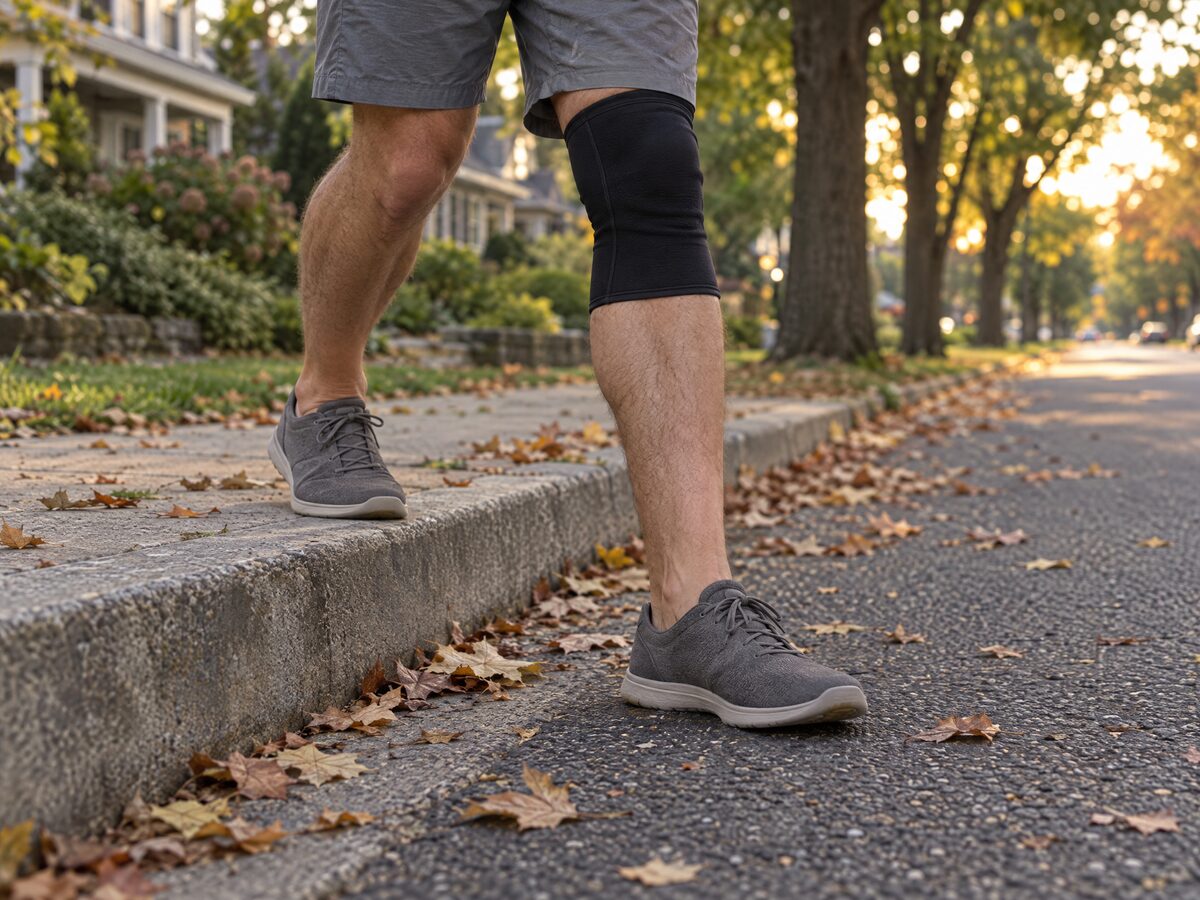
NHS leaflets give one rule: add distance as pain and swelling allow. (Liverpool University Hospitals, 2021; NHS Fife, 2019) More pain and swelling can mean you’re doing too much too soon. (Sherwood Forest Hospitals, 2025)
When that happens, don’t stop walking. Do less, then build again. (East Kent Hospitals)
Step counts after a trim can come close to normal. Three months out, 21 people averaged about 9,200 steps a day. Matched people without surgery averaged about 10,400, so roughly 9 for every 10. One small study, and the trim group moved less briskly. (Journal of Science and Medicine in Sport, 2013)
The walking ladder: hallway to full route
A practical structure, not a tested protocol. After a repair, start only once your surgeon clears full weight, and adjust it with your PT.
- Around the house. A few minutes, every waking hour.
- Short and flat. 5 to 10 minutes outside, once or twice a day.
- Longer and flat. Add 5 minutes to one walk each time you pass the check.
- Thirty minutes. One steady walk on the sidewalk, with no limp.
- Stairs and curbs. Hold the rail. Up with the good leg, down with the operated leg, one step at a time. Step over step comes later. Treat a curb like one stair.
- Uneven ground. Grass, gravel, slopes. Short stretches first.
- Work rehearsal. 45 to 60 minutes with a light bag, porch steps included.
The morning check: Pass if the knee is no more swollen or sore than the morning before, and it straightens just as far.
Pass twice, move up a rung. Fail, drop back one rung for two days.
Stuck on a rung for weeks? See what counts as progress.
Let tomorrow morning, not today’s ambition, decide how far you walk.
Walking for a living
A 2026 review pooled 87 studies of common sports medicine operations, including trims. After a trim, the typical (median) time back to work was 33 days, about 5 weeks. More than 9 in 10 got back to full duty. (American Journal of Sports Medicine, 2026)
Heavier jobs took longer. But many studies didn’t report job type clearly, so that finding is less firm. (American Journal of Sports Medicine, 2026)
NHS leaflets estimate 2 to 6 weeks off for manual work after a scope, and up to 12 weeks for heavy jobs. (NHS Fife, 2019; Gateshead, 2025) After a repair, heavy or twisting work may take up to 12 weeks. (Wrightington, Wigan and Leigh NHS, 2026)
Ask about lighter duties first, like more sitting and no heavy carrying. (RCS England) For the full plan, see how to return to your kind of work after meniscus surgery. Driving to the job? Read when you can drive after knee surgery.
Ask for a shorter route before you ask for your old one.
When not to wait
Call your surgeon’s office the same day if you have any of these. If you can’t reach them, go to urgent care or the ER.
- Calf pain or swelling. If you’re also short of breath or have chest pain, call 911.
- A fever above 101°F (38.3°C) or chills, or redness, swelling or yellowish discharge at an incision.
- Bleeding that soaks through the dressing.
- Pain that pain medicine doesn’t ease, or that keeps getting worse.
- A foot or toes that look darker than normal or feel cool to the touch.
- A knee that turns red or hot, swelling that gets severe or keeps getting worse, or new numbness or tingling around the joint.
- Suddenly not being able to put weight on the leg, especially with a fever or chills.
- A knee that locks, gives way, or keeps losing movement.
Sources: MedlinePlus; nhs.uk on arthroscopy and DVT; AAOS OrthoInfo; NHS leaflets from Wrightington, Wigan and Leigh and Robert Jones and Agnes Hunt.
Back on the route
Gary’s op note says trim. He stops counting steps on day five. He makes the mailbox on one crutch, then on none.
By week three, he walks 30 minutes around the block without a limp. Then curbs. Then the church steps, up and down, twice.
Week five, he’s back on a shorter loop. Week seven, the hill. Next morning, the knee looks the same. That’s a pass.
Your next step: find the words “weight bearing” on your discharge sheet. If they aren’t there, call your surgeon’s office today and ask.
Gary is a composite, drawn from the kinds of stories people with walking jobs describe after knee surgery. The details are illustrative.
Free · Your Before-You-Leave Card
Don’t leave your next appointment with “rest it.”
Get the questions for your injury in 8 taps.
Get my card →Questions readers ask
- How long after meniscus surgery can I walk?
- After a trim, most people can put weight on the leg right away, often stop using crutches within 2 to 7 days, and aim for a normal walk by about week 2. After a repair, many protocols limit weight and use crutches for about 6 weeks. Your surgeon’s protocol comes first.
- When can I stop using crutches after meniscus surgery?
- After a trim, rehab protocols use criteria, not just dates: walking without a limp, a knee that straightens fully without pain, a straight-leg raise without the knee sagging, and little or no swelling. After a repair, protocols also set a minimum time, often about 6 weeks, so follow your surgeon’s limits even if the pain settles.
- Why am I still limping after knee arthroscopy?
- Common causes are a knee that won’t fully straighten, a weak thigh muscle, swelling that can hold the quad back, and fear of moving. Land on your heel, keep both steps the same length, and ask your physical therapist which cause is yours.
Sources & references (27)
- Meniscus Tears · AAOS OrthoInfo
- Meniscus Repair Surgery (Sports Knee Service leaflet) · Wrightington, Wigan and Leigh Teaching Hospitals NHS Foundation Trust, 2026
- Post-operative Rehabilitation Protocol: Meniscal Repair · University of Virginia Department of Orthopaedic Surgery
- Meniscal Root Repair Post-operative Rehabilitation Protocol · University of Virginia Department of Orthopaedic Surgery
- Rehabilitation and return to sports after isolated meniscal repairs: a new evidence-based protocol · Journal of Experimental Orthopaedics, 2022
- Knee Arthroscopy · AAOS OrthoInfo
- Meniscectomy for a Meniscus Tear · ColumbiaDoctors Health Library (Healthwise), 2026
- Rehabilitation Protocol for Arthroscopic Partial Meniscectomy · Mass General Brigham Sports Medicine, 2024
- Rehabilitation Protocol for Arthroscopic Meniscal Repair · Mass General Brigham Sports Medicine, 2021
- Meniscal Surgery · Liverpool University Hospitals NHS Foundation Trust, 2021
- Meniscal Body and Root Repair · James Paget University Hospitals NHS Foundation Trust, 2025
- Rehabilitation following meniscal repair: a systematic review · BMJ Open Sport & Exercise Medicine, 2018
- Knee arthroscopy: discharge · MedlinePlus, 2024
- Get Well Soon: helping you make a speedy recovery after arthroscopic operations on your knee for meniscal tears · Royal College of Surgeons of England
- Post Operative Meniscectomy (patient leaflet) · Gateshead Health NHS Foundation Trust, 2025
- Post-Operative Knee Arthroscopy: Service User Information Leaflet · NHS Fife Musculoskeletal Physiotherapy, 2019
- Knee function and knee muscle strength in middle-aged patients with degenerative meniscal tears eligible for arthroscopic partial meniscectomy · British Journal of Sports Medicine, 2014
- Quadriceps arthrogenic muscle inhibition: the effects of experimental knee joint effusion on motor cortex excitability · Arthritis Research & Therapy, 2014
- Fear-avoidance and self-efficacy psychosocial factors are altered after partial meniscectomy and associated with rehabilitation outcomes · International Journal of Sports Physical Therapy, 2020
- Gait Training After Joint Replacement · OrthoArizona
- Arthroscopic Knee Surgery · Sherwood Forest Hospitals NHS Foundation Trust, 2025
- Meniscal repair: aftercare advice · East Kent Hospitals University NHS Foundation Trust
- Physical activity patterns and function 3 months after arthroscopic partial meniscectomy · Journal of Science and Medicine in Sport, 2013
- Return to work outcomes after common sports-related orthopaedic procedures: a systematic review · American Journal of Sports Medicine, 2026
- Arthroscopy · NHS, 2026
- Deep vein thrombosis (DVT) · NHS, 2026
- Knee Arthroscopy · Robert Jones and Agnes Hunt Orthopaedic Hospital NHS Foundation Trust, 2023
The Series
45 articlesPart 1: Understanding Your Injury (1 to 19)
- After the MRI: How to Read a Rotator Cuff Report Without Getting Sold a Surgery
- Told to “Just Rest It”? Five Questions to Ask Before You Leave
- When Shoulder Pain Keeps Waking You Up
- Meniscus Surgery Recovery: When Can You Return to Your Kind of Work?
- Rotator Cuff Surgery or More Physical Therapy? Questions That Clarify the Decision
- Achilles Tendon Pain: Why This Tendon Is a Different Problem
- Four Months After Rotator Cuff Repair and It Still Hurts: Normal, or a Retear?
- Your Knee Feels Worse After the Meniscus Scope. What Could Be Going On?
- Hip Flexor Pain After Hip Arthroscopy: Why It Shows Up and When It Settles
- Tennis Elbow That Won’t Go Away: Why Rest and Shots Stall, and What Helps
- Knee Swelling After Meniscus Surgery: How Long Is Normal, and When to Call
- Quad Won’t Fire After Knee Surgery? What Quad Shutdown Is and How to Get It Back
- Walking After Meniscus Surgery: When You Can, How Far, and When to Drop the Crutches
- How to Sleep After Rotator Cuff Surgery, and When Nights Get Easier
- Felt a Pop After Knee Surgery? Re-Tear or Setback, and When to Call
- Home After a Microdiscectomy: How Much to Walk and How Long to Sit
- Running After ACL Surgery: When Your First Jog Comes, and What It Tells You About Work
- When Can You Drive After Rotator Cuff Surgery and Get Back in the Work Truck?
- Knee Won’t Straighten After Meniscus Surgery? Why It Happens and What Helps
Part 2: Work and Real Life (20 to 29)
- You Can Still Work. But What Is Your Injury Costing You?
- Self-Employed and Injured: How to Plan for Time Away From Work
- Your Job and Your Workouts Are Loading the Same Injury
- How to Take Time to Recover When Everyone Depends on You
- What Do You Still Want to Be Able to Do in Ten Years?
- Microdiscectomy Recovery: When Can You Go Back to Heavy Work?
- Kneeling After Knee Surgery: Why It Comes Back Last and How to Retrain It
- Rotator Cuff Surgery Recovery: When Can You Go Back to Work?
- When Can You Drive After Knee Surgery and Get Back in the Work Van?
- When Can You Go Back to Physical Work After ACL Surgery?
Part 3: Back to Training (30 to 34)
Part 4: Reading the Evidence (35 to 45)
- Your Watch Says You’re Recovered. Your Shoulder Disagrees.
- Recovery Is Taking Longer Than You Expected. What Counts as Progress?
- Before You Buy Another Recovery Tool, Decide What You Need It to Do
- “It Worked for Me”: How to Evaluate a Recovery Claim
- BPC-157 After an Orthopedic Procedure: What Does the Research Actually Show?
- TB-500 vs. BPC-157: What the Research Actually Compares
- How to Read a Peptide COA: What It Proves and What It Doesn’t
- The Research Stack People Ask About After a Scope, and the Gaps in the Human Data
- What the Tendon Research on BPC-157 Actually Measured
- What’s in the Other 1%? Peptide Impurities, Explained
- Approved, Compounded or “Research Use Only”: What a Peptide’s Label Means in 2026
Free · 60-second recovery check
What’s really holding your recovery back?
Eight quick taps. Find the one thing stalling your recovery, then get the three moves to work on first, picked from 30 guides and 100+ cited sources.
- Your bottleneck, named in 60 seconds
- 3 moves for this week, fitted to your job
- Your Before-You-Leave Card: the questions for your next appointment
What got hurt?
Free. No sign-up to start. Not medical advice.
Keep reading
Knee Won’t Straighten After Meniscus Surgery? Why It Happens and What Helps
Three weeks out, the other knee lies flat and yours won’t. Why a knee stays bent after a meniscus trim or repair, when protocols expect it straight, what rehab teams use to get it back, and the signs that mean call to…
When Can You Drive After Rotator Cuff Surgery and Get Back in the Work Truck?
Dispatch wants you back on the road, and your arm is still strapped to your belly. What the sling means for driving after a rotator cuff repair, what the few driving studies found, and a check to run before your first…
Running After ACL Surgery: When Your First Jog Comes, and What It Tells You About Work
Your PT says you can try a jog. You’re wondering if ladders are next. When the first run usually comes after ACL reconstruction, what clinics test first, what a first run-walk looks like, and what it does and doesn’t …