Quad Won’t Fire After Knee Surgery? What Quad Shutdown Is and How to Get It Back
You tell your thigh to tighten and it barely answers. Why the quad switches off after knee surgery, a two-minute way to check it, and what the research says helps bring it back.
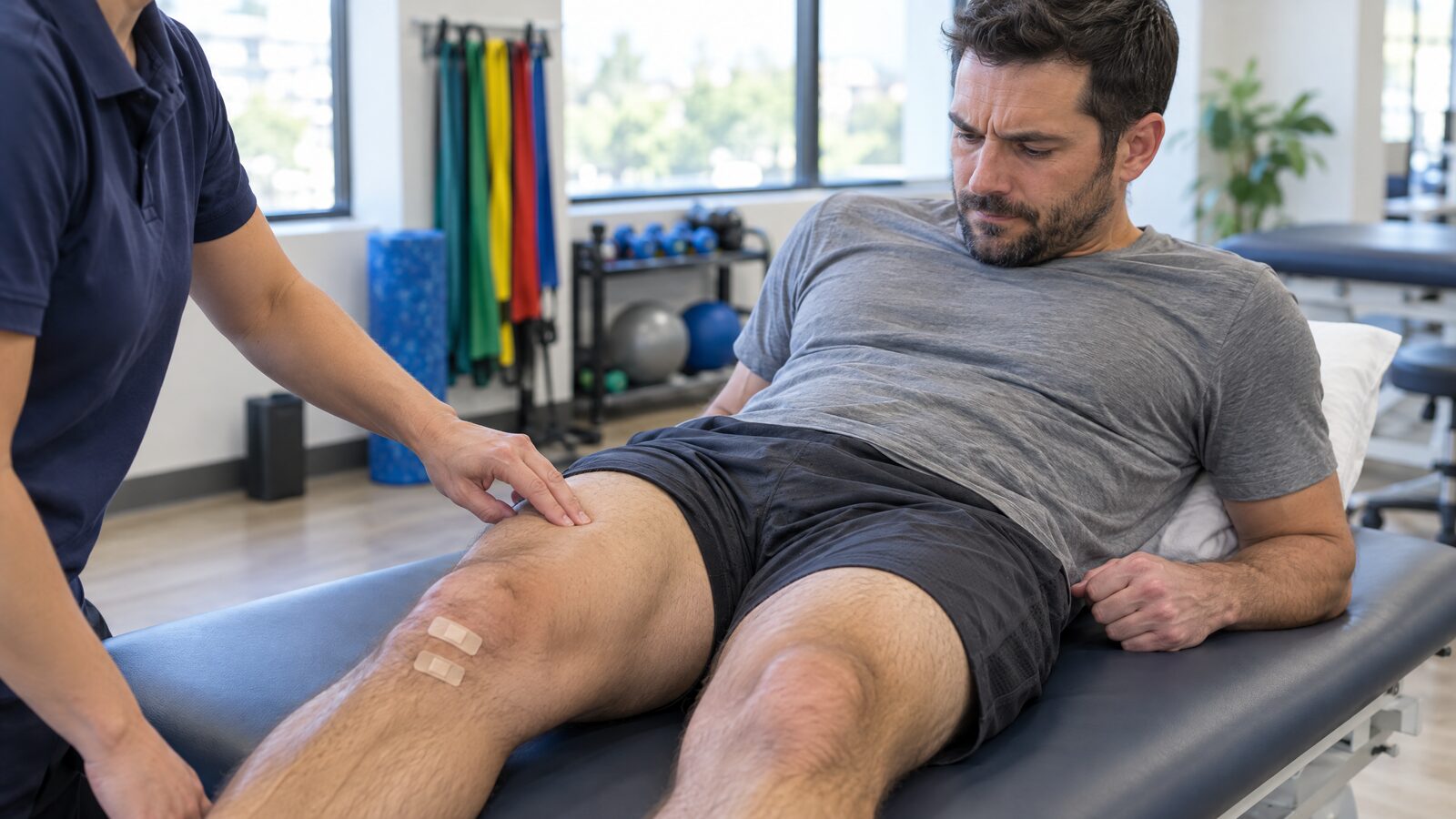
The story below is a composite of real experiences; details changed.
Three weeks after a meniscus trim, Hector lies on the PT table and tells his right thigh to tighten.
His left thigh goes hard as conduit. The right one barely ripples. The kneecap hardly moves.
Hector is 39, a commercial electrician: ladders, stairs, crouching under panels. He figures he isn’t trying hard enough. So he tries harder. Nothing changes.
At home, stairs feel worse than before surgery, especially going down.
Here’s why your quad goes quiet after knee surgery, how to check it, and what helps bring it back.
Quad shutdown is a reflex, not a lack of effort
Researchers call it arthrogenic muscle inhibition, or AMI. “Arthrogenic” means it starts in the joint. After an injury or surgery, your nervous system turns the quad down. (British Journal of Sports Medicine, 2019)
Effort isn’t the problem. One surgical team defines it as being unable to fully switch the muscle on by choice. (Knee Surgery, Sports Traumatology, Arthroscopy, 2022)
Some researchers think the shutdown protects the joint at first. When it lingers, it can slow recovery. (European Journal of Sport Science, 2022)
It’s common after a trim. One US lab screened 31 volunteers, 10 days to 3 years out. About 2 in 3 (20 of them) could switch on less than 85% of their quad. A small, self-selected group. (Journal of Athletic Training, 2010)
It often hits both legs. A review of 15 studies, mostly after ACL injuries, found activation failure is “often observed bilaterally.” (Journal of Athletic Training, 2010)
If your quad won’t answer, you’re not lazy. Your nervous system is holding it back.
Why swelling and pain switch the quad off
Researchers can recreate this by injecting salt water into healthy knees. As little as 10 ml, about 2 teaspoons, may be enough. (Arthritis Research & Therapy, 2014)
In 14 healthy adults averaging 24, about a quarter cup of fluid in the knee cut quad strength by about 14%, roughly a seventh. Pain alone, from a salt-water shot below the kneecap, did about the same. (Journal of Athletic Training, 2013)
With both at once, strength fell about 22%, but that wasn’t a clear difference from either one alone. Young volunteers, tested within minutes. (Journal of Athletic Training, 2013)
So a knee that puffs up after a shift may be holding your quad back too. More on that in knee swelling after meniscus surgery.
Swelling and pain work like a volume knob on your quad. Turn them down and it has room to answer.
How to tell if your quad is firing
- Kneecap glide. Tighten your thigh with the leg straight. One NHS team says you should feel your kneecap move up toward your hip. Compare sides. (University Hospitals Coventry and Warwickshire, 2025)
- Straight-leg raise. Lift the whole leg “like a rod.” If the knee bends as it rises, that’s a lag: the knee won’t straighten under its own power as far as it can be pushed. (UHCW, 2025; Annals of Translational Medicine, 2018)
- Full straightening. One meniscus repair protocol sets a raise without lag and full active straightening as early goals. (Mass General Brigham, 2021)
- A strength test. A US guideline says clinicians should test maximum quad strength at the start of care and again later. (JOSPT, 2018) It’s often shown as a limb symmetry index: your surgical leg as a percentage of the other.
That yardstick has a catch. In 70 athletes six months after ACL surgery, 57% (about 6 in 10) hit 90% symmetry on quad and hop tests. Measured against the other leg’s scores from before surgery, only 29% did, about 3 in 10. (JOSPT, 2017)
Symmetry scores “frequently overestimate knee function,” the authors wrote. One possible reason: quad shutdown often affects both legs. (Journal of Athletic Training, 2010)
Your other leg is a useful yardstick, not a perfect one.
The 2-minute weekly quad check
Same day each week, before your exercises. Write down the answers.
- Kneecap glide, 3 tries. Does it slide up fully, a little, or not at all?
- Straight-leg raise, 5 lifts. How many stay fully straight?
- Straightening. Lying flat, does the back of the knee settle like the other one?
- Swelling. More, less or the same as last week?
- Stairs down. Rail needed? One step at a time, or foot over foot?
Show your PT if the kneecap barely moves, every lift bends, the knee won’t straighten, or two weeks in a row show no change.
Had a repair? Ask your PT before doing straight-leg raises while the knee still lags.
This is a practical structure, not a validated test.
What helps first: exercise and ice
Most of this research comes from ACL surgery. Meniscus studies are fewer and smaller.
Quad sets and straight-leg raises are the usual first step. (UHCW, 2025) But a 2023 ACL guideline says they “might have a small effect” on getting your bend back, not on strength. (British Journal of Sports Medicine, 2023)
So they’re a start, not the plan. A US guideline recommends supervised exercise after a meniscus trim, building to progressive knee and hip strengthening. (JOSPT, 2018)
Ice before you work. A review of 20 studies after ACL surgery rated the evidence for cold therapy and exercise against quad shutdown as moderate. Two of its four cold studies used lab-made swelling. (British Journal of Sports Medicine, 2019)
In 30 people with quad shutdown at least 6 months after ACL surgery, icing right before exercise built more strength than either one alone. Activation itself didn’t clearly improve. A small trial, only 2 weeks long. (Journal of Athletic Training, 2014)
Calm the knee first, then ask the muscle to work.
Extra tools: NMES and BFR
NMES (electrical muscle stimulation) uses pads on the thigh to make the quad contract. The US guideline says clinicians “should provide neuromuscular stimulation/re-education” after meniscus procedures. (JOSPT, 2018)
A 2025 review of 11 ACL trials found it added strength, a moderate effect, but function scores were no better. (Orthopaedic Journal of Sports Medicine, 2025) An older review found only 2 meniscus trials, both short, with no clear benefit. (São Paulo Medical Journal, 2011)
And the 2019 review that backed ice rated the evidence for NMES against quad shutdown as low. (British Journal of Sports Medicine, 2019)
Blood flow restriction (BFR) uses a cuff high on the thigh to partly limit blood flow while you lift light loads. (Clinical Journal of Sport Medicine, 2017) A 2026 review of 9 ACL trials (372 people) found more quad strength, with moderate certainty. (Orthopaedic Journal of Sports Medicine, 2026)
After a meniscus trim, a Chinese trial of 40 adults, average age about 38, found more strength and muscle size at 8 weeks with BFR. Small and short. (Frontiers in Physiology, 2022)
BFR needs a trained clinician to set and watch the cuff. (Frontiers in Physiology, 2022) The 2023 ACL guideline lists heart or blood vessel disease and extensive swelling as reasons to avoid it. (British Journal of Sports Medicine, 2023)
These tools were tested on top of exercise, not instead of it.
The evidence, without the theater
What the research shows
- Swelling and pain each turn the quad down, even in healthy knees.
- Quad shutdown is common after knee injury and surgery.
- In ACL trials, adding NMES or BFR built more quad strength.
What it doesn’t show
- Large, long trials after meniscus surgery.
- Clear gains in everyday function. Results are mixed.
- How long your own quad will take to come back.
Why stairs got harder, especially going down
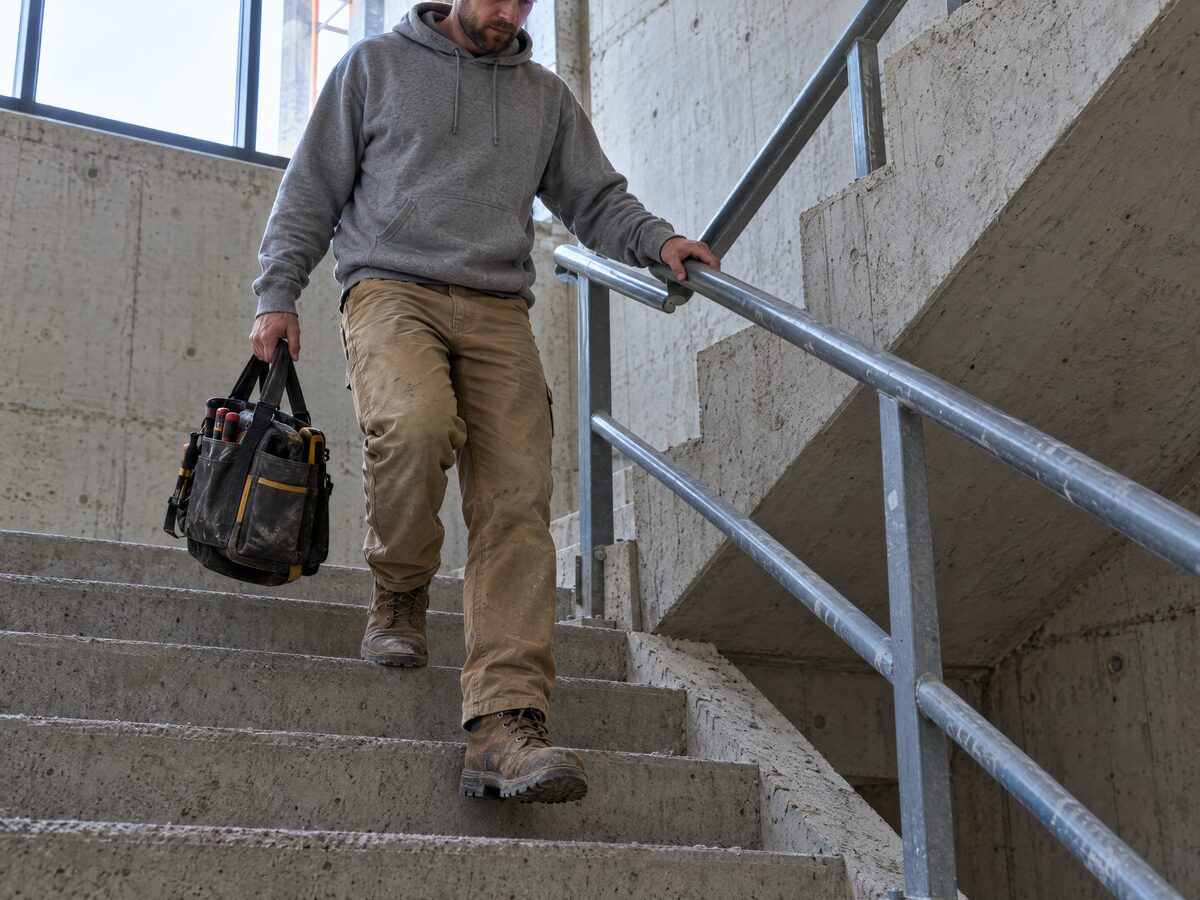
Going down, your quad works as a brake. It lengthens under load to slow your body as each step drops. (Frontiers in Physiology, 2019)
It’s a heavy job. In 84 healthy adults aged 60 to 88, going down stairs took about 120% of their maximum knee-straightening strength. That maximum was measured with the leg held still, and these were older adults. (Gait & Posture, 2011)
After a trim, the leg is often weaker. In 82 people about 3 months out, knee strength was 14% to 16% lower than in healthy people. By 2 years, the gap had closed. (Medicine & Science in Sports & Exercise, 2013)
- Going up, lead with your good leg. One NHS team: put your non-operated leg up first. (UHCW, 2025)
- Going down, lead with your surgical leg. That way your stronger leg stays on the upper step and does the lowering. (UHCW, 2025; MedlinePlus, 2025)
- Use the rail. Hold the handrail if there is one. (MedlinePlus, 2025)
Stairs down are a quad test you take every day. Until you pass it, change how you take it.
What to ask your PT
- Is my quad fully firing? Can you test it against my other leg?
- Do I have a lag, or any loss of straightening?
- Would NMES or BFR fit my surgery and my health?
- What strength target do you want before ladders, running or full duty?
For context, the 2023 ACL guideline suggests quad strength above 80% of the other leg before running. Its authors say no research findings back that number yet. It rests on expert judgment. (British Journal of Sports Medicine, 2023)
More on getting real answers in five questions to ask before you leave.
Ask for a number, not a feeling.
When not to wait
Call your surgeon’s office the same day if you have any of these. If you can’t reach them, go to urgent care or the ER.
- Pain, swelling, warmth or redness in your calf or thigh. For chest pain, trouble breathing, coughing up blood or fainting, call 911.
- A fever above 101°F (38.3°C), or redness, swelling or yellowish discharge at an incision.
- Pain that pain medicine doesn’t ease, or that keeps getting worse.
- A foot or toes that look darker than normal or feel cool to the touch.
- A knee that locks or keeps giving way.
- Suddenly being unable to straighten your knee after a pop or tearing feeling, or a dent above the kneecap. It can mean a torn tendon.
Sources: MedlinePlus on knee arthroscopy and deep vein thrombosis; NHS on DVT and knee pain; AAOS OrthoInfo on meniscus tears and quadriceps tendon tears.
The thigh answers
Hector starts the weekly check. At week 3, the kneecap barely slides, and 1 of 5 lifts stays straight.
His PT has him ice before quad sets and adds electrical stimulation. By week 6, the kneecap glides and all 5 lifts stay straight.
He still leads down the stairs with his right leg, a hand on the rail. He’s not trying harder anymore. He’s tracking what works.
Your next step: this week, do the 2-minute quad check, write down what you see, and bring it to your next PT visit.
Hector is a composite, drawn from the kinds of stories tradespeople describe after knee surgery. The details are illustrative.
Free · Your Before-You-Leave Card
Don’t leave your next appointment with “rest it.”
Get the questions for your injury in 8 taps.
Get my card →Questions readers ask
- Why won’t my quad tighten after knee surgery?
- Often it’s arthrogenic muscle inhibition: after an injury or surgery, the nervous system turns the quad down. Swelling and pain both trigger it, even in healthy knees in lab studies. It isn’t a lack of effort.
- How long does quad weakness last after a meniscus trim?
- It varies. In one study of 82 people, knee strength was 14% to 16% lower than in healthy people about 3 months after a trim, and the gap had closed by 2 years. Ask your physical therapist to test your quad and track it.
- Does electrical stimulation help the quad after knee surgery?
- A US physical therapy guideline says clinicians should provide neuromuscular stimulation after meniscus procedures. In ACL trials it added strength, but function scores were no better, and meniscus trials are few and short. It’s used on top of exercise, not instead of it.
Sources & references (29)
- Arthrogenic muscle inhibition after ACL reconstruction: a scoping review of the efficacy of interventions · British Journal of Sports Medicine, 2019
- Preoperative muscle thickness influences muscle activation after arthroscopic knee surgery · Knee Surgery, Sports Traumatology, Arthroscopy, 2022
- Arthrogenic muscle inhibition manifests in thigh musculature motor unit characteristics after anterior cruciate ligament injury · European Journal of Sport Science, 2022
- Transcranial magnetic stimulation and volitional quadriceps activation · Journal of Athletic Training, 2010
- Quadriceps activation following knee injuries: a systematic review · Journal of Athletic Training, 2010
- Quadriceps arthrogenic muscle inhibition: the effects of experimental knee joint effusion on motor cortex excitability · Arthritis Research & Therapy, 2014
- Pain and effusion and quadriceps activation and strength · Journal of Athletic Training, 2013
- Knee Arthroscopy (Physiotherapy following surgery) · University Hospitals Coventry and Warwickshire NHS Trust, 2025
- Short-term outcomes for total knee arthroplasty patients with active extension lag · Annals of Translational Medicine, 2018
- Rehabilitation Protocol for Arthroscopic Meniscal Repair · Mass General Brigham Sports Medicine, 2021
- Knee Pain and Mobility Impairments: Meniscal and Articular Cartilage Lesions Revision 2018 (clinical practice guideline) · Journal of Orthopaedic & Sports Physical Therapy, 2018
- Limb symmetry indexes can overestimate knee function after anterior cruciate ligament injury · Journal of Orthopaedic & Sports Physical Therapy, 2017
- Aspetar clinical practice guideline on rehabilitation after anterior cruciate ligament reconstruction · British Journal of Sports Medicine, 2023
- Quadriceps muscle function after rehabilitation with cryotherapy in patients with anterior cruciate ligament reconstruction · Journal of Athletic Training, 2014
- Effects of neuromuscular electrical stimulation on quadriceps femoris muscle strength and knee joint function in patients after ACL surgery: a systematic review and meta-analysis of randomized controlled trials · Orthopaedic Journal of Sports Medicine, 2025
- Effectiveness of electrical stimulation on rehabilitation after ligament and meniscal injuries: a systematic review · São Paulo Medical Journal, 2011
- Blood flow restriction training after knee arthroscopy: a randomized controlled pilot study · Clinical Journal of Sport Medicine, 2017
- Blood flow restriction training after ACL reconstruction: a systematic review and meta-analysis of randomized controlled trials · Orthopaedic Journal of Sports Medicine, 2026
- Blood flow restriction training promotes functional recovery of knee joint in patients after arthroscopic partial meniscectomy: a randomized clinical trial · Frontiers in Physiology, 2022
- Combined resistance and stretching exercise training benefits stair descent biomechanics in older adults · Frontiers in Physiology, 2019
- The biomechanical functional demand placed on knee and hip muscles of older adults during stair ascent and descent · Gait & Posture, 2011
- A longitudinal study of strength and gait after arthroscopic partial meniscectomy · Medicine & Science in Sports & Exercise, 2013
- Using crutches · MedlinePlus, 2025
- Knee arthroscopy: discharge · MedlinePlus, 2024
- Deep venous thrombosis · MedlinePlus, 2025
- Deep vein thrombosis (DVT) · NHS, 2026
- Knee pain · NHS
- Meniscus Tears · AAOS OrthoInfo
- Quadriceps Tendon Tear · AAOS OrthoInfo
The Series
45 articlesPart 1: Understanding Your Injury (1 to 19)
- After the MRI: How to Read a Rotator Cuff Report Without Getting Sold a Surgery
- Told to “Just Rest It”? Five Questions to Ask Before You Leave
- When Shoulder Pain Keeps Waking You Up
- Meniscus Surgery Recovery: When Can You Return to Your Kind of Work?
- Rotator Cuff Surgery or More Physical Therapy? Questions That Clarify the Decision
- Achilles Tendon Pain: Why This Tendon Is a Different Problem
- Four Months After Rotator Cuff Repair and It Still Hurts: Normal, or a Retear?
- Your Knee Feels Worse After the Meniscus Scope. What Could Be Going On?
- Hip Flexor Pain After Hip Arthroscopy: Why It Shows Up and When It Settles
- Tennis Elbow That Won’t Go Away: Why Rest and Shots Stall, and What Helps
- Knee Swelling After Meniscus Surgery: How Long Is Normal, and When to Call
- Quad Won’t Fire After Knee Surgery? What Quad Shutdown Is and How to Get It Back
- Walking After Meniscus Surgery: When You Can, How Far, and When to Drop the Crutches
- How to Sleep After Rotator Cuff Surgery, and When Nights Get Easier
- Felt a Pop After Knee Surgery? Re-Tear or Setback, and When to Call
- Home After a Microdiscectomy: How Much to Walk and How Long to Sit
- Running After ACL Surgery: When Your First Jog Comes, and What It Tells You About Work
- When Can You Drive After Rotator Cuff Surgery and Get Back in the Work Truck?
- Knee Won’t Straighten After Meniscus Surgery? Why It Happens and What Helps
Part 2: Work and Real Life (20 to 29)
- You Can Still Work. But What Is Your Injury Costing You?
- Self-Employed and Injured: How to Plan for Time Away From Work
- Your Job and Your Workouts Are Loading the Same Injury
- How to Take Time to Recover When Everyone Depends on You
- What Do You Still Want to Be Able to Do in Ten Years?
- Microdiscectomy Recovery: When Can You Go Back to Heavy Work?
- Kneeling After Knee Surgery: Why It Comes Back Last and How to Retrain It
- Rotator Cuff Surgery Recovery: When Can You Go Back to Work?
- When Can You Drive After Knee Surgery and Get Back in the Work Van?
- When Can You Go Back to Physical Work After ACL Surgery?
Part 3: Back to Training (30 to 34)
Part 4: Reading the Evidence (35 to 45)
- Your Watch Says You’re Recovered. Your Shoulder Disagrees.
- Recovery Is Taking Longer Than You Expected. What Counts as Progress?
- Before You Buy Another Recovery Tool, Decide What You Need It to Do
- “It Worked for Me”: How to Evaluate a Recovery Claim
- BPC-157 After an Orthopedic Procedure: What Does the Research Actually Show?
- TB-500 vs. BPC-157: What the Research Actually Compares
- How to Read a Peptide COA: What It Proves and What It Doesn’t
- The Research Stack People Ask About After a Scope, and the Gaps in the Human Data
- What the Tendon Research on BPC-157 Actually Measured
- What’s in the Other 1%? Peptide Impurities, Explained
- Approved, Compounded or “Research Use Only”: What a Peptide’s Label Means in 2026
Free · 60-second recovery check
What’s really holding your recovery back?
Eight quick taps. Find the one thing stalling your recovery, then get the three moves to work on first, picked from 30 guides and 100+ cited sources.
- Your bottleneck, named in 60 seconds
- 3 moves for this week, fitted to your job
- Your Before-You-Leave Card: the questions for your next appointment
What got hurt?
Free. No sign-up to start. Not medical advice.
Keep reading

Knee Won’t Straighten After Meniscus Surgery? Why It Happens and What Helps
Three weeks out, the other knee lies flat and yours won’t. Why a knee stays bent after a meniscus trim or repair, when protocols expect it straight, what rehab teams use to get it back, and the signs that mean call to…
When Can You Drive After Rotator Cuff Surgery and Get Back in the Work Truck?
Dispatch wants you back on the road, and your arm is still strapped to your belly. What the sling means for driving after a rotator cuff repair, what the few driving studies found, and a check to run before your first…
Running After ACL Surgery: When Your First Jog Comes, and What It Tells You About Work
Your PT says you can try a jog. You’re wondering if ladders are next. When the first run usually comes after ACL reconstruction, what clinics test first, what a first run-walk looks like, and what it does and doesn’t …