Felt a Pop After Knee Surgery? Re-Tear or Setback, and When to Call
Felt a pop, and now the knee is filling up? How often meniscus repairs and ACL grafts really fail, which signs to report, how a setback tends to look, what to log tonight, and when to call.
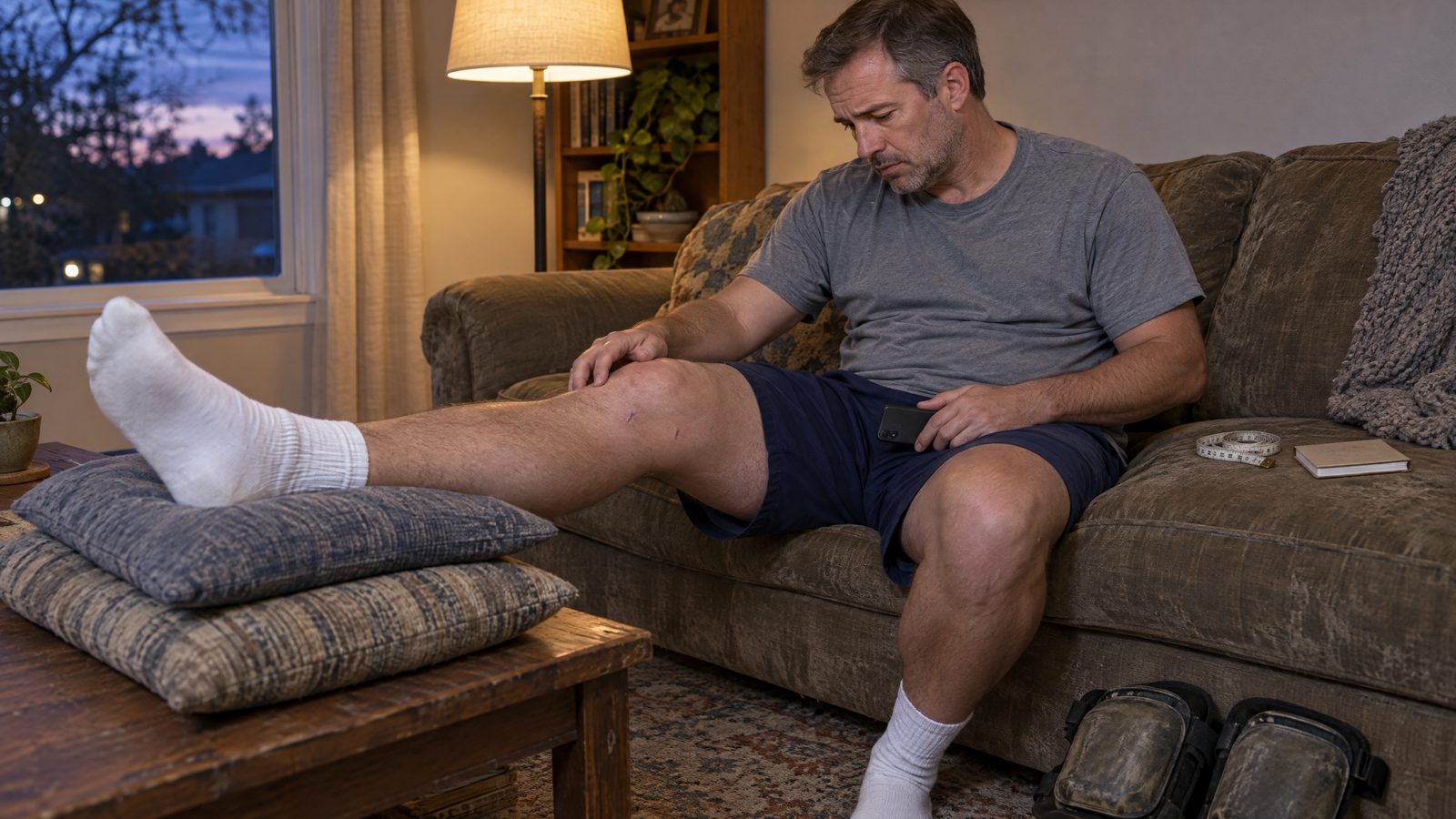
The story below is a composite of real experiences; details changed.
Wade steps off his van’s back bumper with a box of tile on his shoulder. His right foot lands, the knee twists, and something pops.
He’s 44 and lays floors for a living. Four months ago, a surgeon stitched a torn meniscus in that knee. He’d just started kneeling on the job again.
He finishes the job anyway, kneeling on his left. By evening, the right knee is filling up, tight and puffy around the kneecap.
At 2 a.m. he’s still awake, doing the math: another surgery, more weeks with no pay. Did one bad step just undo the whole surgery?
Here’s how often re-tears really happen, which signs to report, how a normal setback tends to look, and when to call.
How often a repair or graft actually fails
That 2 a.m. math runs high.
For a stitched meniscus, three big reviews, all built on low-level evidence such as look-back studies:
- Over about 7 years. Twelve studies, 864 people. About 1 in 5 repairs (19%) needed another operation. (Knee Surgery, Sports Traumatology, Arthroscopy, 2022)
- Over about 3.5 years. Fifty-one studies, close to 4,000 repairs. About 1 in 7 (15%) failed. (American Journal of Sports Medicine, 2024)
- Age 40 and up. Across 14 studies of 466 people chosen for a repair, about 1 in 8 repairs (12%) failed, as each study defined it. That was not significantly different from people under 40. (Orthopaedic Journal of Sports Medicine, 2024)
A trim cuts the damaged tissue away. (AAOS OrthoInfo) So after a trim, a “re-tear” is a new tear in what’s left. In one 2011 review, about 1 to 4 in 100 trims (1.4% to 3.9%) needed another operation, depending on follow-up. (Arthroscopy, 2011)
For an ACL graft:
- Across 14 studies. In younger athletes (study average ages about 16 to 29), grafts tore again in 7%, about 1 in 14. Studies counted re-tears differently, and counting only repeat surgery can miss some. (American Journal of Sports Medicine, 2016)
- Over age 40. Across 21 studies, the middle graft rupture rate was 2.7%, under 3 in 100. In the 9 that reported overall failure, the middle rate was 5%, about 1 in 20. Only 4 defined failure explicitly. (Arthroscopy, Sports Medicine, and Rehabilitation, 2024)
Re-tears are real, and they’re the exception. In these studies, about 4 in 5 or more repairs and 9 in 10 or more grafts didn’t fail, as each study counted it.
Re-tear or setback: what tends to separate them
We found no tested home check that tells them apart. But sources describe the signs of a tear, and how a setback tends to look.
For a meniscus tear, AAOS lists a pop, pain, stiffness and swelling, and catching or locking. It adds giving way, and a knee that can’t move through its full range of motion. (AAOS OrthoInfo)
For an ACL tear, the AAOS list includes a pop, pain, a knee that gives out, and swelling within 24 hours. (AAOS OrthoInfo) A failed graft, one review says, may bring pain, lost motion and repeated giving way. (Annals of Joint, 2018)
The AAOS lists describe first tears. We found no study of how a failed meniscus repair feels.
“Locking” has two meanings. True locking, where a torn piece blocks the knee from straightening, is less common than stiffness from swelling or pain, one review says. (Australian Family Physician, 2012)
A setback looks different. One NHS leaflet for knee injuries calls a small rise in pain or swelling normal if it settles within 24 hours of exercise. (East Lancashire Hospitals)
After ACL surgery or a meniscus repair, hospital leaflets say rising or excessive swelling may mean you’re doing too much. (Royal United Hospitals Bath, 2021; East Kent Hospitals) Don’t stop walking or doing your exercises, the meniscus leaflet says, just change how many you do. (East Kent Hospitals)
A pop starts the story. Locking, giving way and a knee you can’t straighten are the parts to report.
When the risk runs highest
In the 7-year meniscus review, 87 of the 165 failures had a known date. About two-thirds of those (64%) came within 2 years, and about 1 in 3 later. (Knee Surgery, Sports Traumatology, Arthroscopy, 2022)
One NHS trust says to avoid squatting past 90 degrees, pivoting and twisting for 3 months after a repair. (University Hospitals Coventry and Warwickshire, 2024)
Another NHS leaflet says a repair is more likely to fail if you don’t follow the post-op advice and rehab. (Lancashire Teaching Hospitals, 2023) For floor work, see kneeling after knee surgery.
Of 755 people from one surgeon’s practice, 673 were followed up. An estimated 1 in 20 ACL grafts (5%) had torn again by year 2, and about 1 in 9 (11%) by year 15. Techniques have changed since those 1993 and 1994 surgeries. (American Journal of Sports Medicine, 2012)
One study followed 106 athletes in pivoting sports for 2 years after ACL surgery. Each extra month before returning to sport, up to 9 months, was linked to a 51% lower knee reinjury rate, about half. (British Journal of Sports Medicine, 2016)
That was sport, not work. For timing by job, see return to your kind of work after meniscus surgery.
The first 2 years carry more of the risk. Sticking with your restrictions and rehab is the part you control.
The evidence, without the theater
What the research shows
- About 1 in 5 meniscus repairs needed another operation over about 7 years. In people 40 and up, about 1 in 8 failed.
- About 7% of ACL grafts tore again across 14 studies of younger athletes, and under 3% in one review of people over 40.
- After a repair, an MRI can look unhealed in people with no symptoms.
What it doesn’t show
- A tested home checklist that tells a re-tear from a flare.
- How often a pop after surgery turns out to be a re-tear.
- Whether going back to heavy work sooner changes re-tear risk.
What your surgeon will likely check
For a meniscus, expect pressing along the joint line and the McMurray test, which bends, straightens and rotates the knee. (AAOS OrthoInfo) For an ACL graft, expect looseness tests such as the Lachman and the pivot shift. (Annals of Joint, 2018)
An MRI after a repair is harder to read. (Radsource, 2020) One with contrast dye does better than a plain one. (American Journal of Roentgenology, 2018)
In 84 people with no symptoms, about 3 years after a repair, about 2 in 5 (39%) had MRIs read as “not healed.” The authors called them active patients. That was one hospital in Argentina, and the full group’s average age was 27. (World Journal of Orthopedics, 2023)
A re-tear doesn’t automatically mean another operation. For a failed ACL graft, one review says the reason to redo it is ongoing instability in daily life or sport. It lists a lack of significant symptoms as a reason not to operate. (Annals of Joint, 2018)
Bring your operative report: it helps the radiologist read your MRI. (Radsource, 2020) For more, see five questions to ask before you leave.
A scan is one piece of evidence. How your knee behaves is the other.
What to do tonight and tomorrow morning
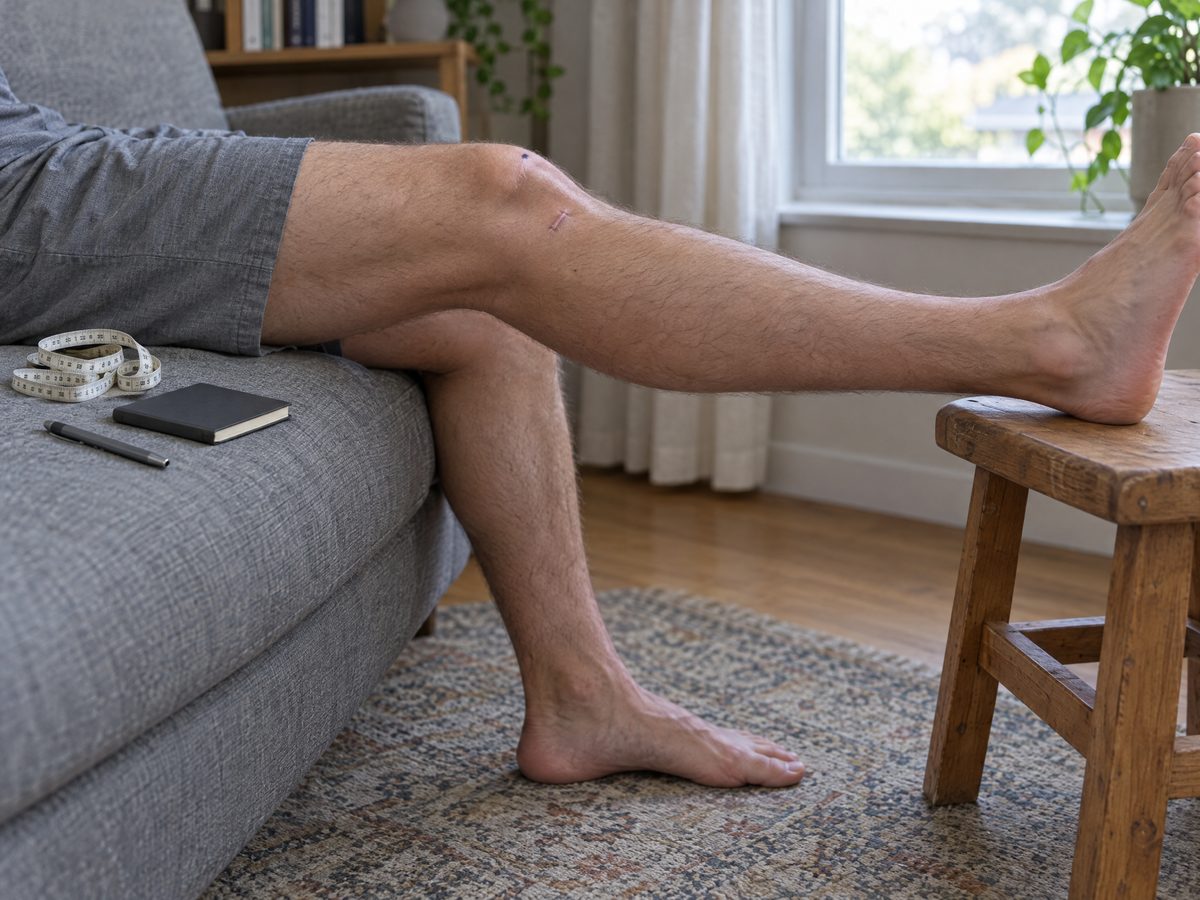
You can’t diagnose a re-tear at home. You can hand your surgeon a clear picture.
The after-a-scare log
Any sign from the “When not to wait” box below? Act now. If not, write each answer down.
Tonight, while it’s fresh:
- What happened. The time, the movement, pop or no pop, and whether you kept working.
- A first measurement. Mark one spot on each knee and measure both. For how, see knee swelling after meniscus surgery.
Tomorrow, before work:
- Swelling. Measure both knees again at the marks, and compare with last night.
- Straightening. Sit with your heel on a stool. Does the back of the knee sink as low as the other side?
- Weight. Can you walk across the room without a limp?
- Locking or catching. Any moment it stuck and you had to wiggle it free?
- Giving way. Did it buckle, or feel like it shifted?
Bring to the call: your surgery date, what was done (trim, repair or ACL graft), your current restrictions, and this log.
This is a practical structure, not a tested protocol.
Write it down tonight. Tomorrow, the log does the talking.
When not to wait
Chest pain, shortness of breath or coughing up blood? Call 911. Don’t drive yourself.
Call your surgeon’s office the same day for any of these. If you can’t reach them, go to urgent care or the ER.
- A knee that won’t fully straighten and feels blocked.
- You can’t put weight on the leg.
- A knee that gives way and makes you fall.
- Large swelling within 1 to 2 hours of the twist.
- A knee that’s very painful, badly swollen or has changed shape.
- Pain that doesn’t ease with pain medicine, or keeps getting worse.
- Redness or heat around the knee, especially with a fever, chills or feeling unwell. It can mean infection.
- A temperature over 101°F (38.3°C), or redness, swelling or yellowish discharge at an incision.
- Throbbing pain or swelling in one leg, usually the calf or thigh, or red or darkened skin there.
- A foot or toes that look darker than normal or feel cool.
- Numbness or pins and needles below the knee.
Sources: NHS on knee pain, septic arthritis and DVT; MedlinePlus on ACL reconstruction and knee arthroscopy; East Lancashire Hospitals; Tyneside Integrated Musculoskeletal Service, 2024; Australian Family Physician, 2012; Lancashire Teaching Hospitals, 2023.
Back at the van
At 6 a.m., Wade checks the knee against his notes. It’s up 1.5 cm, but it straightens almost all the way. No limp, no catching, no buckling.
At 8, log in hand, he calls the surgeon’s office from the van. They book an exam that week.
He still doesn’t know if it’s a re-tear. At 2 a.m., the math was surgery and lost pay. Now it’s a page of facts, and a surgeon will read it.
If the scare shook your faith in the knee, read you used to trust your body.
Your next step: tonight, write down what happened and measure both knees. Tomorrow, finish the log before work and call your surgeon’s office.
Wade is a composite, drawn from the kinds of stories tradespeople describe after knee surgery. The details are illustrative.
Free · Your Before-You-Leave Card
Don’t leave your next appointment with “rest it.”
Get the questions for your injury in 8 taps.
Get my card →Questions readers ask
- How do I know if I re-tore my meniscus after surgery?
- You can’t tell for sure at home, and we found no tested home check. AAOS lists a pop, pain, stiffness and swelling, catching or locking, giving way, and lost range of motion as meniscus tear signs. Those describe first tears. Log what happened and call your surgeon’s office. After a repair, an MRI is harder to read, and one with contrast dye does better.
- How common is a re-tear after meniscus repair or ACL surgery?
- In large reviews, about 1 in 7 to 1 in 5 meniscus repairs failed over about 3.5 to 7 years. In people 40 and up, about 1 in 8 failed. Across 14 studies of younger athletes, about 7% of ACL grafts tore again. In one review of people over 40, it was under 3%. These reviews rest on low-level evidence.
- When should I call my surgeon after a pop in my knee?
- For chest pain, shortness of breath or coughing up blood, call 911, and don’t drive yourself. Call the same day if your knee feels blocked and won’t fully straighten, can’t take your weight, or gives way and makes you fall. The same goes for large swelling within 1 to 2 hours, or a knee that’s very painful, badly swollen or has changed shape. Redness or heat around the knee, especially with a fever, chills or feeling unwell, needs a same-day call too. So do throbbing pain or swelling in one leg, numbness below the knee, or a fever over 101°F (38.3°C). For a smaller scare, log what happened tonight and call your surgeon’s office in the morning.
Sources & references (26)
- Nineteen percent of meniscus repairs are being revised and failures frequently occur after the second postoperative year: a systematic review and meta-analysis with a minimum follow-up of 5 years · Knee Surgery, Sports Traumatology, Arthroscopy, 2022
- Meniscal Repair Outcome in 3829 Patients With a Minimum Follow-up From 2 Years Up to 5 Years: A Meta-analysis on the Overall Failure Rate and Factors Influencing Failure · American Journal of Sports Medicine, 2024
- Systematic Review and Meta-analysis of Clinical Outcomes Following Meniscus Repair in Patients 40 Years and Older · Orthopaedic Journal of Sports Medicine, 2024
- Meniscus Tears · AAOS OrthoInfo
- Meniscal repair versus partial meniscectomy: a systematic review comparing reoperation rates and clinical outcomes · Arthroscopy, 2011
- Risk of Secondary Injury in Younger Athletes After Anterior Cruciate Ligament Reconstruction: A Systematic Review and Meta-analysis · American Journal of Sports Medicine, 2016
- Anterior Cruciate Ligament Reconstruction in Patients Over 40 Years Old Shows Low Failure Rates: A Systematic Review · Arthroscopy, Sports Medicine, and Rehabilitation, 2024
- Anterior Cruciate Ligament (ACL) Injuries · AAOS OrthoInfo
- The role of anatomic ACL reconstruction in ACL revision surgery · Annals of Joint, 2018
- Management of Acute Knee Injuries · Tyneside Integrated Musculoskeletal Service (NHS), 2024
- Meniscal tear: presentation, diagnosis and management · Australian Family Physician, 2012
- Traumatic Knee Injury: Information and Exercise Leaflet for Patients and Carers · East Lancashire Hospitals NHS Trust
- Post Operative Advice after ACL Reconstruction · Royal United Hospitals Bath NHS Foundation Trust, 2021
- Meniscal repair: aftercare advice · East Kent Hospitals University NHS Foundation Trust
- Meniscal repair · University Hospitals Coventry and Warwickshire NHS Trust, 2024
- Meniscal Repair Surgery · Lancashire Teaching Hospitals NHS Foundation Trust, 2023
- Survival of the Anterior Cruciate Ligament Graft and the Contralateral ACL at a Minimum of 15 Years · American Journal of Sports Medicine, 2012
- Simple decision rules can reduce reinjury risk by 84% after ACL reconstruction: the Delaware-Oslo ACL cohort study · British Journal of Sports Medicine, 2016
- The Postoperative Meniscus · Radsource, 2020
- Imaging the postoperative knee meniscus: an evidence-based review · American Journal of Roentgenology, 2018
- Failure rate, return-to-sports and magnetic resonance imaging after meniscal repair: 119 patients with 7 years mean follow up · World Journal of Orthopedics, 2023
- Knee pain · NHS
- Septic arthritis · NHS
- Deep vein thrombosis (DVT) · NHS
- ACL reconstruction: discharge · MedlinePlus, 2024
- Knee arthroscopy: discharge · MedlinePlus, 2024
The Series
45 articlesPart 1: Understanding Your Injury (1 to 19)
- After the MRI: How to Read a Rotator Cuff Report Without Getting Sold a Surgery
- Told to “Just Rest It”? Five Questions to Ask Before You Leave
- When Shoulder Pain Keeps Waking You Up
- Meniscus Surgery Recovery: When Can You Return to Your Kind of Work?
- Rotator Cuff Surgery or More Physical Therapy? Questions That Clarify the Decision
- Achilles Tendon Pain: Why This Tendon Is a Different Problem
- Four Months After Rotator Cuff Repair and It Still Hurts: Normal, or a Retear?
- Your Knee Feels Worse After the Meniscus Scope. What Could Be Going On?
- Hip Flexor Pain After Hip Arthroscopy: Why It Shows Up and When It Settles
- Tennis Elbow That Won’t Go Away: Why Rest and Shots Stall, and What Helps
- Knee Swelling After Meniscus Surgery: How Long Is Normal, and When to Call
- Quad Won’t Fire After Knee Surgery? What Quad Shutdown Is and How to Get It Back
- Walking After Meniscus Surgery: When You Can, How Far, and When to Drop the Crutches
- How to Sleep After Rotator Cuff Surgery, and When Nights Get Easier
- Felt a Pop After Knee Surgery? Re-Tear or Setback, and When to Call
- Home After a Microdiscectomy: How Much to Walk and How Long to Sit
- Running After ACL Surgery: When Your First Jog Comes, and What It Tells You About Work
- When Can You Drive After Rotator Cuff Surgery and Get Back in the Work Truck?
- Knee Won’t Straighten After Meniscus Surgery? Why It Happens and What Helps
Part 2: Work and Real Life (20 to 29)
- You Can Still Work. But What Is Your Injury Costing You?
- Self-Employed and Injured: How to Plan for Time Away From Work
- Your Job and Your Workouts Are Loading the Same Injury
- How to Take Time to Recover When Everyone Depends on You
- What Do You Still Want to Be Able to Do in Ten Years?
- Microdiscectomy Recovery: When Can You Go Back to Heavy Work?
- Kneeling After Knee Surgery: Why It Comes Back Last and How to Retrain It
- Rotator Cuff Surgery Recovery: When Can You Go Back to Work?
- When Can You Drive After Knee Surgery and Get Back in the Work Van?
- When Can You Go Back to Physical Work After ACL Surgery?
Part 3: Back to Training (30 to 34)
Part 4: Reading the Evidence (35 to 45)
- Your Watch Says You’re Recovered. Your Shoulder Disagrees.
- Recovery Is Taking Longer Than You Expected. What Counts as Progress?
- Before You Buy Another Recovery Tool, Decide What You Need It to Do
- “It Worked for Me”: How to Evaluate a Recovery Claim
- BPC-157 After an Orthopedic Procedure: What Does the Research Actually Show?
- TB-500 vs. BPC-157: What the Research Actually Compares
- How to Read a Peptide COA: What It Proves and What It Doesn’t
- The Research Stack People Ask About After a Scope, and the Gaps in the Human Data
- What the Tendon Research on BPC-157 Actually Measured
- What’s in the Other 1%? Peptide Impurities, Explained
- Approved, Compounded or “Research Use Only”: What a Peptide’s Label Means in 2026
Free · 60-second recovery check
What’s really holding your recovery back?
Eight quick taps. Find the one thing stalling your recovery, then get the three moves to work on first, picked from 30 guides and 100+ cited sources.
- Your bottleneck, named in 60 seconds
- 3 moves for this week, fitted to your job
- Your Before-You-Leave Card: the questions for your next appointment
What got hurt?
Free. No sign-up to start. Not medical advice.
Keep reading
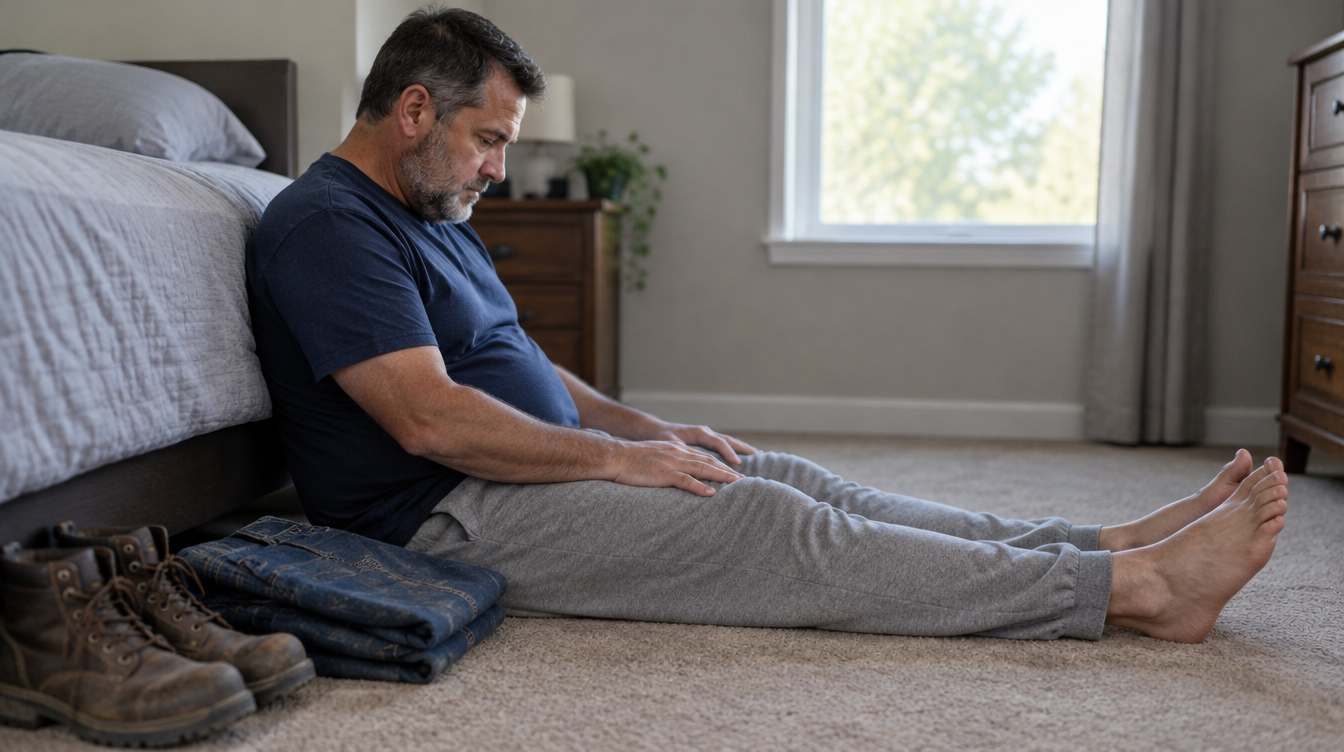
Knee Won’t Straighten After Meniscus Surgery? Why It Happens and What Helps
Three weeks out, the other knee lies flat and yours won’t. Why a knee stays bent after a meniscus trim or repair, when protocols expect it straight, what rehab teams use to get it back, and the signs that mean call to…
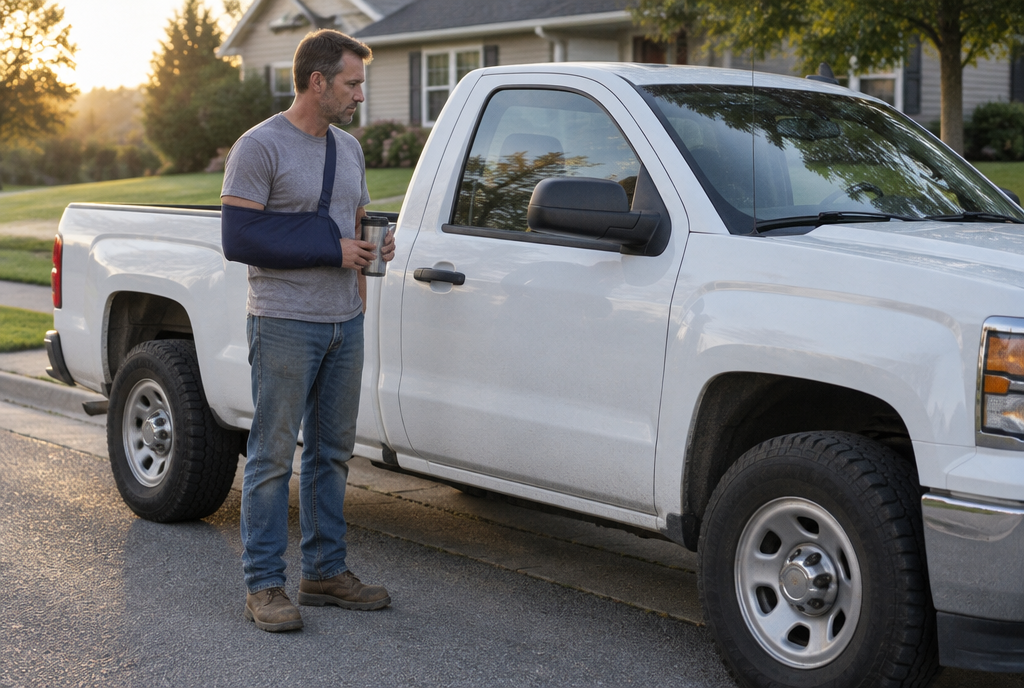
When Can You Drive After Rotator Cuff Surgery and Get Back in the Work Truck?
Dispatch wants you back on the road, and your arm is still strapped to your belly. What the sling means for driving after a rotator cuff repair, what the few driving studies found, and a check to run before your first…
Running After ACL Surgery: When Your First Jog Comes, and What It Tells You About Work
Your PT says you can try a jog. You’re wondering if ladders are next. When the first run usually comes after ACL reconstruction, what clinics test first, what a first run-walk looks like, and what it does and doesn’t …