You Used to Trust Your Body. How Do You Get That Back?
You were cleared. Your body said yes. Something else said no. Why hesitation after injury is so common, and a step-by-step ladder to rebuild trust.

The story below is a composite of real experiences; details changed.
Your surgeon cleared you. The rest of you didn’t get the memo.
Kevin Doyle, 38, tore his ACL at 36, going up for a rebound in a Tuesday night league. Surgery went fine. Rehab went fine. Ten months ago the surgeon shook his hand and said, “You’re good to go.”
He hasn’t played since.
Last Saturday his son asked him to shoot around. Kevin went. He stood flat-footed at the free-throw line and didn’t jump once.
His knee said yes. Something else said no.
That something is fear of reinjury. It’s more common than anyone admits, and it can be retrained.
This is more common than anyone admits
You might think you’re the only one. You’re not.
A large review pooled 69 studies and more than 7,500 people after ACL reconstruction. About eight in ten got back to some sport. Only about two in three got back to their old level. Just over half returned to competitive play. (Ardern et al., British Journal of Sports Medicine, 2014)
The same review found a pattern. People with less fear of reinjury, and more psychological readiness, were more likely to get back to their old level.
That’s ACL data, and it shows a link, not a cause. But the message travels. Your head is part of your recovery, not a side issue.
Your body can be cleared before you are. Both need rehab.
Why the hesitation makes sense
Hesitation is your brain doing its job. It remembers the pop, the swelling, the months of work. It wants proof before it lets you take the risk again.
That’s not irrational. The problem is when it never gets the proof, because you never give it a safe chance to collect any.
Experts see return to activity as a continuum, not a single “cleared” moment. A 2016 international consensus describes it in stages: return to participation, return to sport, then return to performance. Physical, psychological and life factors all shape the decision. (Ardern et al., Bern Consensus, 2016)
In plain terms: “cleared” is a starting line, not a finish line.
The evidence, without the theater
What the research shows
- Many people don’t get back to their old level, even after a successful surgery.
- Lower fear and greater readiness go with getting back to the old level.
- Return to activity happens in stages.
What it doesn’t show
- That fear means your tissue is weak, or that it’s strong.
- That confidence alone prevents reinjury.
- A universal test that says you’re ready.
Build a confidence ladder
You rebuilt strength one rep at a time. Confidence works the same way.
Your confidence ladder
- Name the top rung. The exact thing you want back. “Play pickup with my son.”
- Break it into 5 to 8 rungs. Kevin’s: jog the court, defensive slides, two-foot jumps, one-foot hops, shoot off the dribble, half-court 1-on-1, full game.
- Clear each rung with your clinician or PT. They know what your knee can handle.
- Repeat a rung until it’s boring. Boring is the goal. Boring means your brain believes it.
- Only then move up. One rung at a time.
Track expected versus actual
Before each session, write down two things:
- What you expect to happen. “My knee will buckle on the hop.”
- How worried you are, from 0 to 10.
After the session, write what actually happened.
Most people find the gap is big. They expected the worst and got a good session. That gap, written down again and again, is how trust comes back.
Keep two separate scores: what your knee can do and how sure you feel. They move at different speeds, and both count. For more on measuring the right things, see what counts as progress.
Pain dropped, but not sure you’re ready to go hard? Read our guide to pain being down and being ready to train hard again.
When not to wait
Stop and get checked if:
- The joint gives way, locks or catches.
- It swells after activity and stays swollen.
- You feel a new pop or sharp pain.
- Fear or low mood is hurting your sleep, work or relationships. Tell your clinician. A sports psychologist or counselor can help, and asking is a smart move, not a weak one.
For a longer view of what you’re rebuilding for, ask what you still want to be able to do in ten years.
Saturday, again
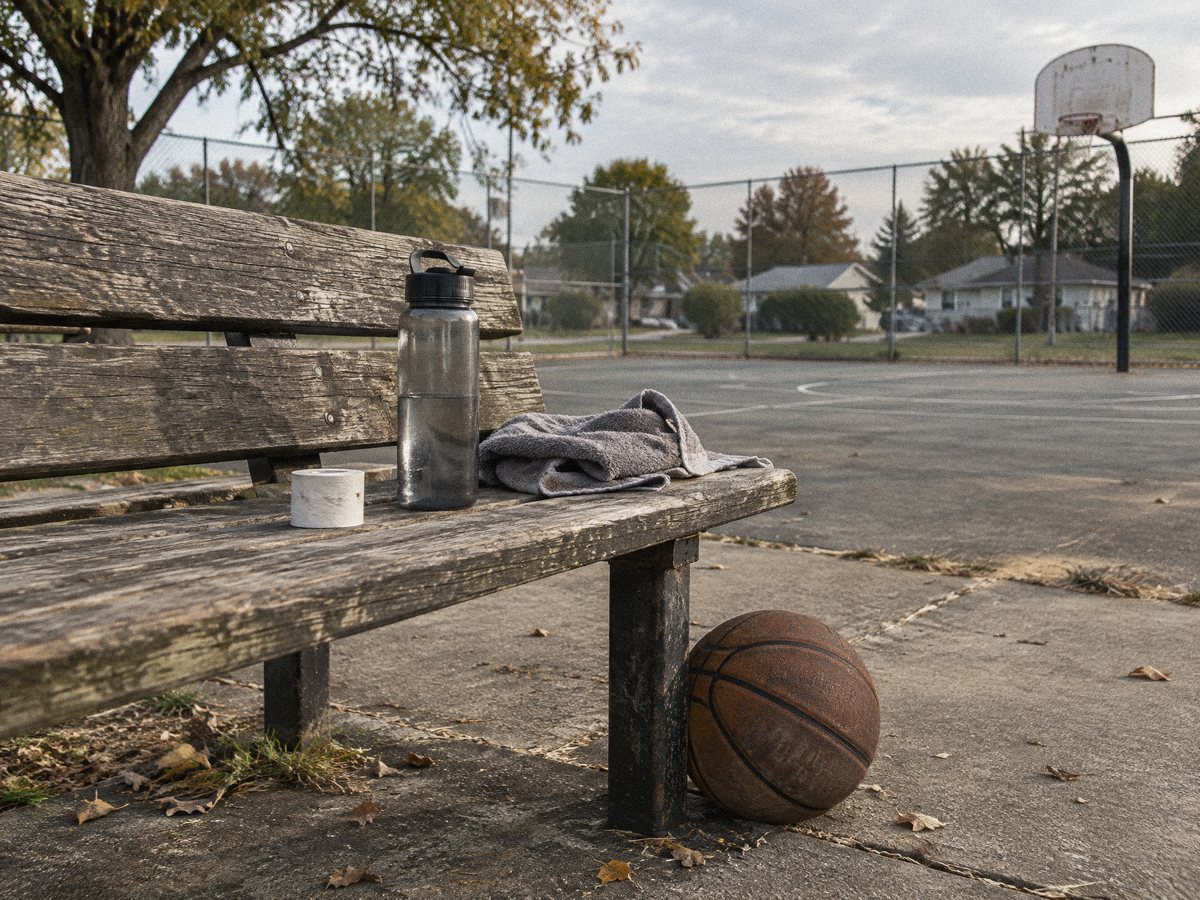
Six weeks later, Kevin is back at the same hoop. He’s been working the ladder: slides, hops, off-the-dribble.
His notebook from Thursday reads: Expected: knee gives out on the hop. Worry: 7. Actual: fine. Did 20.
His son bounces him the ball. Kevin takes one dribble and goes up.
It’s not pretty. It goes in anyway.
Trust doesn’t come back all at once. It comes back one boring rep at a time. Tonight, write down your top rung. Then write the first small step below it.
Kevin is a composite, drawn from the kinds of stories people describe after injury. The details are illustrative. The pattern is real.
Free · Your Before-You-Leave Card
Don’t leave your next appointment with “rest it.”
Get the questions for your injury in 8 taps.
Get my card →Questions readers ask
- Is it normal to be afraid of reinjury after being cleared?
- Yes. After ACL reconstruction, many people return to some sport but not their old level, and a large review found that lower fear of reinjury and greater psychological readiness were linked to getting back to the old level.
- How do I rebuild confidence after an injury?
- Break the activity you want back into small steps, clear each step with your clinician or physical therapist, repeat each one until it feels routine, and track what you expected to happen against what actually happened.
- When should hesitation after injury be checked out?
- Get checked if the joint gives way, locks, swells after activity or you feel a new pop. If fear or low mood is affecting your sleep, work or relationships, tell your clinician; a sports psychologist or counselor can help.
Sources & references (3)
- Fifty-five per cent return to competitive sport following anterior cruciate ligament reconstruction surgery: an updated systematic review and meta-analysis · British Journal of Sports Medicine, 2014
- 2016 Consensus statement on return to sport from the First World Congress in Sports Physical Therapy, Bern · British Journal of Sports Medicine, 2016
- Sports Injuries: Diagnosis, Treatment, and Steps to Take · NIAMS, 2024
The Series
45 articlesPart 1: Understanding Your Injury (1 to 19)
- After the MRI: How to Read a Rotator Cuff Report Without Getting Sold a Surgery
- Told to “Just Rest It”? Five Questions to Ask Before You Leave
- When Shoulder Pain Keeps Waking You Up
- Meniscus Surgery Recovery: When Can You Return to Your Kind of Work?
- Rotator Cuff Surgery or More Physical Therapy? Questions That Clarify the Decision
- Achilles Tendon Pain: Why This Tendon Is a Different Problem
- Four Months After Rotator Cuff Repair and It Still Hurts: Normal, or a Retear?
- Your Knee Feels Worse After the Meniscus Scope. What Could Be Going On?
- Hip Flexor Pain After Hip Arthroscopy: Why It Shows Up and When It Settles
- Tennis Elbow That Won’t Go Away: Why Rest and Shots Stall, and What Helps
- Knee Swelling After Meniscus Surgery: How Long Is Normal, and When to Call
- Quad Won’t Fire After Knee Surgery? What Quad Shutdown Is and How to Get It Back
- Walking After Meniscus Surgery: When You Can, How Far, and When to Drop the Crutches
- How to Sleep After Rotator Cuff Surgery, and When Nights Get Easier
- Felt a Pop After Knee Surgery? Re-Tear or Setback, and When to Call
- Home After a Microdiscectomy: How Much to Walk and How Long to Sit
- Running After ACL Surgery: When Your First Jog Comes, and What It Tells You About Work
- When Can You Drive After Rotator Cuff Surgery and Get Back in the Work Truck?
- Knee Won’t Straighten After Meniscus Surgery? Why It Happens and What Helps
Part 2: Work and Real Life (20 to 29)
- You Can Still Work. But What Is Your Injury Costing You?
- Self-Employed and Injured: How to Plan for Time Away From Work
- Your Job and Your Workouts Are Loading the Same Injury
- How to Take Time to Recover When Everyone Depends on You
- What Do You Still Want to Be Able to Do in Ten Years?
- Microdiscectomy Recovery: When Can You Go Back to Heavy Work?
- Kneeling After Knee Surgery: Why It Comes Back Last and How to Retrain It
- Rotator Cuff Surgery Recovery: When Can You Go Back to Work?
- When Can You Drive After Knee Surgery and Get Back in the Work Van?
- When Can You Go Back to Physical Work After ACL Surgery?
Part 3: Back to Training (30 to 34)
Part 4: Reading the Evidence (35 to 45)
- Your Watch Says You’re Recovered. Your Shoulder Disagrees.
- Recovery Is Taking Longer Than You Expected. What Counts as Progress?
- Before You Buy Another Recovery Tool, Decide What You Need It to Do
- “It Worked for Me”: How to Evaluate a Recovery Claim
- BPC-157 After an Orthopedic Procedure: What Does the Research Actually Show?
- TB-500 vs. BPC-157: What the Research Actually Compares
- How to Read a Peptide COA: What It Proves and What It Doesn’t
- The Research Stack People Ask About After a Scope, and the Gaps in the Human Data
- What the Tendon Research on BPC-157 Actually Measured
- What’s in the Other 1%? Peptide Impurities, Explained
- Approved, Compounded or “Research Use Only”: What a Peptide’s Label Means in 2026
Free · 60-second recovery check
What’s really holding your recovery back?
Eight quick taps. Find the one thing stalling your recovery, then get the three moves to work on first, picked from 30 guides and 100+ cited sources.
- Your bottleneck, named in 60 seconds
- 3 moves for this week, fitted to your job
- Your Before-You-Leave Card: the questions for your next appointment
What got hurt?
Free. No sign-up to start. Not medical advice.
Keep reading
Doing PT but Not Getting Better? Why Tendons Plateau and What to Reassess
You haven’t missed a session, and you’re still stuck. Why tendons adapt slowly, what PT studies actually measure, and a six-point check to get your plan moving again.
How to Keep Training When Work Takes Over Your Week
Things don’t calm down, and your rehab can’t wait until they do. How little training it takes to hold on to strength, and how to plan normal, busy and disruption weeks.
Worried About Losing Muscle While Injured? Start With a Plan
It feels like years of work are disappearing. Some loss is real, and most is manageable. What disuse does, why training the other side helps, and a cleared-activity list.