How to Sleep After Rotator Cuff Surgery, and When Nights Get Easier
Awake in the recliner at 3 a.m., weeks after surgery? How to set up the chair or bed, the sling and the ice, when sleep usually comes back, and when to call.

The story below is a composite of real experiences; details changed.
3:15 a.m., the fourth night running. Doug shifted an inch in the recliner, and his shoulder yanked him out of sleep.
He’s 52 and runs a small framing crew. Three weeks ago, a surgeon reattached a torn tendon in his right shoulder. The arm now lives in a sling.
He carries 2x12s up ladders for a living. Tonight, he can’t pull the recliner lever. It’s on his bad side.
His crew is setting rafters without him, and every week in the sling means a short paycheck. At this hour, the worst thought gets loud: what if this is how it stays?
Here’s how to sleep after rotator cuff surgery, when the nights usually get easier, and when to call.
Why nights are the hardest part
You’re not imagining it. One NHS leaflet calls pain at night “particularly common” after rotator cuff repair. (Wrightington, Wigan and Leigh NHS, 2026)
Lying flat tends to hurt more. And you’re sleeping in a sling, which leaflets admit is hard. (WashU Medicine Orthopedics; Sandwell and West Birmingham NHS, 2026)
Bruising and some arm swelling are common too. They usually fade over a few weeks. (Oxford University Hospitals, 2024)
Bad nights may not be new, either. In one surgeon’s 326 patients, about 9 in 10 (89%) said the shoulder kept them from sleeping comfortably before surgery. That was a single yes-or-no question. (Journal of Shoulder and Elbow Surgery, 2022)
If the nights were bad long before surgery, read when shoulder pain keeps waking you up.
So when do they ease? One hospital warns that sleep can be hard for the first week or two. (WashU Medicine Orthopedics)
In one small study, sleep in 34 people after a cuff repair trended worse at 2 weeks, then improved by 3 months. The findings come from a conference abstract. (American Shoulder and Elbow Surgeons, 2025)
Bad nights at week 3 are common. They’re a stage, not a verdict.
How to sleep after rotator cuff surgery
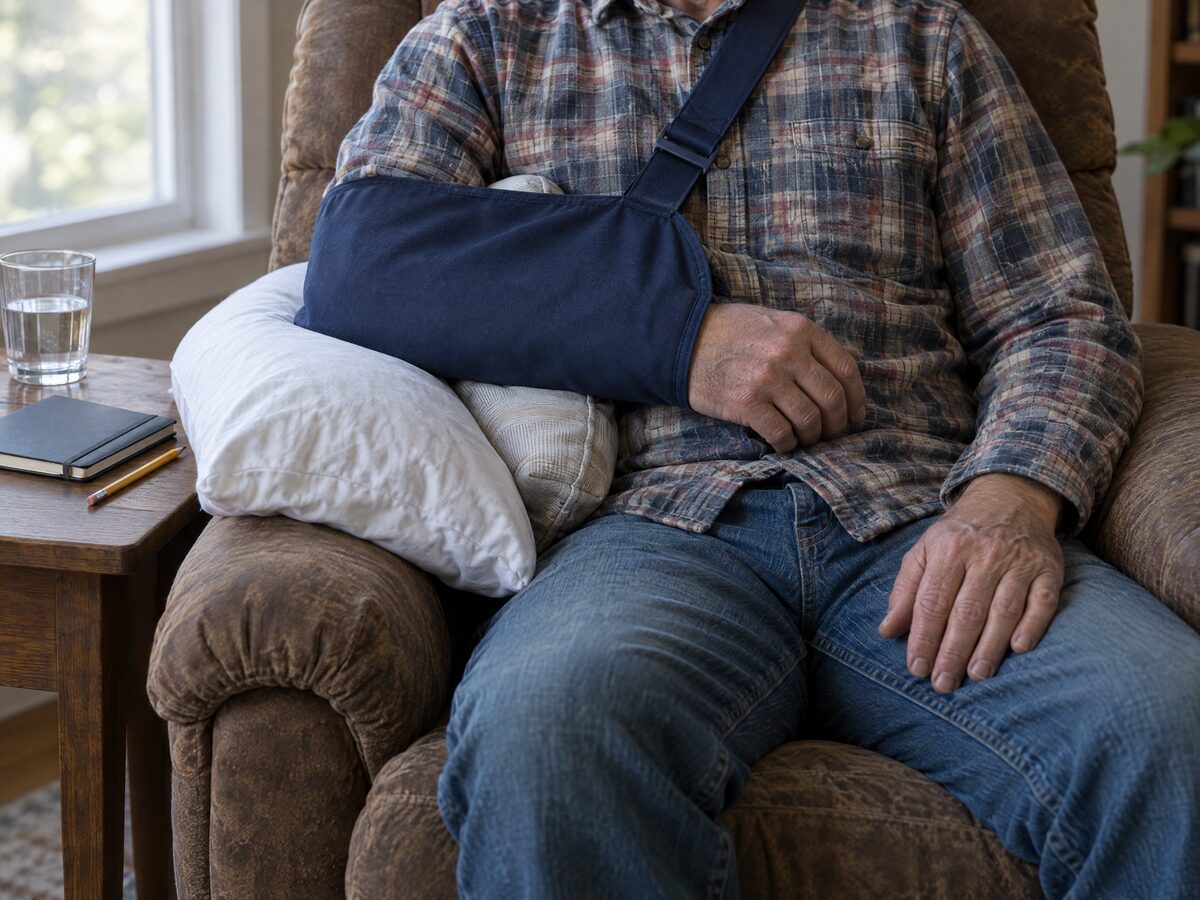
We found no trial comparing a recliner with a bed after this surgery. Leaflets don’t all agree, so your surgeon’s sheet wins.
- Sit back. Use a recliner, or prop your upper body on two or three pillows, about 45 degrees in one guide. Some US guides say never lie flat. Several NHS leaflets allow your back. (Kaiser Permanente, 2026; Allegheny Health Network, 2020; Sherwood Forest Hospitals, 2025; Sandwell and West Birmingham NHS, 2026)
- Prop the arm. Put pillows under your elbow and hand, not under the shoulder. Tuck another between your arm and your side. (UW Medical Center, 2026; WashU Medicine Orthopedics)
- Keep the sling on, nights included. Most leaflets say about 4 to 6 weeks. Your surgeon sets the date. One guide lets you loosen it lying down, but not take it off. (WashU Medicine Orthopedics; Oxford University Hospitals, 2024; UW Medical Center, 2026; Kaiser Permanente, 2026)
- Stay off the operated side. Two NHS leaflets say for 6 weeks. They suggest your back or your good side instead. One US guide says not to sleep on either side, so check your sheet. (Royal Berkshire NHS, 2025; Gateshead Health NHS; Kaiser Permanente, 2026)
- Allowed on your good side? Hug a pillow. It supports the arm. Leaflets warn against letting the elbow drift across your body at night. A pillow along your back keeps you from rolling onto the sore side. (Gateshead Health NHS; Royal Berkshire NHS, 2025; Sherwood Forest Hospitals, 2025)
Get in and out on your good side, and don’t push up with the operated arm. (UW Medical Center, 2026)
How long in the recliner? No study says. One surgeon writes that many people prefer it “especially for the first few days.” (OrthoNebraska, 2021)
Prop the arm, keep the sling on and stay off the operated side. Then sleep wherever that works and your surgeon’s sheet allows.
Pain relief, ice and the hour before bed
Take prescribed pain relief regularly at first, as directed. Tablets can take up to an hour to work. (Oxford University Hospitals, 2024)
One surgeon suggests timing pain relief to work as you fall asleep. Ask your surgeon or pharmacist whether that fits your prescription. (OrthoNebraska, 2021)
In the first week, one hospital suggests icing “especially before going to sleep.” Wrap the ice in a thin towel and keep the dressing dry. (WashU Medicine Orthopedics; Oxford University Hospitals, 2024)
Leaflets cap each session at 10 to 20 minutes, so follow your sheet. Don’t fall asleep with it on. (Royal Berkshire NHS, 2025; James Paget University Hospitals, 2021; MedlinePlus, 2024; OrthoNebraska, 2021)
The proof for cold is thin. Two small, old trials (50 and 70 people) tested a cold therapy device after various shoulder operations. Those given it slept better or hurt less right after surgery, but neither was blinded. (Journal of Shoulder and Elbow Surgery, 1996; Journal of Shoulder and Elbow Surgery, 2001)
A 2026 review pooled 28 trials after bone and joint surgery. Pain fell by less than 1 point out of 10, below what patients usually notice. Only 2 trials were shoulders. (British Journal of Sports Medicine, 2026)
Treat ice and pain relief as comfort tools. Plan them around bedtime, as your surgeon’s sheet says.
The evidence, without the theater
What the research shows
- Poor sleep is common before a repair, and most people sleep better within months.
- In one small study, sleep trended worse at 2 weeks, then improved.
- Cold therapy may ease pain a little in the first days.
What it doesn’t show
- That a recliner beats a bed, or how long to use one.
- That surgery caused the better sleep. Most studies had no comparison group.
- When your own nights will turn.
When the nights get easier
Studies track sleep in months, not nights. Here’s the rough shape.
- Weeks 1 to 2. Often hard. In the small study above, sleep trended worse at 2 weeks. (American Shoulder and Elbow Surgeons, 2025)
- Around 6 weeks. In 48 people (average age 62), night pain came less often than before surgery. Of 68 who started, 20 dropped out. (Orthopaedic Journal of Sports Medicine, 2019)
- Around 3 months. In 58 people (average age 63), sleep wasn’t clearly better at 1 month, but was by 3. No comparison group. (International Journal of Environmental Research and Public Health, 2021)
- By 6 months to 2 years. The one-surgeon study followed 250 people who slept badly before surgery. About 6 in 10 (62%) could sleep comfortably again by 6 months, and about 8 in 10 (81%) by 2 years. Of the 250, 33 dropped out before reporting better sleep. (Journal of Shoulder and Elbow Surgery, 2022)
- Your operated side. In 474 people, side sleeping improved fastest between months 3 and 6. Years later, about 2 in 3 (66%) could sleep on that side. Records reviewed after the fact, in a conference abstract. (AAOS Annual Meeting, 2025)
Some people take longer. One NHS leaflet says it’s not unusual to have as much pain at 3 months as before surgery. Another, covering several kinds of shoulder surgery, says most people’s pain eases a lot by then. (Leeds Teaching Hospitals, 2022; NHS Western Isles, 2023)
At week 3, Doug is near the start of that curve. If yours feels stuck later, read what counts as progress.
Expect weeks for the worst nights to ease, and months for sleep to come back.
Log your nights for one week
At 3 a.m., every night feels like the worst one. A week on paper shows the real trend.
The night setup and a one-week sleep log
Before bed, check:
- Recliner set, or two or three pillows behind your back.
- A pillow under the elbow and hand, and one at your side.
- Sling on, loosened only if your surgeon allows it.
- Ice wrapped, used before bed, off before you sleep.
- Water, phone and any prescribed pain relief on your good side.
Each morning, write down:
- Where you slept, and how upright.
- Lights out and final wake-up.
- Wake-ups: how many, and when.
- What woke you: ache, arm slipped, rolled over, sling, other.
- Pain on waking, 0 to 10.
- Ice before bed, and when you took prescribed pain relief.
- How rested you feel, 0 to 10.
Getting easier: fewer wake-ups and lower waking pain, week over week.
Bring it in: a week worse than the one before, or pain that climbs instead of easing.
This is a practical structure, not a tested protocol. Take it to your follow-up, along with the five questions to ask before you leave.
Judge the week, not the night.
What’s not normal
Slow and uneven is normal. A turn for the worse, or a new symptom, is a phone call.
When not to wait
Call 911 for chest pain, shortness of breath, coughing up blood or fainting.
Call your surgeon’s office right away if you have any of these. If you can’t reach them, go to urgent care or the ER.
- A fever above 101°F (38.3°C), or feeling unwell with a temperature.
- Redness, warmth, swelling, red streaks, or yellow or green discharge at a wound, or a wound that opens.
- Bleeding that soaks through the dressing.
- Numbness or tingling in your fingers or hand once any nerve block has worn off.
- Fingers that look blue or darker, or feel cool.
- Arm swelling that’s new, or getting worse instead of fading.
- Pain or swelling in one calf or thigh.
- Pain your prescribed pain relief doesn’t touch, or a sudden jump in severe pain.
- A sudden change in what the arm can do.
Sources: MedlinePlus on shoulder surgery; NHS on DVT; Kaiser Permanente; Sandwell and West Birmingham, Gateshead and Leeds NHS trusts.
Back in the recliner
The next night, Doug builds the setup: a pillow under his elbow, another at his side. His wife works the lever.
Ice on at 9:30, off at 9:45. His surgeon’s office helps him time his pain relief.
Every wake-up goes in the log on the armrest. By the end of week 4, it shows two a night instead of four.
Not fixed. Better, and on paper. When the 3 a.m. fear shows up, his own handwriting talks back.
The crew is still months away. For that part, read going back to work after rotator cuff surgery.
Worried about the crew or the money? See how to recover when everyone depends on you, and how to plan for time away from work.
For now, his only job is the night.
Your next step: tonight, put a pillow under your elbow and a pen by your chair, and write down every wake-up.
Doug is a composite, drawn from the kinds of stories tradespeople describe after rotator cuff surgery. The details are illustrative.
Free · Your Before-You-Leave Card
Don’t leave your next appointment with “rest it.”
Get the questions for your injury in 8 taps.
Get my card →Questions readers ask
- How should I sleep after rotator cuff surgery?
- Sit back, in a recliner or propped on two or three pillows. Put pillows under your elbow and hand, not under the shoulder, and tuck another between your arm and your side. Keep the sling on, nights included, and stay off the operated side. Leaflets don’t all agree on lying flat or sleeping on your good side, so follow your surgeon’s sheet.
- How long will I sleep in a recliner after rotator cuff surgery?
- No study says, and we found no trial comparing a recliner with a bed after this surgery. One surgeon writes that many people prefer a recliner especially for the first few days. Wherever you sleep, keep the sling on, nights included. Most leaflets say about 4 to 6 weeks, and your surgeon sets the date.
- When does sleep get better after rotator cuff surgery?
- Sleep can be hard for the first week or two. In small studies, sleep was better by about 3 months. One surgeon’s study followed 250 people who slept badly before surgery. About 6 in 10 could sleep comfortably again by 6 months, and about 8 in 10 by 2 years. In a records review of 474 people, sleeping on the operated side improved fastest between months 3 and 6.
Sources & references (24)
- Rotator Cuff Repair Surgery · Wrightington, Wigan and Leigh Teaching Hospitals NHS Foundation Trust, 2026
- Rotator cuff surgery: preparing for surgery and recovery · WashU Medicine Orthopedics
- Following Shoulder Surgery · Sandwell and West Birmingham NHS Trust, 2026
- Rotator cuff repair: Information for patients · Oxford University Hospitals NHS Foundation Trust, 2024
- Majority of patients find sleep patterns return to normal 6 months following rotator cuff repair · Journal of Shoulder and Elbow Surgery, 2022
- Sleep Quality and Response after Rotator Cuff Repair, Total Shoulder Arthroplasty, and Reverse Shoulder Arthroplasty · American Shoulder and Elbow Surgeons, 2025
- Rotator Cuff Repair: What to Expect at Home · WebMD Ignite, via Kaiser Permanente, 2026
- Your complete guide to recovery after rotator cuff surgery · Allegheny Health Network, 2020
- Rotator cuff repair operation · Sherwood Forest Hospitals NHS Foundation Trust, 2025
- Protecting Your Shoulder After Surgery · University of Washington Medical Center, 2026
- Rotator cuff repair · Royal Berkshire NHS Foundation Trust, 2025
- Shoulder and Elbow: Post-surgery information · Gateshead Health NHS Foundation Trust
- FAQ About Sleeping After Shoulder Surgery · OrthoNebraska, 2021
- Rotator Cuff Repair · James Paget University Hospitals NHS Foundation Trust, 2021
- Shoulder surgery: discharge · MedlinePlus, 2024
- The efficacy of cryotherapy in the postoperative shoulder · Journal of Shoulder and Elbow Surgery, 1996
- The efficacy of continuous cryotherapy on the postoperative shoulder: a prospective, randomized investigation · Journal of Shoulder and Elbow Surgery, 2001
- Effectiveness of cryotherapy on pain intensity, range of motion, swelling and function in the postoperative care of musculoskeletal disorders: a systematic review and meta-analysis of randomised controlled trials · British Journal of Sports Medicine, 2026
- Narcotic Use and Resiliency Scores Do Not Predict Changes in Sleep Quality 6 Months After Arthroscopic Rotator Cuff Repair · Orthopaedic Journal of Sports Medicine, 2019
- Arthroscopic Rotator Cuff Repair Improves Sleep Disturbance and Quality of Life: A Prospective Study · International Journal of Environmental Research and Public Health, 2021
- Improvement in Sleep Disturbance Following Arthroscopic Rotator Cuff Repair · AAOS Annual Meeting, 2025
- Rotator Cuff Repair: Information for patients · Leeds Teaching Hospitals NHS Trust, 2022
- Shoulder Surgery: post-surgery information and advice · NHS Western Isles, 2023
- Deep vein thrombosis (DVT) · NHS, 2026
The Series
45 articlesPart 1: Understanding Your Injury (1 to 19)
- After the MRI: How to Read a Rotator Cuff Report Without Getting Sold a Surgery
- Told to “Just Rest It”? Five Questions to Ask Before You Leave
- When Shoulder Pain Keeps Waking You Up
- Meniscus Surgery Recovery: When Can You Return to Your Kind of Work?
- Rotator Cuff Surgery or More Physical Therapy? Questions That Clarify the Decision
- Achilles Tendon Pain: Why This Tendon Is a Different Problem
- Four Months After Rotator Cuff Repair and It Still Hurts: Normal, or a Retear?
- Your Knee Feels Worse After the Meniscus Scope. What Could Be Going On?
- Hip Flexor Pain After Hip Arthroscopy: Why It Shows Up and When It Settles
- Tennis Elbow That Won’t Go Away: Why Rest and Shots Stall, and What Helps
- Knee Swelling After Meniscus Surgery: How Long Is Normal, and When to Call
- Quad Won’t Fire After Knee Surgery? What Quad Shutdown Is and How to Get It Back
- Walking After Meniscus Surgery: When You Can, How Far, and When to Drop the Crutches
- How to Sleep After Rotator Cuff Surgery, and When Nights Get Easier
- Felt a Pop After Knee Surgery? Re-Tear or Setback, and When to Call
- Home After a Microdiscectomy: How Much to Walk and How Long to Sit
- Running After ACL Surgery: When Your First Jog Comes, and What It Tells You About Work
- When Can You Drive After Rotator Cuff Surgery and Get Back in the Work Truck?
- Knee Won’t Straighten After Meniscus Surgery? Why It Happens and What Helps
Part 2: Work and Real Life (20 to 29)
- You Can Still Work. But What Is Your Injury Costing You?
- Self-Employed and Injured: How to Plan for Time Away From Work
- Your Job and Your Workouts Are Loading the Same Injury
- How to Take Time to Recover When Everyone Depends on You
- What Do You Still Want to Be Able to Do in Ten Years?
- Microdiscectomy Recovery: When Can You Go Back to Heavy Work?
- Kneeling After Knee Surgery: Why It Comes Back Last and How to Retrain It
- Rotator Cuff Surgery Recovery: When Can You Go Back to Work?
- When Can You Drive After Knee Surgery and Get Back in the Work Van?
- When Can You Go Back to Physical Work After ACL Surgery?
Part 3: Back to Training (30 to 34)
Part 4: Reading the Evidence (35 to 45)
- Your Watch Says You’re Recovered. Your Shoulder Disagrees.
- Recovery Is Taking Longer Than You Expected. What Counts as Progress?
- Before You Buy Another Recovery Tool, Decide What You Need It to Do
- “It Worked for Me”: How to Evaluate a Recovery Claim
- BPC-157 After an Orthopedic Procedure: What Does the Research Actually Show?
- TB-500 vs. BPC-157: What the Research Actually Compares
- How to Read a Peptide COA: What It Proves and What It Doesn’t
- The Research Stack People Ask About After a Scope, and the Gaps in the Human Data
- What the Tendon Research on BPC-157 Actually Measured
- What’s in the Other 1%? Peptide Impurities, Explained
- Approved, Compounded or “Research Use Only”: What a Peptide’s Label Means in 2026
Free · 60-second recovery check
What’s really holding your recovery back?
Eight quick taps. Find the one thing stalling your recovery, then get the three moves to work on first, picked from 30 guides and 100+ cited sources.
- Your bottleneck, named in 60 seconds
- 3 moves for this week, fitted to your job
- Your Before-You-Leave Card: the questions for your next appointment
What got hurt?
Free. No sign-up to start. Not medical advice.
Keep reading
Knee Won’t Straighten After Meniscus Surgery? Why It Happens and What Helps
Three weeks out, the other knee lies flat and yours won’t. Why a knee stays bent after a meniscus trim or repair, when protocols expect it straight, what rehab teams use to get it back, and the signs that mean call to…
When Can You Drive After Rotator Cuff Surgery and Get Back in the Work Truck?
Dispatch wants you back on the road, and your arm is still strapped to your belly. What the sling means for driving after a rotator cuff repair, what the few driving studies found, and a check to run before your first…
Running After ACL Surgery: When Your First Jog Comes, and What It Tells You About Work
Your PT says you can try a jog. You’re wondering if ladders are next. When the first run usually comes after ACL reconstruction, what clinics test first, what a first run-walk looks like, and what it does and doesn’t …