Kneeling After Knee Surgery: Why It Comes Back Last and How to Retrain It
Your surgeon is happy with the knee. You still can’t put it on the floor. Why kneeling lags after a scope, an ACL graft or a knee replacement, what the research shows, and a ladder to retrain it.

The story below is a composite of real experiences; details changed.
Travis has laid floors for 19 years. His work happens on his knees.
Nine months ago, a surgeon rebuilt his right ACL with a strip of his own patellar tendon. Travis is 41. He can squat again and carry plank up two flights. His surgeon is happy with the graft.
But he can’t put his right knee on the subfloor.
The skin below his kneecap is numb. Yet kneeling there feels like pressing on a bruise. So he kneels on his left and twists to reach.
Here’s why kneeling is often the last thing to come back after knee surgery, and how to retrain yours in steps.
Why kneeling is usually the last thing to come back
Kneeling puts your body weight on a small patch at the front of the knee. In a small lab study, most of that pressure went through the patellar tendon and the bony bump below it, not the kneecap. (Applied Ergonomics, 2010)
That’s where a patellar tendon graft comes from. Scope incisions sit beside it, and a replacement incision runs down the front.
Even a scope can leave kneeling stuck. In a Danish study of 641 adults having meniscus surgery, kneeling was among the most common limitations. A year later, some problems had barely improved. (Acta Orthopaedica, 2018)
Getting worse instead of slowly better? Read about a knee that feels worse after a meniscus scope.
Kneeling is a pressure test on the most-operated-on patch of your knee. Expect it to lag.
How long it takes, by surgery
| Surgery | Why kneeling hurts | What the research found | What usually helps |
|---|---|---|---|
| Scope to trim a meniscus | Swelling, sore incisions, a weak thigh | Rehab about 3 to 6 weeks, but kneeling is a common holdout | Let swelling settle, then soft surfaces |
| ACL, patellar tendon graft | Tender donor site where you kneel, numbness | About 1 in 5 (21.3%) had severe or extreme kneeling difficulty at 2 years | Graded practice, wide padding |
| ACL, hamstring graft | Numbness from the harvest incision | About 1 in 10 (9.4%) at 2 years | The same graded practice |
| Knee replacement | Numbness, limited bend, fear for the implant | About 1 in 3 (35%) kneel within a year; about half (48%) after 3+ years | A clear go-ahead, teaching, practice |
Sources: AAOS OrthoInfo and the studies cited below.
Find your row. It shows what’s normal for now.
Why a patellar tendon graft makes kneeling harder
New Zealand’s national ACL registry tracked 10,999 patients. At two years, 21.3% with a patellar tendon graft reported severe or extreme kneeling difficulty: about 1 in 5. With a hamstring graft, it was 9.4%, about 1 in 10. (American Journal of Sports Medicine, 2023)
Overall knee pain was no different. Those knees were just harder to kneel on.
Norway’s registry found the same at five years. Among 10,329 patients, hamstring grafts carried about 43% lower odds of kneeling problems, a little over half the odds. Both registries rely on self-reports. (Journal of Experimental Orthopaedics, 2025)
That doesn’t make your graft the wrong call. The Norwegian authors say graft choice should weigh your job and sport against the risk of graft failure. Planning the whole return? See going back to physical work after ACL surgery.
Hard kneeling after a patellar tendon graft is common. On its own, it doesn’t mean the surgery failed.
Why a numb patch makes kneeling feel wrong
A small skin nerve, the infrapatellar branch of the saphenous nerve, crosses the front of the knee below the kneecap. Incisions there can cut or stretch it.
One study followed 60 people with a patellar tendon graft. About 3 in 4 (77%) reported reduced feeling. About two years out, 58% still had it: more than half. (Journal of Orthopaedic Surgery, 2017)
Three of them regretted the surgery because of numbness and trouble kneeling.
Hamstring grafts aren’t immune. Depending on the incision, 45% to 77% still had a numb patch at six months: roughly half to 3 in 4. (Journal of Orthopaedic Surgery, 2017)
After knee replacement, studies cited in a 2021 review link more numbness to worse kneeling. (Knee Surgery & Related Research, 2021)
Numb skin over tender tissue is a strange mix. You can’t feel the floor, but you feel the ache underneath.
Numbness may never fully fade. Plan to kneel with it, not wait it out.
After a knee replacement, can you kneel on it?
Many people can’t at first. A 2021 review pooled 36 studies of 12,626 people with knee replacements. About 1 in 3 (35%) could kneel within a year. After three or more years, about half (48%) could. (Knee Surgery & Related Research, 2021)
Part of that gap is fear. In one study cited by a 2023 review, only about 1 in 3 people with a knee replacement (37%) thought they could kneel. When tested, about 4 in 5 (81%) could. (Arthroplasty, 2023)
Part of it is mixed messages. MedlinePlus discharge instructions say not to kneel to pick things up. (MedlinePlus)
Yet one NHS physical therapy team tells patients: “You will not do any harm to the knee replacement by kneeling on it.” (Royal Berkshire NHS Foundation Trust)
Teaching helps. In a randomized trial of 60 people with a partial knee replacement, those given kneeling advice and education reported better kneeling a year later. (Physical Therapy, 2008)
Ask your surgeon for a clear yes or no on kneeling, and a date to start.
The evidence, without the theater
What the research shows
- Kneeling trouble is common after knee surgery and can take years to improve.
- Patellar tendon grafts bring more kneeling difficulty than hamstring grafts, without more overall pain.
- After partial knee replacement, teaching people to kneel helped.
What it doesn’t show
- A tested kneeling program after ACL surgery or a scope.
- What years of daily kneeling at work do to a knee replacement.
- When you, personally, will kneel comfortably again.
How to retrain kneeling, one rung at a time
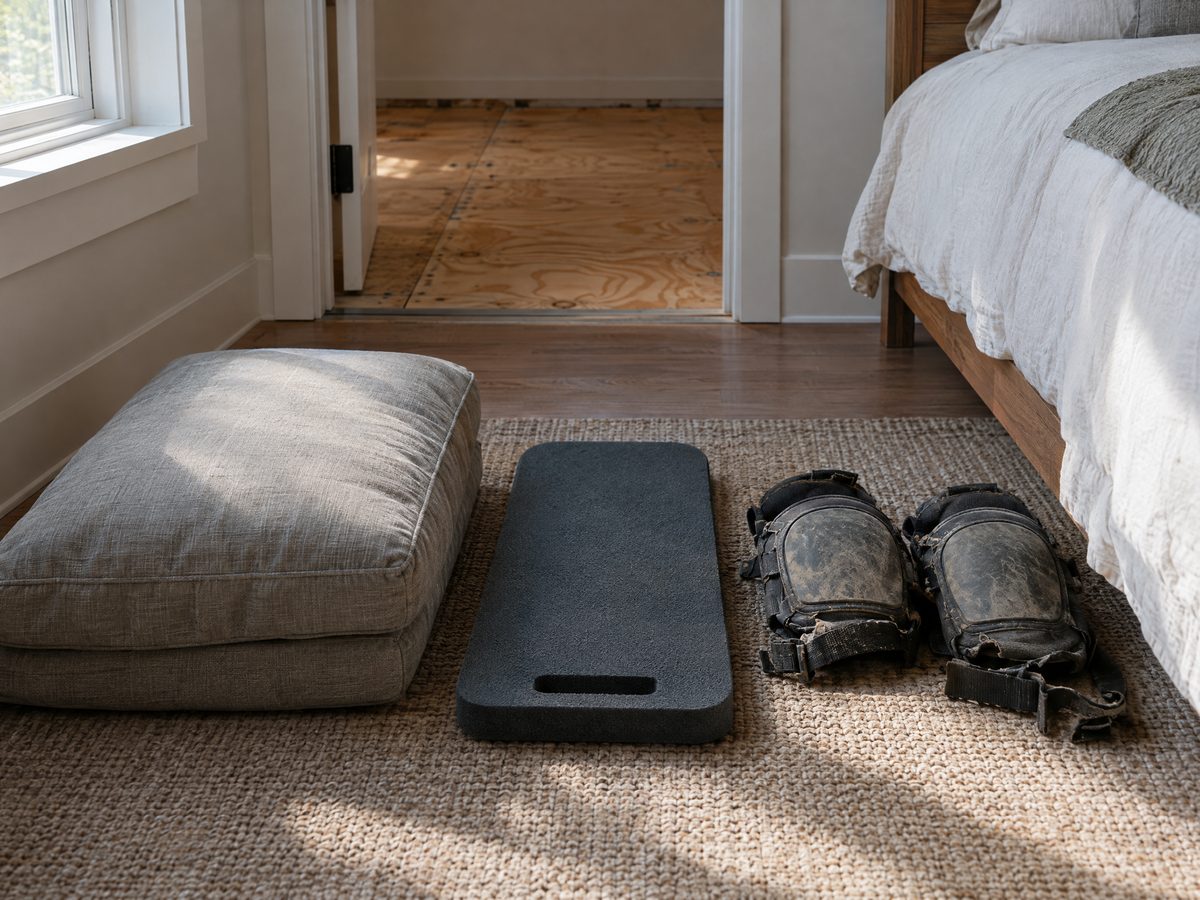
Start once you’re cleared and the scar is comfortable. Then follow the NHS team’s order: soft surfaces first, then firmer ones with a pad.
The kneeling ladder: bed to job site
- The bed. Kneel on the mattress, hands down. 30 seconds.
- Half-kneel on a cushion. Surgical knee down, a hand on a chair. 1 minute.
- Tall kneel on a thick mat. 2 minutes, then ease your hips back toward your heels.
- Knee pads on carpet. Do a light task, like sorting fittings. 5 to 10 minutes.
- Knee pads on the job floor. Real work in short blocks.
The rule: Pass means pain stays at 3 out of 10 or lower. By morning, the knee is back to its usual, with no extra swelling.
Pass twice, move up. Fail, drop back one rung for a few days. Sharp pain means stop.
This is a practical structure, not a tested protocol. Adjust it with your PT.
Log your rung each week. Progress is uneven, so know what counts as progress.
Let the morning after, not the calendar, decide when you move up.
Making the job fit the knee while it catches up
Pads help, but they don’t erase the load. In that kneeling study, pads lowered peak pressure over the tendon, yet peaks above 25 psi remained. (Applied Ergonomics, 2010)
- Test pads early. Look for padding that spreads the load wide, not a hard point under the tendon.
- Half-kneel and switch. Swap knees before either one gets sore.
- Get off your knees when you can. Try a low rolling seat, and do layout and cuts standing.
- Kneel in blocks. Twenty minutes down, a few minutes up.
Had a scope? See when to return to your kind of work after meniscus surgery. Run your own crew? Here’s how to plan for time away from work.
The job doesn’t have to wait for a perfect knee. It has to fit the knee you have this month.
When not to wait
Call your surgeon the same day if you have:
- A fever above 101°F (38.3°C), or redness, swelling or yellowish discharge at an incision.
- A hot, swollen knee, especially with fever or chills.
- An incision that opens, or bleeding that won’t stop with pressure.
- Calf pain or swelling. For chest pain or shortness of breath, call 911.
- Pain that keeps getting worse.
- A foot or toes that look darker than normal or feel cool to the touch.
- A knee that locks and won’t straighten, or keeps giving way.
Sources: MedlinePlus on knee arthroscopy and knee replacement; AAOS OrthoInfo.
Back on the subfloor
Travis starts on the bed, feeling ridiculous. Two weeks later, he’s half-kneeling on a couch cushion during the game.
By month eleven, he’s on rung 5: pads on, twenty-minute blocks, cuts done standing. The numb patch is still there. The bruise underneath is fading.
He’s back down on his right knee. No more twisting to reach.
Give it a ladder, not a guess.
Your next step: this week, ask your surgeon, “Am I cleared to kneel, and from when?”
Travis is a composite, drawn from the kinds of stories tradespeople describe after knee surgery. The details are illustrative.
Free · Your Before-You-Leave Card
Don’t leave your next appointment with “rest it.”
Get the questions for your injury in 8 taps.
Get my card →Questions readers ask
- Why can’t I kneel after knee surgery?
- Kneeling puts your weight on a small patch at the front of the knee, where many grafts and incisions sit. Swelling, a tender donor site, numb skin and limited bending all make it harder. In large studies, kneeling trouble is common after knee surgery and can take years to improve.
- Is kneeling harder after a patellar tendon ACL graft?
- In New Zealand’s ACL registry, 21.3% of patients with a patellar tendon graft reported severe or extreme kneeling difficulty at two years, versus 9.4% with a hamstring graft. Overall knee pain was no different. Norway’s registry found hamstring grafts carried about 43% lower odds of kneeling problems at five years.
- Can kneeling damage a knee replacement?
- One NHS physical therapy team tells patients that kneeling will not harm the knee replacement, and suggests starting on a soft surface once the scar is comfortable. Early discharge instructions may say not to kneel, so ask your surgeon when you’re cleared. A 2021 review found about 35% of people could kneel within a year and about 48% after three or more years.
Sources & references (10)
- Comparison of Knee Pain and Difficulty With Kneeling Between Patellar Tendon and Hamstring Tendon Autografts After Anterior Cruciate Ligament Reconstruction: A Study From the New Zealand ACL Registry · The American Journal of Sports Medicine, 2023
- Use of hamstring autografts for ACL reconstruction significantly decreased the risk of reporting problems with kneeling at a 5-year follow-up · Journal of Experimental Orthopaedics, 2025
- Prevalence and clinical implications of nerve injury during bone patellar tendon bone harvesting for anterior cruciate ligament reconstruction · Journal of Orthopaedic Surgery, 2017
- Injury of the infrapatellar branch of the saphenous nerve due to hamstring graft harvest: A prospective comparative study of two different incisions · Journal of Orthopaedic Surgery, 2017
- Surgery-related predictors of kneeling ability following total knee arthroplasty: a systematic review and meta-analysis · Knee Surgery & Related Research, 2021
- Patellar resurfacing and kneeling ability after total knee arthroplasty: a systematic review · Arthroplasty, 2023
- After partial knee replacement, patients can kneel, but they need to be taught to do so: a single-blind randomized controlled trial · Physical Therapy, 2008
- Advice and exercises after a total knee replacement · Royal Berkshire NHS Foundation Trust, 2024
- Pressure distribution on the anatomic landmarks of the knee and the effect of kneepads · Applied Ergonomics, 2010
- Patient-reported symptoms and changes up to 1 year after meniscal surgery · Acta Orthopaedica, 2018
The Series
45 articlesPart 1: Understanding Your Injury (1 to 19)
- After the MRI: How to Read a Rotator Cuff Report Without Getting Sold a Surgery
- Told to “Just Rest It”? Five Questions to Ask Before You Leave
- When Shoulder Pain Keeps Waking You Up
- Meniscus Surgery Recovery: When Can You Return to Your Kind of Work?
- Rotator Cuff Surgery or More Physical Therapy? Questions That Clarify the Decision
- Achilles Tendon Pain: Why This Tendon Is a Different Problem
- Four Months After Rotator Cuff Repair and It Still Hurts: Normal, or a Retear?
- Your Knee Feels Worse After the Meniscus Scope. What Could Be Going On?
- Hip Flexor Pain After Hip Arthroscopy: Why It Shows Up and When It Settles
- Tennis Elbow That Won’t Go Away: Why Rest and Shots Stall, and What Helps
- Knee Swelling After Meniscus Surgery: How Long Is Normal, and When to Call
- Quad Won’t Fire After Knee Surgery? What Quad Shutdown Is and How to Get It Back
- Walking After Meniscus Surgery: When You Can, How Far, and When to Drop the Crutches
- How to Sleep After Rotator Cuff Surgery, and When Nights Get Easier
- Felt a Pop After Knee Surgery? Re-Tear or Setback, and When to Call
- Home After a Microdiscectomy: How Much to Walk and How Long to Sit
- Running After ACL Surgery: When Your First Jog Comes, and What It Tells You About Work
- When Can You Drive After Rotator Cuff Surgery and Get Back in the Work Truck?
- Knee Won’t Straighten After Meniscus Surgery? Why It Happens and What Helps
Part 2: Work and Real Life (20 to 29)
- You Can Still Work. But What Is Your Injury Costing You?
- Self-Employed and Injured: How to Plan for Time Away From Work
- Your Job and Your Workouts Are Loading the Same Injury
- How to Take Time to Recover When Everyone Depends on You
- What Do You Still Want to Be Able to Do in Ten Years?
- Microdiscectomy Recovery: When Can You Go Back to Heavy Work?
- Kneeling After Knee Surgery: Why It Comes Back Last and How to Retrain It
- Rotator Cuff Surgery Recovery: When Can You Go Back to Work?
- When Can You Drive After Knee Surgery and Get Back in the Work Van?
- When Can You Go Back to Physical Work After ACL Surgery?
Part 3: Back to Training (30 to 34)
Part 4: Reading the Evidence (35 to 45)
- Your Watch Says You’re Recovered. Your Shoulder Disagrees.
- Recovery Is Taking Longer Than You Expected. What Counts as Progress?
- Before You Buy Another Recovery Tool, Decide What You Need It to Do
- “It Worked for Me”: How to Evaluate a Recovery Claim
- BPC-157 After an Orthopedic Procedure: What Does the Research Actually Show?
- TB-500 vs. BPC-157: What the Research Actually Compares
- How to Read a Peptide COA: What It Proves and What It Doesn’t
- The Research Stack People Ask About After a Scope, and the Gaps in the Human Data
- What the Tendon Research on BPC-157 Actually Measured
- What’s in the Other 1%? Peptide Impurities, Explained
- Approved, Compounded or “Research Use Only”: What a Peptide’s Label Means in 2026
Free · 60-second recovery check
What’s really holding your recovery back?
Eight quick taps. Find the one thing stalling your recovery, then get the three moves to work on first, picked from 30 guides and 100+ cited sources.
- Your bottleneck, named in 60 seconds
- 3 moves for this week, fitted to your job
- Your Before-You-Leave Card: the questions for your next appointment
What got hurt?
Free. No sign-up to start. Not medical advice.
Keep reading
When Can You Go Back to Physical Work After ACL Surgery?
Your foreman wants a date, and you can’t even jog yet. How long physical jobs take after ACL reconstruction, why ladders and heavy loads come later, and a plan he can schedule around.
When Can You Drive After Knee Surgery and Get Back in the Work Van?
Dispatch wants a date, and your right knee isn’t ready to give one. When people drive again after a knee scope or ACL surgery, why the right knee takes longer, and a brake check to run first.

Rotator Cuff Surgery Recovery: When Can You Go Back to Work?
Your foreman wants a date, and your job is overhead. Typical return times after a rotator cuff repair, why heavy and overhead work come last, and a plan he can schedule around.