Microdiscectomy Recovery: When Can You Go Back to Heavy Work?
Your discharge sheet says no lifting for six weeks. Your job is lifting. Typical return times for heavy work, how often a disc herniates again, and how to climb back to full duty one rung at a time.

The story below is a composite of real experiences; details changed.
Nate’s discharge sheet says no lifting over 10 pounds for six weeks. Nate lifts concrete block for a living.
He’s 42, on a commercial masonry crew. All day he lifts block off the pallet, turns and sets it, bent over the wall.
Five weeks after his microdiscectomy, the leg pain that drove him to surgery is gone. A numb patch on the outside of his left foot isn’t.
His foreman wants a date. And a guy on his crew blew his disc again within a year of the same surgery.
So Nate has two questions. When can he go back? And will it hold?
Here’s how long heavy workers usually take to get back, how often a disc herniates again, and a four-rung ladder you can hand your foreman instead of a date.
How long until you can go back to heavy work?
Longer than a desk worker. ACC, New Zealand’s national injury insurer, publishes return-to-work timeframes for lumbar discectomy. They’re based on the clinical opinion of New Zealand spine surgeons. (ACC)
| Kind of work | Examples | Typical full return |
|---|---|---|
| Sedentary | Office and desk work | 2 to 4 weeks |
| Light: mostly on your feet | Retail, hospitality | 4 to 6 weeks |
| Medium: frequent lifts over about 11 lb (5 kg) | Couriers, warehouse staff | 6 to 8 weeks |
| Heavy: frequent lifts over about 20 lb (9 kg) | Builders, mechanics, farm workers | 8 to 12 weeks |
| Very heavy: frequent lifts over about 48 lb (22 kg) | Firefighters, forestry workers | 12 to 16+ weeks |
These are expert-opinion ranges, not promises. The same guide puts lifting over about 44 pounds (20 kg) at 12 to 16 weeks.
A 2025 Dutch study followed 257 people who had a microdiscectomy. A year later, 69% were back at their old job with no restrictions. That’s about two in three. (Rooker et al., Spine, 2025)
Those who made it took a median of about 16 weeks. People whose work was mainly physical got back more slowly. It’s one study, so treat it as a guide, not a deadline.
If you lift for a living, plan in months. Sixteen weeks isn’t a failure.
Will the disc herniate again?
It can. Reported recurrence rates mostly run from 5% to 15%, depending on the study: roughly 1 in 20 to 1 in 7. (Huang et al., Medicine, 2016)
AAOS patient guidance gives a wider lifetime figure: up to a 20% to 25% chance, with or without surgery. That’s 1 in 5 to 1 in 4. (AAOS OrthoInfo)
The 2016 review pooled 17 studies. Smoking roughly doubled the odds. A contained type of herniation, called a protrusion, and diabetes also raised them.
In the three studies that compared them, heavy and light work showed no clear difference. That doesn’t prove lifting is harmless. The data are thin.
Of the risks you can change, smoking has the clearest signal.
Why your restrictions don’t match your buddy’s
One surgeon says six weeks of no bending, lifting or twisting. Another says two. There’s no strong consensus on how long restrictions should last. (Mass General)
A Mass General trial randomly assigned 112 adults to two or six weeks of restrictions after discectomy. Pain and disability came out about the same at every checkpoint.
Reherniation didn’t differ significantly either, though the trial was too small to settle that.
A Cochrane review of 22 rehab trials found none reporting more reoperations after first-time disc surgery. (Cochrane)
Moving early looks safe. Full loads are where staging comes in.
The evidence, without the theater
What the research shows
- Heavy workers usually need longer: 8 to 12 weeks or more in guideline ranges.
- Reported recurrence mostly runs from 5% to 15%, or 1 in 20 to 1 in 7.
- In one randomized trial, two weeks of restrictions worked about as well as six.
- Exercise-based rehab eases short-term pain and disability a little.
What it doesn’t show
- Your personal return date or recurrence risk.
- Whether heavy lifting raises recurrence. The few studies are small.
- The right lifting limit for each week. Those numbers are mostly expert opinion.
What rehab is actually for
Surgery takes pressure off the nerve. It doesn’t rebuild the back you need for block work.
In the Cochrane review, exercise starting 4 to 6 weeks after surgery slightly eased short-term pain and disability compared with no treatment. Higher-intensity programs did a little better. The evidence was low to very low quality.
The usual start is walking, about 30 minutes a day, then exercises to strengthen the lower back and abdominal muscles. (AAOS OrthoInfo) For the first weeks at home, see walking and sitting after a microdiscectomy.
For a heavy worker, rehab should end with the job itself: lifting from the floor, carrying, turning with a load.
If you also lift in the gym, read why your job and your workouts are loading the same injury.
Ask your PT to build rehab around your actual tasks.
The tasks that load your back the most
A 2018 review of 24 studies looked at which work exposures were tied to sciatica from a pinched low-back nerve root. (Kuijer et al., Neurology, 2018)
- Bending or twisting the trunk: about 2.4 times the odds, more than double.
- Lifting and carrying combined with bending or twisting: about 2.8 times the odds, close to triple.
- Professional driving and sitting: no clear link.
Whole-body vibration, like a day on a loader, is linked to about twice the odds of sciatica. (Burström et al., 2015)
These reviews looked at who develops sciatica, not who herniates again. But they point at the moves your restrictions target.
Bending, twisting and lifting together come back last.
Stage the return
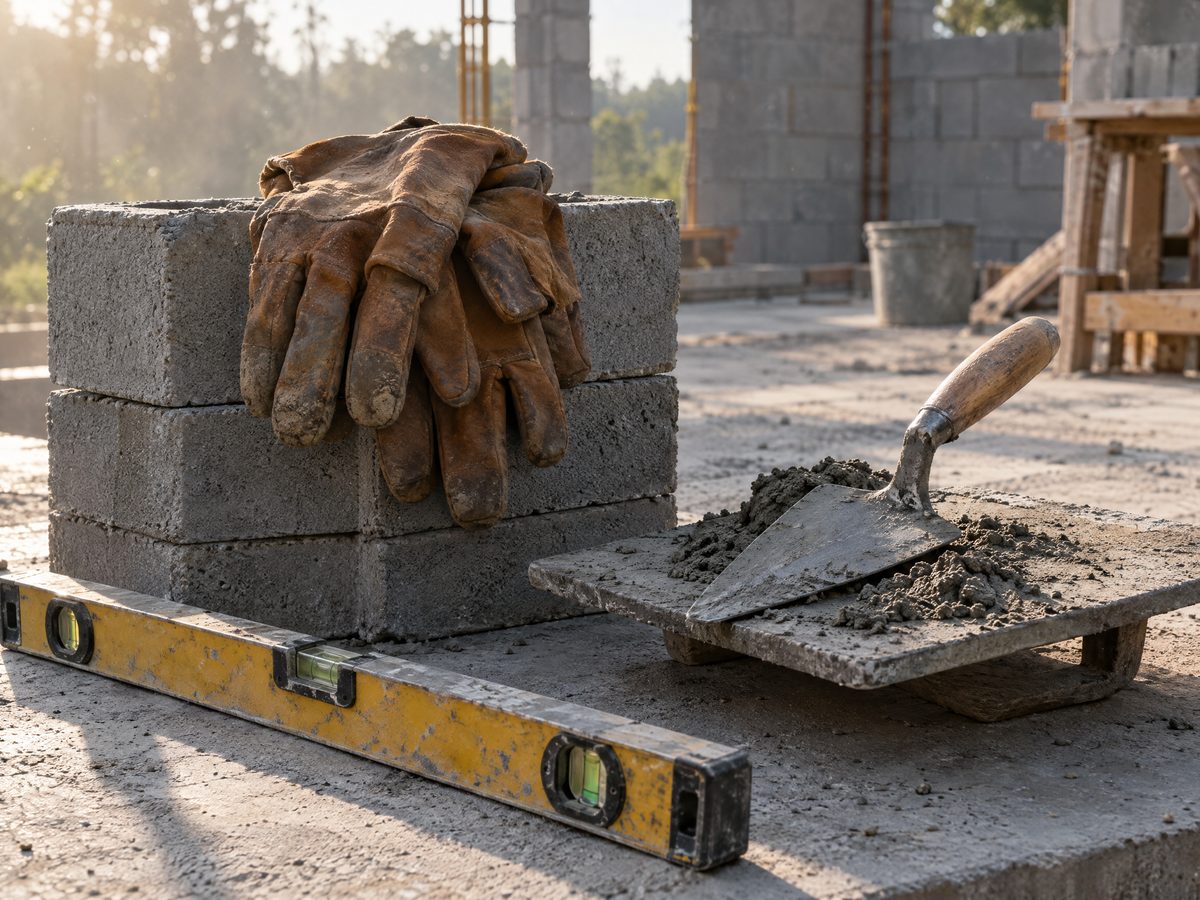
A four-rung return ladder
- Rung 1, light duty: Layout, estimates, running the crew.
- Rung 2, light loads in straight lines: Carry light material close to your body at waist height. No twisting under load.
- Rung 3, moderate loads: Heavier lifts from knee or waist height. Short bouts bent forward. Limited time on vibrating equipment.
- Rung 4, full duty: Floor-to-shoulder lifts, turning with a load, long stretches bent forward, full days on the machine.
Move up only when your surgeon or PT clears it and the last rung left your leg no worse the next morning. Ask them:
- What’s my lifting limit, in pounds, and until when?
- When can I bend and twist with a load?
- What should make me call you before my next visit?
Climb one rung at a time, and let the next morning tell you when.
If you own the business, here’s how to plan for time away from work when you’re self-employed. And judge the trend across weeks, not one bad day: here’s what counts as progress.
If your leg still hurts or tingles
Nerves recover in an order: pain usually first, then leg strength, and sensation last. (AAOS OrthoInfo)
On-and-off leg pain in the first few weeks is common. Persistent leg pain, new weakness and infection are flags for a slower recovery. (ACC)
Numbness that fades slowly is common. Weakness that gets worse is not.
If you never had surgery
Many herniated discs settle without an operation. AAOS says most people are free of symptoms by 3 to 4 months.
A Dutch trial followed 283 people with 6 to 12 weeks of severe sciatica. Early surgery eased leg pain faster than waiting. (Peul et al., NEJM, 2007)
By one year, disability scores were similar, and about 95% in both groups felt recovered: nearly everyone. Of those assigned to wait, 39% ended up having surgery, about two in five.
Surgery mostly buys speed. The staged return applies either way.
If the fear of it going again is louder than the pain, read how to trust your body again.
When not to wait
Go to the ER or call 911 if you have (NHS; AAOS OrthoInfo):
- Numbness around or under your genitals, or around your bottom.
- New trouble starting to pee, or controlling your bladder or bowels.
- Weakness or numbness in both legs that’s severe or getting worse, or sciatica in both legs.
Don’t drive yourself. Have someone take you, or call 911.
Call your surgeon the same day for:
- Worsening weakness in one leg, like a foot that starts to drag.
- A fever, or a red, warm or draining incision.
- Clear fluid leaking from the incision, or a bad headache that eases when you lie down. That can mean a spinal fluid leak.
Back on the wall
Nate brings a list to his six-week visit: his five heaviest tasks and the questions above. His surgeon clears him for rung two.
His foreman doesn’t get a date. He gets the ladder. For the next month Nate runs layout and carries only what his PT signs off on.
By week twelve he’s laying block again, half days first. The numb patch is smaller. He checks it every morning, then goes to work.
Your next step: write down the five heaviest things your job asks of your back, and take that list to your next appointment.
Nate is a composite, drawn from the kinds of stories tradesmen and lifters describe after back surgery. The details are illustrative.
Free · Your Before-You-Leave Card
Don’t leave your next appointment with “rest it.”
Get the questions for your injury in 8 taps.
Get my card →Questions readers ask
- How long after a microdiscectomy can I go back to heavy lifting at work?
- Return-to-work guidelines from New Zealand’s ACC, based on spine surgeons’ clinical opinion, put a full return to heavy work at about 8 to 12 weeks, and very heavy work at 12 to 16 weeks or more. In a 2025 Dutch study, people who got back to their old job without restrictions took a median of about 16 weeks, and those with mainly physical jobs took longer. Your surgeon sets your actual limits.
- What are the chances of reherniation after a microdiscectomy?
- Reported recurrence rates mostly run from 5% to 15%. AAOS patient guidance gives up to a 20% to 25% lifetime chance, with or without surgery. In a 2016 review, smoking roughly doubled the odds, while heavy and light work showed no clear difference in the three studies that compared them.
- Is it normal to still have leg numbness after a microdiscectomy?
- It can be. According to AAOS, pain usually improves first, then leg strength, and sensation last. Tell your surgeon about numbness that lingers, and call the same day for leg weakness that is getting worse. New numbness around the genitals or bottom, or new bladder or bowel trouble, needs emergency care.
Sources & references (10)
- Return to work guidelines: Lumbar discectomy · ACC (Accident Compensation Corporation, New Zealand)
- Timelines and Associated Factors for Return-to-Work of Patients With Painful Lumbar Radiculopathy Who Undergo Lumbar Microdiscectomy Followed by Physiotherapy: A Prospective Cohort Study · Spine, 2025
- Risk Factors for Recurrent Lumbar Disc Herniation: A Systematic Review and Meta-Analysis · Medicine (Baltimore), 2016
- Herniated Disk in the Lower Back · AAOS OrthoInfo
- Length of Activity Restriction After Lumbar Discectomy Does Not Affect Recovery · Massachusetts General Hospital, Advances in Motion, 2018
- Rehabilitation after lumbar disc surgery · Cochrane, 2014
- Work-relatedness of lumbosacral radiculopathy syndrome: Review and dose-response meta-analysis · Neurology, 2018
- Whole-body vibration and the risk of low back pain and sciatica: a systematic review and meta-analysis · International Archives of Occupational and Environmental Health, 2015
- Surgery versus prolonged conservative treatment for sciatica · New England Journal of Medicine, 2007
- Sciatica · NHS
The Series
45 articlesPart 1: Understanding Your Injury (1 to 19)
- After the MRI: How to Read a Rotator Cuff Report Without Getting Sold a Surgery
- Told to “Just Rest It”? Five Questions to Ask Before You Leave
- When Shoulder Pain Keeps Waking You Up
- Meniscus Surgery Recovery: When Can You Return to Your Kind of Work?
- Rotator Cuff Surgery or More Physical Therapy? Questions That Clarify the Decision
- Achilles Tendon Pain: Why This Tendon Is a Different Problem
- Four Months After Rotator Cuff Repair and It Still Hurts: Normal, or a Retear?
- Your Knee Feels Worse After the Meniscus Scope. What Could Be Going On?
- Hip Flexor Pain After Hip Arthroscopy: Why It Shows Up and When It Settles
- Tennis Elbow That Won’t Go Away: Why Rest and Shots Stall, and What Helps
- Knee Swelling After Meniscus Surgery: How Long Is Normal, and When to Call
- Quad Won’t Fire After Knee Surgery? What Quad Shutdown Is and How to Get It Back
- Walking After Meniscus Surgery: When You Can, How Far, and When to Drop the Crutches
- How to Sleep After Rotator Cuff Surgery, and When Nights Get Easier
- Felt a Pop After Knee Surgery? Re-Tear or Setback, and When to Call
- Home After a Microdiscectomy: How Much to Walk and How Long to Sit
- Running After ACL Surgery: When Your First Jog Comes, and What It Tells You About Work
- When Can You Drive After Rotator Cuff Surgery and Get Back in the Work Truck?
- Knee Won’t Straighten After Meniscus Surgery? Why It Happens and What Helps
Part 2: Work and Real Life (20 to 29)
- You Can Still Work. But What Is Your Injury Costing You?
- Self-Employed and Injured: How to Plan for Time Away From Work
- Your Job and Your Workouts Are Loading the Same Injury
- How to Take Time to Recover When Everyone Depends on You
- What Do You Still Want to Be Able to Do in Ten Years?
- Microdiscectomy Recovery: When Can You Go Back to Heavy Work?
- Kneeling After Knee Surgery: Why It Comes Back Last and How to Retrain It
- Rotator Cuff Surgery Recovery: When Can You Go Back to Work?
- When Can You Drive After Knee Surgery and Get Back in the Work Van?
- When Can You Go Back to Physical Work After ACL Surgery?
Part 3: Back to Training (30 to 34)
Part 4: Reading the Evidence (35 to 45)
- Your Watch Says You’re Recovered. Your Shoulder Disagrees.
- Recovery Is Taking Longer Than You Expected. What Counts as Progress?
- Before You Buy Another Recovery Tool, Decide What You Need It to Do
- “It Worked for Me”: How to Evaluate a Recovery Claim
- BPC-157 After an Orthopedic Procedure: What Does the Research Actually Show?
- TB-500 vs. BPC-157: What the Research Actually Compares
- How to Read a Peptide COA: What It Proves and What It Doesn’t
- The Research Stack People Ask About After a Scope, and the Gaps in the Human Data
- What the Tendon Research on BPC-157 Actually Measured
- What’s in the Other 1%? Peptide Impurities, Explained
- Approved, Compounded or “Research Use Only”: What a Peptide’s Label Means in 2026
Free · 60-second recovery check
What’s really holding your recovery back?
Eight quick taps. Find the one thing stalling your recovery, then get the three moves to work on first, picked from 30 guides and 100+ cited sources.
- Your bottleneck, named in 60 seconds
- 3 moves for this week, fitted to your job
- Your Before-You-Leave Card: the questions for your next appointment
What got hurt?
Free. No sign-up to start. Not medical advice.
Keep reading
When Can You Go Back to Physical Work After ACL Surgery?
Your foreman wants a date, and you can’t even jog yet. How long physical jobs take after ACL reconstruction, why ladders and heavy loads come later, and a plan he can schedule around.
When Can You Drive After Knee Surgery and Get Back in the Work Van?
Dispatch wants a date, and your right knee isn’t ready to give one. When people drive again after a knee scope or ACL surgery, why the right knee takes longer, and a brake check to run first.

Rotator Cuff Surgery Recovery: When Can You Go Back to Work?
Your foreman wants a date, and your job is overhead. Typical return times after a rotator cuff repair, why heavy and overhead work come last, and a plan he can schedule around.